AI Agents vs. Automations vs. Chatbots: What Is the Actual Difference?
The AI software market has become confusing for small-business owners. Almost every software company now uses words such as AI agent, AI automation, intelligent automation, AI assistant, and chatbot.
Sometimes these terms describe genuinely different technologies. Other times, they are simply different marketing labels for similar features.
For a U.S. small business, the important question is not which term sounds more advanced. The important question is what the software actually does.
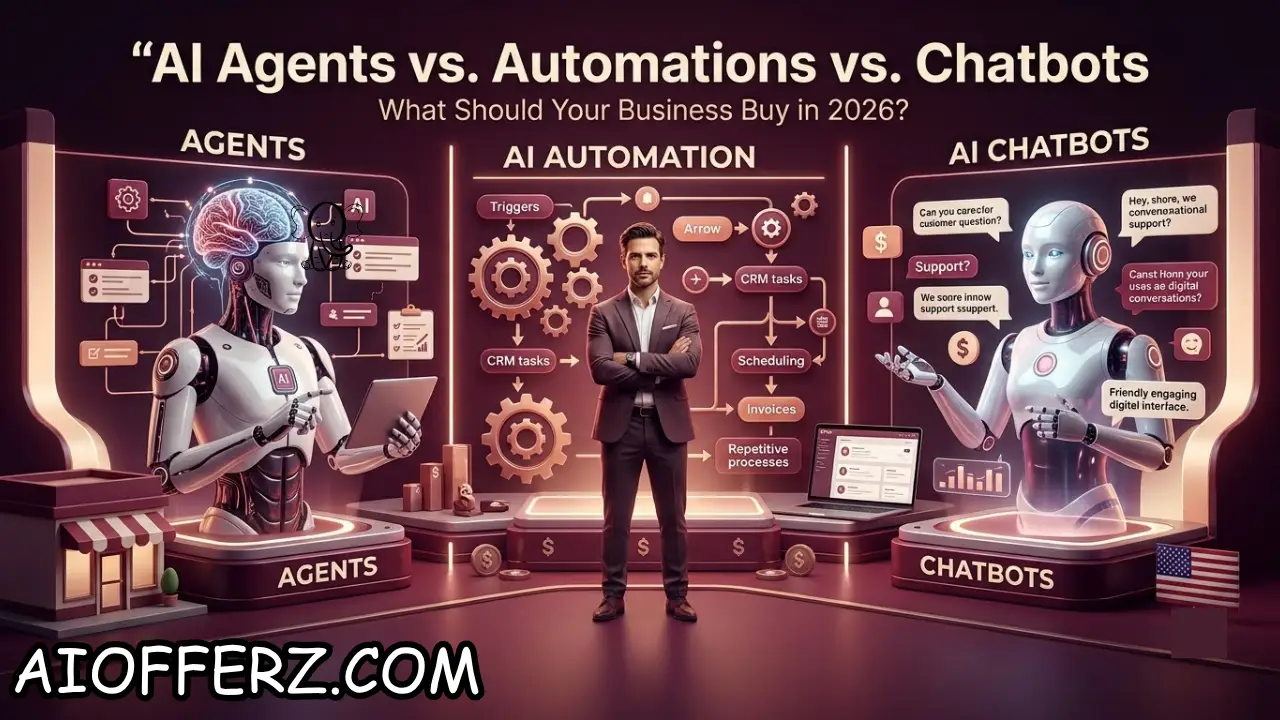
A chatbot primarily communicates with people. Traditional automation follows predefined rules to move information or trigger actions.
An AI agent can work toward a goal, decide which steps are necessary, use available tools, and potentially handle a multi-step workflow with less direct instruction.
OpenAI’s current guidance describes agents as systems that can perform workflows on a user’s behalf with a high degree of independence.
That is an important distinction from conventional software automation, where the workflow is usually explicitly defined in advance.
A chatbot, by comparison, is usually designed around conversation. A customer might ask about business hours, pricing, shipping, appointment availability, or a return policy.
The chatbot provides an answer or directs the customer toward the appropriate next step. Modern chatbots can use generative AI, but that does not automatically make them autonomous agents.
Traditional automation is different again. Imagine a customer completes an online form. The system adds the contact to a CRM, sends an email, creates a task, and notifies a salesperson.
Nothing about that workflow necessarily requires an AI agent. If the rules are predictable, ordinary automation can often perform the job more cheaply and consistently.
AI agents become more useful when the process contains multiple possible paths. An agent might receive a lead, read the inquiry, determine what the customer wants, look up relevant information, ask follow-up questions, qualify the opportunity, update the CRM, schedule a meeting, and escalate unusual cases. The exact path may change depending on the information it discovers.
That distinction should drive the buying decision. A business should not purchase an AI agent simply because agents are the newest category.
If a $20-per-month automation can reliably perform the job, paying significantly more for an autonomous system may make little financial sense.
Want To Use Other AI To Write…
When a U.S. Small Business Should Choose Traditional Automation
Traditional automation remains one of the most useful technologies available to small businesses. It is often overlooked because it is less exciting than an AI agent, but predictable workflows are exactly where conventional automation can be strongest.
Consider a simple invoice workflow. When an invoice is marked paid, the accounting system can automatically send a receipt, update the customer record, notify the appropriate employee, and create a bookkeeping entry. There may be no reason for an AI agent to make decisions in this process.
The same applies to appointment reminders. When a customer books an appointment, an automation can send a confirmation immediately, schedule a reminder, and send a follow-up after the appointment. The workflow is deterministic. The same trigger produces essentially the same sequence of actions.
Traditional automation is also useful for lead routing. A company could automatically assign leads according to ZIP code, product interest, salesperson, or business size. If the rules are clear, conventional workflow software can execute them without needing an AI model.
Another advantage is predictability. A rules-based automation generally does exactly what it was configured to do. That makes it easier to test, troubleshoot, and audit. There is no need to worry about an AI model interpreting a request differently because the wording changed.
Cost is another reason to start with automation. A small business that needs to move data between systems, send notifications, create records, or trigger predefined tasks may get excellent results without paying for an advanced agent.
Automation also works well when mistakes would be expensive and the process has a clear logical structure. A business can define exactly what should happen under each condition and test those conditions before deployment.
This does not make traditional automation old-fashioned. In many cases, it should be the first choice. The smarter approach is to use AI only where conventional automation reaches its limits.
A useful rule is simple: if you can describe the workflow with a clear flowchart and relatively few branches, start with automation before considering an AI agent.
When a Chatbot Is the Better AI Purchase
A chatbot can be the right investment when the primary business problem involves answering questions rather than taking complicated actions.
Restaurants, professional-service firms, retailers, medical practices, home-service companies, and many other small businesses receive repetitive questions every day.
Customers may want to know operating hours, service areas, prices, appointment availability, policies, product details, or basic requirements.
A chatbot can answer these questions around the clock. That alone can create meaningful value if employees currently spend significant time responding to repetitive inquiries.
Chatbots are also useful for website visitors who need quick answers before contacting a business. Instead of forcing every visitor to search through several pages, the chatbot can provide a conversational interface for finding relevant information.
Modern AI chatbots are considerably more flexible than the old scripted bots that could only recognize a handful of predefined phrases. Generative AI allows them to understand natural-language questions and produce more conversational responses.
However, businesses should define clear boundaries. A customer-facing chatbot should know when it lacks sufficient information and when a human should take over.
For example, a chatbot can explain a company’s cancellation policy, but a complicated dispute may require an employee. A chatbot can answer questions about services, but a sensitive complaint may require a manager.
A chatbot can collect information for a sales inquiry, but a high-value negotiation should generally remain with a salesperson.
This makes human handoff an important part of chatbot design. A chatbot that traps customers in an endless automated conversation can damage the customer experience instead of improving it.
Chatbots are especially attractive for businesses where customer questions are high-volume but relatively repetitive. If employees answer the same 20 questions hundreds of times each month, conversational AI can remove a substantial amount of repetitive work.
The key is not to confuse a chatbot with a complete business automation system. A chatbot primarily provides an interface for conversation.
It becomes more powerful when connected to business systems, but once it starts independently coordinating multiple actions, the business is moving toward an agentic workflow.
For many small businesses, therefore, a chatbot is the right starting point when the immediate problem is customer communication rather than complex process execution.
Wanna Use CustomGPT AI…
When an AI Agent Is Actually Worth Buying in 2026
An AI agent becomes more attractive when a business process involves multiple steps, multiple systems, changing information, and decisions that cannot easily be represented by fixed rules.
Imagine a roofing company receiving an online inquiry. The customer describes a roof problem, uploads photographs, provides an address, asks about availability, and wants an estimate.
A simple automation may struggle because the information is inconsistent and the appropriate next step depends on what the customer says.
An AI agent can interpret the inquiry, identify missing information, ask relevant questions, summarize the customer’s needs, classify the opportunity, update the CRM, and schedule the appropriate next step. The agent is not simply following one fixed path.
Sales is another strong example. An AI agent can respond to a new lead, determine whether the prospect is within the service area, ask qualifying questions, identify the product or service requested, check available scheduling options, and pass qualified opportunities to a salesperson.
Customer service can also benefit from agentic workflows. Instead of merely answering a question, an agent might determine the issue, retrieve customer information, check order status, create a support ticket, provide the appropriate response, and escalate the case if required.
The difference is that the agent is working toward an outcome rather than merely executing one predetermined action.
OpenAI’s guidance emphasizes that agents are particularly relevant for workflows involving complex decisions, unstructured data, or tasks that are difficult to encode using traditional rules.
That does not mean every complicated workflow should be given to an autonomous agent. Businesses still need guardrails, testing, permissions, and human oversight. The more authority an agent has, the more important those controls become.
Recent U.S. SMB research reinforces the need for realistic expectations. Upwork’s Q1 2026 research found that 74% of surveyed SMBs reported AI improving productivity, but most reported improvements below 25%. Uncertainty about ROI was the second-largest adoption barrier after data security and compliance.
That means a business should choose an AI agent because a particular workflow has measurable economic value, not because competitors are talking about autonomous AI.
How to Decide Between an AI Agent, Automation and Chatbot
The easiest way to choose the right technology is to start with the workflow rather than the software.
Ask what the customer or employee needs to accomplish. If the answer is simply “get information,” a chatbot may be enough. If the answer is “move information from system A to system B and then send a notification,” traditional automation may be the better choice.
And If the answer is “understand the situation, decide what should happen next, use several tools, and complete a series of tasks,” an AI agent may be appropriate.
The amount of variation in the workflow is another important factor. Traditional automation works best when the possible situations are known in advance. AI agents become more valuable when inputs are messy, language-based, or unpredictable.
The frequency of the task matters too. A sophisticated AI agent may not make sense for something that happens five times per month. A simple automation may be enough.
Volume changes the economics. If a company receives thousands of customer inquiries every month, even a modest improvement in response time or employee productivity can justify a meaningful technology investment.
Risk should also influence the decision. Businesses should be more conservative when AI is making decisions involving money, legal obligations, employment, medical information, financial accounts, or sensitive customer data.
A useful decision framework is to score each workflow on five factors: repetition, volume, complexity, business value, and risk.
- High repetition plus low complexity usually points toward traditional automation.
- High customer interaction plus repetitive questions usually points toward a chatbot.
- High complexity plus multiple steps and systems may justify an AI agent.
- High risk plus high business impact usually requires stronger human oversight regardless of which technology is used.
The best 2026 AI strategy is therefore not “replace automation with agents.” It is to use the cheapest technology that can reliably accomplish the business objective.
That may mean a small business uses all three technologies at the same time.
A website chatbot could answer common questions. Traditional automation could move customer information into the CRM. An AI agent could handle complicated lead qualification and follow-up.
This layered approach is often more practical than trying to force one AI product to perform every function.
Using Many AI’s For Many Work, Solution Is Here…
What a Realistic 2026 AI Stack Looks Like for a U.S. Small Business
A small business does not need dozens of AI tools to create a useful technology stack. In many cases, a relatively small number of connected systems can cover most operational requirements.
The first layer is usually the existing business software. This might include a CRM, accounting platform, calendar, help desk, phone system, e-commerce platform, or project-management application.
The second layer is conventional automation. This connects systems and handles predictable events. New lead received, appointment booked, payment completed, form submitted, or ticket closed can all trigger predefined actions.
The third layer can be a chatbot. It provides a conversational interface for customers or employees who need quick access to information.
The fourth layer is agentic AI. The agent should be reserved for workflows where interpretation, reasoning, tool use, or multi-step execution provides enough value to justify the additional complexity.
This architecture prevents a common mistake: using an expensive AI agent to solve a problem that a basic automation could handle.
It also makes troubleshooting easier. If an automated workflow stops working, the business can identify which layer failed rather than having one giant AI system responsible for everything.
Security should be considered across the entire stack. Businesses should carefully control which systems an AI agent can access and what actions it is permitted to perform.
For example, an AI agent might be allowed to create a CRM lead and schedule a meeting but not issue a refund or transfer money without human approval.
The concept of limited permissions is particularly important as AI agents become capable of taking actions rather than simply generating text.
The current SMB market suggests that adoption is accelerating, but adoption does not automatically equal successful implementation.
Upwork’s research found SMBs are actively piloting AI agents across decision support, information retrieval, workflow automation, multistep planning, and autonomous task execution.
At the same time, today’s AI-agent market includes plenty of products that use “agent” as a marketing term. A business should therefore ask vendors exactly what the system can do independently, which tools it can access, what decisions it can make, and where human approval is required.
The technology stack should be built around business outcomes rather than product terminology.
How Much Should a U.S. Small Business Spend on AI in 2026?
There is no universal AI budget that works for every small business. The right spending level depends on workflow volume, labor costs, revenue opportunity, complexity, and the financial value of solving the problem.
A business should first calculate the current cost of the workflow. If employees spend 100 hours per month answering repetitive questions, the company has a measurable labor-capacity cost even if nobody is explicitly assigned to “AI-ready” work.
Next, calculate the value of improvement. If automation eliminates 60 hours of repetitive work, the business should determine what employees can realistically do with those hours.
Revenue opportunities should also be considered. An AI agent that responds instantly to leads may create more value through additional customers than through labor savings.
The cost side must include more than the software subscription. Setup, integrations, monitoring, training, maintenance, human review, usage charges, and potential error-handling costs should all be considered.
A small business should also calculate its payback period. If a system costs $3,000 to implement and produces an estimated $1,000 in net monthly value, the initial investment has a simple three-month payback period.
Conservative assumptions are important. If a vendor claims that an AI agent will automate 80% of a workflow, the business should model what happens if the real figure is only 40%.
The business should also run a pilot before making a major commitment whenever possible.
For example, a company could test an AI lead-response system for 60 to 90 days and compare response time, qualified leads, appointments, conversions, and revenue against its previous baseline.
If the numbers improve enough to justify the cost, expand the system.
If they do not, change the workflow or stop.
Current research supports this outcome-focused approach. The strongest SMB AI adopters are not simply adding more tools; they are trying to determine where AI creates measurable operational value.
Upwork’s 2026 research specifically describes SMB leaders as taking an ROI-focused approach while productivity gains remain incremental.
The biggest mistake is buying the most sophisticated technology first. A $100 automation that reliably eliminates a repetitive task can be a better investment than a $2,000 AI agent that performs the same task with unnecessary complexity.
For most U.S. small businesses, the smartest 2026 strategy is therefore progressive: automate predictable work first, use chatbots for repetitive conversations, and introduce AI agents where flexible reasoning and multi-step execution provide enough additional value to justify the cost.
To get relief from Joint Pain , you can go for this.
FAQs
1. What is the main difference between an AI agent and a chatbot?
A chatbot primarily communicates with users and answers questions. An AI agent can pursue a goal, make decisions within defined boundaries, use tools, and complete multiple steps on a user’s behalf.
2. Is an AI agent better than traditional automation?
Not always. Traditional automation is usually better for predictable, rules-based workflows. AI agents are more useful when a process requires interpretation, flexible decision-making, or multiple steps.
3. Should a small business buy an AI chatbot first?
A chatbot can be a good starting point when the main problem is repetitive customer questions. Businesses should first determine whether customers actually need conversational support and whether the expected savings justify the cost.
4. What is the best AI technology for lead follow-up?
It depends on the workflow. Basic scheduled follow-ups can use traditional automation, while an AI agent can be more useful when leads provide different information and require qualification or personalized responses.
5. Can AI agents replace small-business employees?
They can automate portions of jobs, but businesses should generally design them to augment employees, particularly for decisions involving customers, money, compliance, or sensitive information.
6. Are AI agents expensive for small businesses?
Costs vary widely depending on the software, integrations, usage, and complexity. A small business should evaluate total cost against measurable savings or revenue rather than choosing based on the monthly subscription alone.
7. When should a business use traditional automation instead of AI?
Use traditional automation when the process follows clear rules and predictable triggers. There is little reason to introduce an AI agent when a simpler system can perform the task reliably.
8. Can a chatbot also perform automated actions?
Yes. Modern chatbots can connect to calendars, CRMs, databases, and other tools. When the system begins independently planning and executing multi-step workflows, however, it starts moving toward agentic behavior.
9. What is the biggest mistake small businesses make when buying AI?
A common mistake is buying technology before identifying the business problem. Companies should define the workflow, establish a baseline, calculate potential ROI, and then select the appropriate technology.
10. Which should a U.S. small business buy in 2026: an AI agent, automation or chatbot?
There is no universal winner. Choose automation for predictable rules, a chatbot for conversational customer support, and an AI agent for complex, multi-step workflows where flexible reasoning creates measurable additional value.
Ready to Begin?
➜ Click Here to explore top rated affiliate programs on ClickBank!
➜ Reach Our Free Offers: “Come Here To Earn Money By Your Mobile Easily in 2025.”
Want To Read More Then Click Here…
If You Are Interested In Health And Fitness Articles Then Click Here.
If You Are Interested In Indian Share Market Articles Then Click Here.
Thanks To Visit Our Website-We Will Wait For You Come Again Soon…