Why AI Fraud Detection Matters More for U.S. Small Businesses in 2026
Fraud is no longer a problem limited to large banks, major retailers, and multinational corporations. U.S. small businesses are increasingly exposed to payment fraud, account takeovers, fake invoices, business impersonation, stolen credentials, chargebacks, synthetic identities, and other forms of financial deception.
For a small company with limited cash reserves, one successful fraud attempt can have a much bigger impact than it would on a large corporation.
The scale of the broader fraud problem shows why businesses need better detection and response systems.
The Federal Trade Commission reported that consumers submitted approximately 3 million fraud reports in 2025 and reported $15.9 billion in losses. Imposter scams alone generated more than $3.5 billion in reported losses.
Small businesses face a particular challenge because they often do not have large fraud departments. An owner, bookkeeper, office manager, or finance employee may be responsible for reviewing payments and identifying suspicious activity.
That creates an obvious limitation: people cannot manually inspect every transaction, email, login, invoice, and customer interaction with the same consistency as an automated system.
This is where AI fraud detection can become useful. AI systems can examine large amounts of activity, identify unusual patterns, compare new transactions against historical behavior, and flag events that deserve additional attention.
The technology can operate continuously rather than only when an employee has time to review records.
However, automation should not be treated as a replacement for human judgment. A transaction can look unusual without being fraudulent.
A legitimate customer may suddenly place a large order. An employee may travel and log in from a different location. A supplier may legitimately change its bank account.
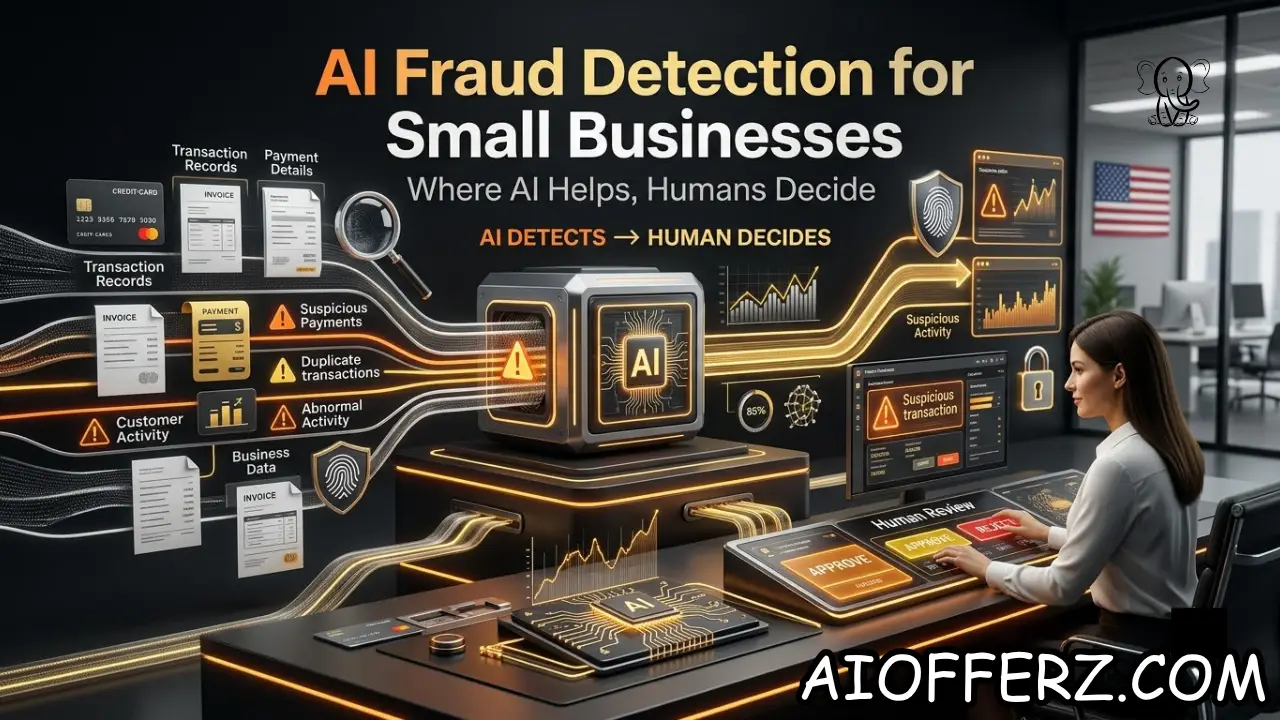
The strongest approach for a small business is therefore a combination of AI detection and human decision-making. AI can find suspicious activity faster, prioritize cases, and reduce repetitive review.
Humans can investigate context, communicate with customers, verify changes, and make final decisions when the consequences are significant.
That distinction is particularly important in 2026 because fraud techniques are becoming more sophisticated. AI itself can help businesses detect fraud, but criminals can also use automation to create convincing messages, impersonate businesses, and scale attacks.
The FTC has specifically warned about business impersonation and other scams targeting organizations and consumers.
For small businesses, the goal should not be to automate every fraud decision. The goal is to build a system that identifies potential problems early enough for a human to make a better decision.
Want To Use Other AI To Write…
How AI Fraud Detection Can Identify Suspicious Transactions and Payments
One of the most practical applications of AI fraud detection is transaction monitoring. Instead of relying exclusively on fixed rules, an AI-powered system can examine patterns across previous transactions and identify activity that differs significantly from normal business behavior.
For example, suppose a small business normally receives payments between $100 and $5,000 from established customers.
A sudden $45,000 transaction from a new account could trigger additional review. The transaction is not automatically fraudulent, but it is unusual enough to deserve attention.
AI can consider multiple signals simultaneously. These may include transaction amount, timing, customer history, payment method, location, frequency, device information, account behavior, and relationships between transactions.
Combining signals can provide a more useful risk assessment than relying on a single rule.
This is particularly helpful for businesses processing many transactions. An employee may notice an unusually large payment, but they are less likely to recognize subtle patterns across hundreds or thousands of transactions.
AI can also prioritize alerts. Instead of giving a finance employee hundreds of equally important warnings, a detection system can rank cases according to estimated risk. High-risk cases can be reviewed first, while lower-risk anomalies can remain under monitoring.
This approach can reduce alert fatigue. If employees receive too many false alarms, they may begin ignoring them. An effective fraud detection system therefore needs to balance sensitivity with accuracy.
The human role remains important because transaction context matters. A large payment may be suspicious in one situation but completely normal in another. For example, a construction company may suddenly receive a large deposit when a major project begins.
The AI can identify the anomaly, but an employee may know that the payment matches an approved contract. The human decision therefore prevents the system from unnecessarily blocking legitimate business activity.
AI can also be used to monitor outgoing payments. A sudden request to change a vendor’s bank account, especially shortly before a large payment, can trigger a warning requiring independent verification.
This is important because business email compromise frequently relies on social engineering rather than a purely technical attack. The attacker may attempt to convince an employee that payment instructions have changed.
AI can help identify the unusual pattern, but a human should verify sensitive payment changes using a trusted communication channel rather than relying only on the incoming message.
How AI Can Detect Fake Invoices, Business Impersonation and Account Takeover Attempts
Invoice fraud is a major concern for small businesses because accounting departments often process invoices under time pressure. A fraudulent invoice can look legitimate enough to pass a quick manual review.
AI can compare new invoices against historical vendor information. It may identify changes in bank details, unusual invoice amounts, altered payment instructions, duplicate invoices, or unusual billing patterns.
Optical character recognition and document-analysis technology can extract information from invoices automatically. AI can then compare those details with existing accounting records and flag discrepancies.
For example, if a vendor that normally invoices $2,000 monthly suddenly sends a $17,000 invoice, the system can identify the unusual amount. If the invoice also contains new banking information, the combined signals can create a higher-priority alert.
This does not mean the invoice is automatically fraudulent. A legitimate vendor could have increased its prices or completed a larger project. The AI should therefore flag the event rather than make an irreversible decision.
Business impersonation is another area where automation can help. Scammers may pretend to be company executives, vendors, banks, government agencies, or other trusted organizations.
The FTC reported that consumers lost nearly $1 billion to business impersonators in 2025, demonstrating how significant impersonation-based fraud has become.
AI can examine communication patterns for unusual language, sender information, requests, timing, and other signals. It can help identify messages that differ from normal business communications.
However, AI-generated content makes this area particularly challenging. A fraudulent message may be professionally written and contain very few obvious spelling or grammar errors.
Businesses should therefore avoid relying on AI alone to determine whether an email is legitimate.
Human verification remains critical when a message requests money, credentials, confidential information, or changes to payment instructions.
A good policy is to require independent confirmation for high-risk actions. If an email appears to come from the owner requesting a large wire transfer, an employee should call the owner using a known phone number instead of replying to the email.
AI can flag the request, but the human verification step provides an additional layer of protection.
Wanna Use CustomGPT AI…
Where AI Automation Helps Most and Where Humans Still Need to Decide
AI is particularly effective at repetitive detection tasks. It can continuously monitor activity, compare patterns, classify alerts, detect anomalies, and organize large amounts of information much faster than a person.
It is also useful for prioritization. A business may have thousands of transactions that are completely normal but only a few that deserve investigation. AI can reduce the amount of manual work by directing attention toward the most unusual activity.
Another strong use case is early warning. An AI system can detect changes in customer behavior before a human notices them manually.
For example, an account that suddenly begins attempting multiple transactions from unfamiliar devices may deserve investigation even if no individual transaction looks obviously fraudulent.
AI can also identify relationships across events. A single suspicious login may not mean much, but a suspicious login followed by a password change, a new payment method, and an unusual transaction creates a much stronger signal.
Humans remain essential when the decision involves significant financial, legal, customer, or operational consequences.
An AI system should generally not have unrestricted authority to permanently close accounts, accuse customers of fraud, deny legitimate claims, terminate employees, or transfer large amounts of money without appropriate controls.
The reason is simple: unusual behavior is not automatically fraudulent behavior.
A legitimate customer can behave differently because of travel, a new device, a large purchase, a business expansion, or another unusual but valid event.
Human investigators can ask questions that automated systems cannot answer reliably from transaction data alone. They can contact the customer, verify documents, examine contracts, speak with vendors, and understand the company’s relationship with the parties involved.
This human-in-the-loop model is particularly appropriate for small businesses because many transactions have relatively rich business context that may not exist in a large standardized dataset.
The best system therefore creates a clear escalation process. Low-risk anomalies may simply be monitored. Moderate-risk events may require employee verification. High-risk events may temporarily require additional approval before money or sensitive information is released.
The objective is not maximum automation. It is appropriate automation.
How Small Businesses Can Build an AI Fraud Detection Workflow
A small business does not need to deploy an expensive enterprise fraud platform immediately. It can begin by identifying the transactions and activities where fraud would cause the greatest damage.
The first step is to document normal behavior. Businesses should understand their typical transaction sizes, vendors, payment methods, customer patterns, employee access patterns, and approval processes.
Without a baseline, it is difficult to identify anomalies.
The second step is to identify high-risk actions. These may include bank-account changes, wire transfers, new payment recipients, large refunds, unusual credit-card activity, changes to payroll information, administrator account changes.
and requests for sensitive customer information.
These actions should receive stronger controls than routine activities.
The third step is to establish automated alerts. The system can monitor for predefined risk conditions and unusual behavior.
For example, a company might require additional verification when a vendor requests a bank-account change and a large payment is scheduled shortly afterward.
The fourth step is to define human escalation rules. Employees should know exactly what to do when an alert appears.
A fraud alert without a response process is not enough. Employees need instructions explaining who investigates the alert, who approves a transaction, how customer identity is verified, and when an incident should be escalated.
The fifth step is to record outcomes. If an alert turns out to be legitimate, that result should be recorded. If it was fraudulent, the business should document what happened and what controls could prevent similar incidents.
Over time, these outcomes can improve the detection process.
Small businesses should also regularly review access permissions. Employees should have access only to the systems and financial functions they actually need.
AI can help monitor access behavior, but basic security controls remain important. Multi-factor authentication, strong passwords, least-privilege access, employee training, and secure payment procedures should work alongside AI detection.
The FTC and NIST have continued emphasizing the need for small businesses to address scams and cybersecurity risks rather than treating fraud as a problem only for large organizations.
AI should therefore become one layer within a broader fraud-prevention program.
Using Many AI’s For Many Work, Solution Is Here…
How AI Fraud Detection Should Handle False Positives, Privacy and Security
False positives are one of the biggest challenges in automated fraud detection. If a system flags too many legitimate transactions, employees may become frustrated and begin ignoring alerts.
For example, a small business owner might make a large legitimate purchase that is completely outside their normal transaction pattern. An overly aggressive AI system could classify it as suspicious.
The answer is not simply to make the system less sensitive. Instead, businesses should create different risk levels and escalation paths.
Low-risk anomalies can generate notifications without blocking activity. Medium-risk events can require employee confirmation. High-risk events can require stronger verification or temporary holds where appropriate.
The system should also explain why something was flagged whenever possible.
An employee is more likely to make a good decision when they understand that an alert was triggered because of a new payment destination, unusual amount, unfamiliar device, or multiple simultaneous risk signals.
Privacy is another important consideration. Fraud detection systems may process financial records, customer information, employee data, transaction details, and other sensitive business information.
Businesses should understand what data an AI provider receives, how that data is stored, who can access it, how long it is retained, and whether it is used for other purposes.
AI vendors should be evaluated based on security practices, access controls, data handling, integration security, audit capabilities, and contractual terms.
Small businesses should also avoid sending sensitive information to random public AI tools simply because those tools can analyze text or documents.
A controlled business environment is generally more appropriate for sensitive fraud-related workflows.
Another concern is model reliability. AI systems can make mistakes, and their output should not automatically be treated as fact.
Businesses should maintain logs of important fraud decisions and alerts where appropriate. These records can help investigate incidents and improve the detection system.
The FTC’s recent enforcement activity also demonstrates why businesses should be careful about making unsupported claims about AI capabilities.
In March 2026, the FTC announced a settlement involving Air AI after allegations that the company made deceptive claims concerning business growth, earnings potential, and refunds.
For businesses purchasing AI fraud technology, this is an important lesson: evaluate actual capabilities instead of relying on marketing claims.
How U.S. Small Businesses Can Measure the ROI of AI Fraud Detection
AI fraud detection should be measured like any other business investment. The goal is not simply to deploy technology but to determine whether it reduces risk and improves operational efficiency.
The first metric is prevented or avoided loss. If the system helps identify a fraudulent payment before it is completed, the potential financial impact can be significant.
However, businesses should avoid claiming that every flagged transaction represents money saved. A suspicious transaction that turns out to be legitimate is not a prevented loss.
Another important metric is investigation time. If employees previously spent 20 hours per week reviewing transactions and automation reduces that workload substantially without increasing risk, the business has gained measurable productivity.
Alert accuracy is also important. Businesses should monitor the percentage of alerts that are confirmed fraud, legitimate activity, or unresolved.
A high false-positive rate can make an automated system less useful even if it detects genuine fraud.
Response time should also be tracked. The faster a suspicious event is identified and investigated, the more opportunities the business may have to stop or limit the damage.
Businesses should also measure the number of high-risk events detected before financial loss occurs.
Employee adoption matters as well. A sophisticated fraud system is ineffective if employees routinely bypass alerts or ignore verification procedures.
Training should therefore be included in the implementation plan.
The business should conduct periodic reviews of the fraud workflow and adjust thresholds as its normal behavior changes.
A growing company may naturally begin processing larger transactions. A rule that was appropriate when the company had $50,000 in monthly payments may become inappropriate after it reaches $500,000.
AI systems can adapt to changing patterns, but businesses still need governance.
Ultimately, the best AI fraud detection strategy is one that combines technology with clear procedures and informed human judgment.
The technology should make suspicious activity easier to identify, not create a false sense of security.
For U.S. small businesses in 2026, the practical advantage is not having an AI system that makes every fraud decision automatically.
It is having an intelligent monitoring layer that helps a small team see potential problems earlier, investigate them faster, and make better decisions before a suspicious event becomes a costly loss.
To get relief from Joint Pain , you can go for this.
FAQs
1. What is AI fraud detection?
AI fraud detection uses machine-learning and other automated technologies to analyze transactions, account activity, communications, and behavioral patterns to identify potentially suspicious activity.
2. Can AI completely prevent fraud?
No. AI can identify suspicious patterns and improve detection, but no system can guarantee that every fraudulent activity will be detected or prevented.
3. How can AI help a small business detect fraud?
AI can monitor transactions, identify unusual behavior, detect payment anomalies, prioritize alerts, analyze invoices, and help identify suspicious account activity.
4. Should AI automatically block suspicious transactions?
Not every suspicious transaction should be automatically blocked. Lower-risk alerts can be reviewed, while high-risk actions may require additional verification depending on the business’s procedures.
5. Why are human investigators still important?
Humans can understand context that may not be visible in transaction data. They can verify customers, contact vendors, examine contracts, and determine whether unusual activity has a legitimate explanation.
6. Can AI detect fake invoices?
AI can identify suspicious invoice patterns, duplicate invoices, unusual amounts, altered payment details, and deviations from historical vendor behavior, but employees should verify important payment changes.
7. Can AI detect business impersonation scams?
AI can identify unusual communication and behavioral signals associated with suspicious messages, but independent human verification remains important for high-risk requests.
8. What is a false positive in fraud detection?
A false positive occurs when a legitimate transaction or activity is incorrectly flagged as suspicious. Excessive false positives can create alert fatigue and reduce employee trust in the system.
9. What should a small business do when AI detects possible fraud?
The business should follow a predefined escalation process, verify the activity independently, document the investigation, and involve the appropriate financial, security, or management personnel.
10. Is AI fraud detection worth it for small businesses?
It can be valuable when targeted at high-risk and repetitive processes. The strongest business case comes from measurable improvements in fraud detection, investigation time, response speed, and employee productivity.
Conclusion
AI can give U.S. small businesses a stronger fraud-detection capability without requiring a large fraud department.
It can monitor activity continuously, identify unusual patterns, prioritize alerts, analyze invoices, and help employees focus on the cases that actually need attention.
But automation should stop short of replacing human judgment where context matters. A suspicious transaction is not automatically fraudulent, and an unusual customer or vendor behavior may have a legitimate explanation.
The most effective model is therefore AI detection plus human verification. Businesses can automate monitoring and prioritization while keeping people responsible for important decisions.
As fraud becomes more sophisticated and criminals increasingly use technology themselves, small businesses need layered defenses rather than a single security tool.
AI can become an important layer, but it works best alongside employee training, strong authentication, access controls, payment verification, and clearly defined response procedures.
The goal is simple: detect potential fraud earlier, investigate it faster, and prevent legitimate business activity from being unnecessarily disrupted.
Ready to Begin?
➜ Click Here to explore top rated affiliate programs on ClickBank!
➜ Reach Our Free Offers: “Come Here To Earn Money By Your Mobile Easily in 2025.”
Want To Read More Then Click Here…
If You Are Interested In Health And Fitness Articles Then Click Here.
If You Are Interested In Indian Share Market Articles Then Click Here.
Thanks To Visit Our Website-We Will Wait For You Come Again Soon…