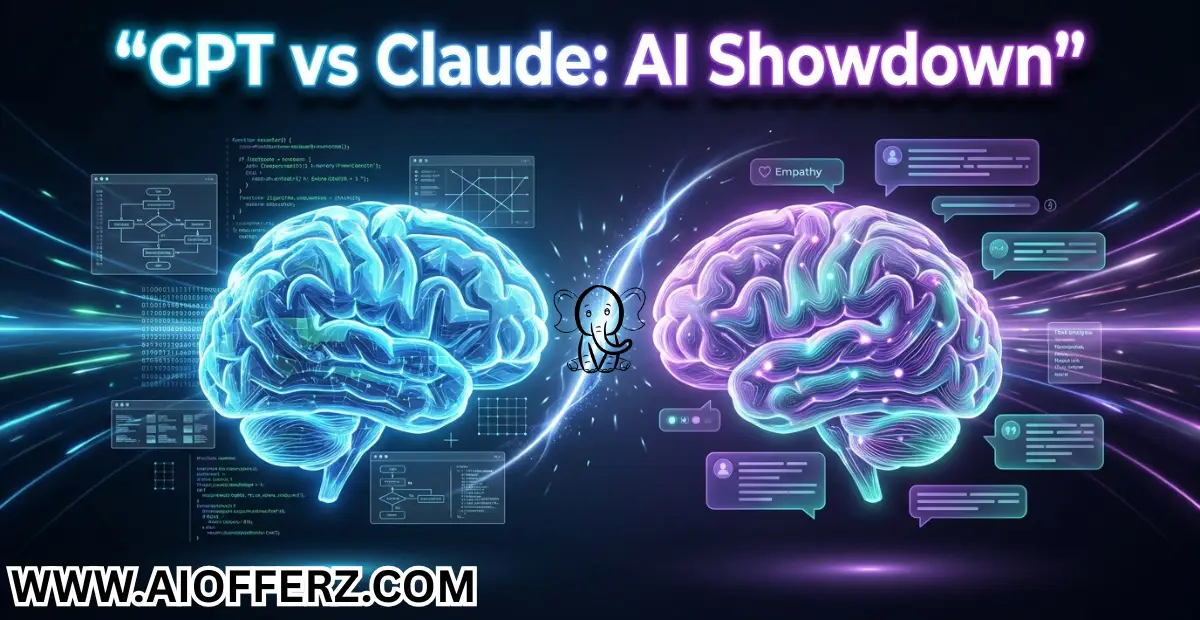
The competition in the artificial intelligence space is intensifying as users and industry observers begin comparing the latest models from leading AI companies.
OpenAI’s GPT-5.5 and Anthropic’s Claude Opus 4.7 have emerged as two of the most talked about systems with discussions growing around which model delivers better performance across real-world tasks.
Both models represent major advancements in generative AI, offering improved reasoning, faster responses and more accurate outputs compared to earlier versions.
They are being used for a wide range of applications, including content creation, coding assistance, research and business automation.
How the Two AI Models Compare
Early feedback from users suggests that GPT-5.5 performs strongly in structured tasks such as coding, logical reasoning and technical problem solving.
Its ability to handle complex instructions and generate detailed responses has made it popular among developers and professionals.
On the other hand, Claude Opus 4.7 is gaining attention for its natural conversational style and balanced responses.
Users report that it often provides clearer explanations and maintains a more human like tone, making it useful for writing, communication and general purpose queries.
While both systems are highly capable, differences in response style, speed and accuracy are shaping user preferences depending on their specific needs.
What This Means for the AI Industry
The growing comparison between these models highlights the rapid pace of innovation in the AI sector. Companies are racing to release more advanced systems, each aiming to improve performance, usability and reliability.
Experts say this competition is ultimately beneficial for users, as it drives continuous improvements and expands the range of available tools.
However, it also raises important questions about benchmarking standards, transparency and how AI performance should be measured.
As more users test and compare these models, the debate over which AI is “better” is likely to continue. For now, the choice appears to depend largely on use case with each model offering strengths in different areas.
The ongoing rivalry between leading AI developers signals a new phase in the industry, where performance, user experience and real world application will determine the next generation of AI leaders.