Last quarter, our finance team at a rapidly scaling manufacturing firm in Ohio was drowning. We were processing roughly 400 invoices a month by hand.
A single missing purchase order could stall a vendor payment for weeks, leading to tense phone calls and missed early-payment discounts.
The breaking point arrived when an invoice slipped through for a marketing SaaS subscription we had canceled six months prior.
It wasn’t a massive sum, just $1,200, but it woke us up to a sobering reality. If a glaring duplicate charge could bypass our manual review, what else were we missing?
That identical pain point plagues thousands of small and mid-sized businesses across the United States. Manual accounts payable workflows are not merely slow; they represent a significant financial vulnerability.
For small and medium-sized businesses (SMBs), managing cash flow requires absolute precision. Yet, traditional accounts payable (AP) methods rely heavily on human intervention, making them prone to data entry mistakes, processing bottlenecks and sophisticated billing scams.
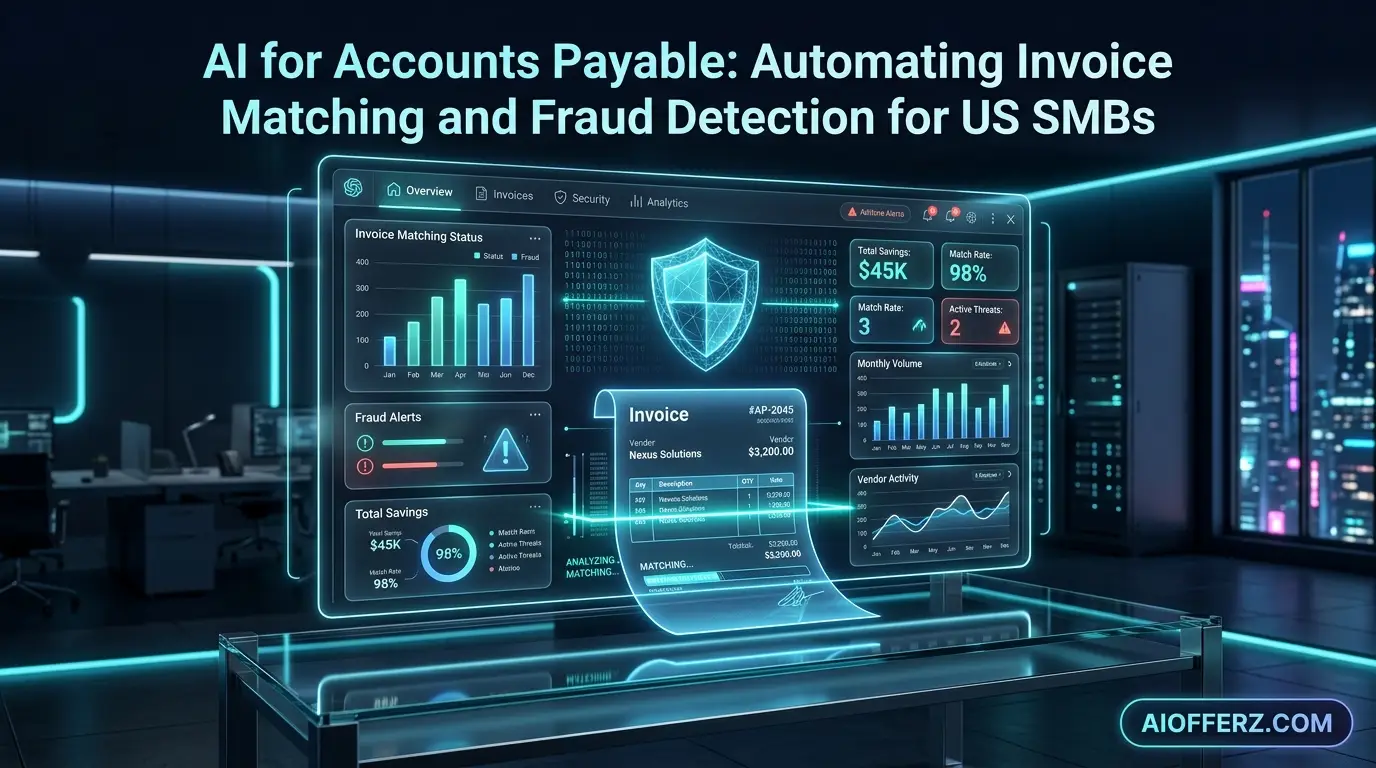
Implementing artificial intelligence into your AP department completely reshapes this landscape. By automating the tedious task of invoice matching and building an intelligent shield against fraudulent billing practices, AI turns a traditional cost center into an optimized, secure data hub.
The Hidden Cost of Manual Accounts Payable in SMBs
Many small business owners view manual invoice processing as a normal cost of doing business.
You receive an email with a PDF invoice, a bookkeeper manually types the line items into the accounting software, cuts a check or schedules an ACH transfer and files the document away.
On paper, this seems straightforward. In practice, it is incredibly expensive and inefficient.
Want To Use Other AI To Write…
The Financial Strain of Data Entry Errors
Human data entry has an average error rate of roughly one to four percent. When a tired accounting clerk types an extra zero or transposes two numbers in a vendor invoice, the downstream consequences are highly disruptive.
A $1,500 invoice easily becomes a $15,000 overpayment. Even if the vendor is honest and returns the funds, the time spent auditing the error, issuing stop-payments and reconciling the bank statements drains precious internal hours.
The Bottleneck of Manual Approval Chains
In a typical US SMB, an invoice cannot be paid the moment it arrives. It must be verified by a department manager, matched against what was actually delivered and approved by a director or business owner.
When this process relies on routing paper documents or sending endless internal emails, invoices get stuck. Vendors become frustrated by late payments which destroys your leverage to negotiate better credit terms or volume discounts.
Furthermore, many American suppliers offer a “2/10 Net 30” discount, giving you a 2% price reduction if you clear the bill within ten days. Manual systems are rarely fast enough to capture these savings consistently.
Understanding AI-Powered Invoice Matching
The cornerstone of modern AP automation is intelligent invoice matching. To understand how AI upgrades this process, we must first look at the traditional framework used by enterprise financial teams: the three-way match.
Three-Way Matching Process
The three-way matching process is an important internal control used in procurement and accounts payable to verify that a purchase is accurate before payment is approved.
It begins with the Purchase Order (PO), which is created during the procurement process. This document specifies the items or services ordered, along with the agreed quantities, prices and delivery terms.
Once the supplier delivers the goods, a Receiving Report is generated to confirm that the shipment has been received and inspected. This report records the quantities and condition of the items delivered, providing evidence that the order has been fulfilled.
The final document is the Vendor Invoice which is issued by the supplier requesting payment for the delivered goods or services.
Before payment is processed, the organization compares the purchase order, receiving report and vendor invoice to ensure that all three documents match in terms of quantities, pricing and other relevant details.
If the information is consistent, the invoice is approved for payment. Any discrepancies are investigated and resolved before funds are released, helping organizations prevent overpayments, duplicate payments and procurement fraud while ensuring accurate financial records.
An ideal matching system cross-references these three distinct documents to verify three critical facts:
-
Did we actually order these goods? (Matches the Purchase Order)
-
Did we actually receive these goods in perfect condition? (Matches the Receiving Report)
-
Is the vendor charging us the agreed-upon price? (Matches the Invoice)
Wanna Use CustomGPT AI…
How Optical Character Recognition and AI Team Up
Traditional software uses basic Optical Character Recognition (OCR) to convert text on a page into digital data. However, standard OCR is rigid.
If a vendor changes their invoice layout by moving the balance due from the top right to the bottom left, standard OCR fails because it relies on fixed templates.
AI-driven AP tools use cognitive data extraction. The machine learning model reads an invoice much like a human eye does. It understands context.
It searches for the semantic meaning of phrases like “Amount Due” “Total Balance” or “Net Pay” regardless of where they sit on the document.
This eliminates the need to build and maintain custom templates for every single supplier in your vendor master file.
Real-Time Discrepancy Flagging
Once the AI extracts the data from the invoice, it instantly compares the line items against the corresponding purchase order and receiving log housed in your ERP or accounting software.
If the system detects a mismatch such as a shipping fee that was never approved or a unit price that exceeds the contracted rate it instantly flags the invoice and routes it to a human administrator for review.
If the documents match perfectly, the system completes a “straight-through process” and schedules the payment automatically without requiring a single human click.
Erecting a Shield Against Modern B2B Fraud
Small and mid-sized businesses are the primary targets for corporate billing fraud. Fraudsters know that enterprise corporations have massive compliance departments and rigorous internal controls, whereas SMBs often have a single overworked accountant managing the entire financial pipeline.
According to industry data, internal and external fraud costs small businesses billions of dollars annually, sometimes proving fatal to companies operating on thin margins.
Using Many AI’s For Many Work, Solution Is Here…
Intercepting Business Email Compromise
Business Email Compromise (BEC) is one of the fastest-growing cyber threats in the United States. In a typical BEC scenario, a hacker compromises the email account of one of your legitimate suppliers.
They monitor the email threads, find an upcoming invoice, change the routing and account numbers to their own bank account, and send the invoice from the real supplier’s email address.
To a human bookkeeper, the email looks completely authentic. However, an AI fraud detection engine analyzes behavioral and structural metadata.
It flags if the banking coordinates on the invoice have suddenly shifted to a different region or bank.
It cross-references the new banking data against known fraudulent accounts and alerts your management team to verify the payment methods over the phone before a single dollar leaves your firm.
Detecting Ghost Vendors and Internal Collusion
Fraud does not always originate from external cybercriminals; sometimes it happens inside your own walls. An employee with access to the accounting system might create a “ghost vendor” with a business name that sounds remarkably similar to an existing supplier.
They can then generate fake, low-value invoices for “consulting services” or “office supplies” hoping the amounts are small enough to glide under the owner’s radar.
AI systems constantly monitor system logs and vendor behavior. They analyze the frequency, timing and amounts of all billing submissions.
If a vendor suddenly submits an invoice for an arbitrary amount without any historical purchase order or contract history, the system blocks the automated payment path, demanding executive authorization.
“Live Chat Jobs – You have to try this one”
Choosing the Right AI Vendor for US Small Businesses
Navigating the financial technology marketplace can feel overwhelming. US SMBs have vastly different needs than global corporations; you do not need an enterprise software setup that takes nine months and $100,000 to deploy. You need agility, speed and seamless integration.
Evaluating Integration Compatibility
The most vital element of any AI AP tool is how cleanly it speaks to your current software ecosystem. If your business runs on QuickBooks Online, Xero, Sage Intacct or NetSuite, the AI tool must feature a direct, bidirectional API integration.
Data must flow smoothly back and forth in real time. If you have to manually export CSV files from your AI tool and import them into your accounting software every afternoon, you are simply replacing one manual chore with another.
Assessing User Interface and Onboarding Smoothness
Your accounting team must actually enjoy using the tool. Look for platforms that offer clean dashboards, clear visual alerts and intuitive drill down menus.
During your vetting process, ask vendors about their machine learning training period. A great AI tool should show high data extraction accuracy from day one and rapidly improve as it learns your specific vendor nuances over the first thirty days.
The Smoothie Diet : 21 Day Rapid Weight Loss Program
Step by Step Implementation Strategy
Transitioning from a manual system to an AI-driven accounts payable workflow requires a methodical approach to ensure team adoption and zero operational downtime.
Phase 1: Establish Internal Workflow Rules
Before configuring your new software, map out your existing approval tiers. Define precisely who has the authority to approve expenditures at varying price thresholds.
For instance, invoices under $1,000 might only require department head approval while bills exceeding $10,000 must automatically route to the CFO or business owner.
Programming these logical parameters into the AI tool creates a bulletproof digital compliance trail.
Phase 2: Cleanse Your Vendor Master File
An AI system is only as good as the historical data it accesses. Before turning the system on, dedicate time to cleaning your current vendor records inside your accounting database.
Remove duplicate profiles, delete inactive suppliers and verify that all tax identification numbers and banking details are completely accurate. This prevents the system from triggering false fraud alerts on legitimate historical partners.
You also can use MITOLYN to get an overall healthy body in a natural way.
Phase 3: Run Parallel Processing
When you deploy the AI tool, do not discard your old system overnight. Run both systems in parallel for at least two weeks or one full monthly billing cycle.
Process your bills through the AI tool while having your staff double check the outputs against their manual observations. This builds deep trust in the automation and allows you to fine tune data fields before fully cutting the safety cord.
Future Horizons: The Evolution of Intelligent B2B Payments
The transformation of corporate finance extends far beyond just reading paper documents and catching typos. As machine learning algorithms become more sophisticated, the line between data management and strategic cash forecasting is blurring completely.
Predictive Cash Flow Architecture
Future-ready AP tools do not just look backward at what you owe; they look forward at your overall financial runway.
By analyzing historical payment cadences, seasonal inventory spikes and vendor fulfillment schedules, AI can predict exactly how much liquid cash your business will need three to six weeks in advance.
This empowers business owners to make highly strategic decisions about when to accelerate inventory purchases and when to hold onto cash to protect capital reserves.
Autonomous B2B Payment Optimization
As alternative B2B payment rails like Real-Time Payments (RTP) and FedNow expand across the United States, AI systems will dynamically choose the most cost-effective, secure way to settle balance accounts.
The system will weigh factors like processing transaction fees, vendor payment speed preferences and current bank balances to automatically decide whether a bill should clear via virtual credit card, ACH transfer or instant digital settlement. This maximizes your capital efficiency without adding any administrative overhead.
You can use it to control blood pressure and increase the strength of the heart.
Capital Efficiency Summary
| Processing Metric | Traditional Manual System | AI-Automated Framework |
| Average Processing Time | 8 to 14 Business Days | 2 to 5 Minutes |
| Data Extraction Accuracy | 96.0% to 99.0% (Human Error Risk) | 99.9% (Continuous ML Verification) |
| Early-Payment Discount Capture | Rarely Achieved (< 20%) | Consistently Captured (> 90%) |
| Fraud Prevention Vector | Reactive (Discovered Post-Payment) | Proactive (Intercepted Pre-Settlement) |
Moving your small business away from legacy data input methods is no longer a luxury reserved for multi-million dollar corporations.
By adopting automated invoice verification and advanced threat detection software, you secure your working capital, free your accounting staff from repetitive labor and build a scalable financial foundation designed to support long-term growth.
FAQs
1. Will implementing AI in accounts payable mean I have to lay off my current bookkeeping staff?
Absolutely not. Implementing AI changes the nature of your accounting staff’s daily work from tedious data entry to high-value analytical oversight.
Instead of typing lines from a PDF into a screen for hours, your team steps into strategic roles. They manage exceptions, investigate flagged fraud attempts, optimize vendor relationships and negotiate better payment terms.
The AI acts as a digital assistant that removes the grunt work, allowing your existing team to support a much larger operational volume without burning out.
2. How long does it typically take for an AI accounts payable system to learn our specific business invoices?
Modern cloud-based AI systems require very little training time because they leverage pre-trained large language models and global document intelligence networks.
When you connect the system, it can instantly read and extract key fields from standard invoices. For unique, highly customized or poorly formatted vendor documents, the system learns from human corrections.
If a human accountant corrects a misread field once or twice, the machine learning algorithm remembers that specific pattern and handles it perfectly on all subsequent submissions.
3. Our small business handles sensitive financial records. Is AI cloud data processing safe and compliant with US standards?
Reputable AI financial tools prioritize enterprise-grade security protocols. When vetting software vendors, verify that their platform holds SOC 1 and SOC 2 Type II certifications.
This ensures that their data handling, privacy shields and encryption infrastructure meet stringent independent audits. Look for tools that encrypt data both while it is traveling across the web and while it sits on their servers.
This level of security is typically far more robust than storing paper bills in a physical filing cabinet or saving PDFs in unsecured local email folders.
4. Can AI software handle non-PO invoices, such as recurring utility bills or monthly rent?
Yes, advanced systems handle non-purchase order expenses with ease. For recurring bills that arrive without an explicit PO, the system checks the historical database to verify consistency.
If your monthly internet bill or office lease invoice arrives within the expected price window, the AI automatically categorizes it to the correct general ledger account and routes it directly to the designated manager for quick approval.
If the utility bill features an unexpected 40% spike, the system instantly halts the process and flags it for an audit.
5. What exactly happens when the AI system flags a potential fraud attempt or an invoice error?
When a discrepancy or risk factor is discovered, the system halts the automated payment track and flags the invoice with a clear visual warning banner.
The document enters a dedicated digital review queue. An administrator can open the file to see exactly why the system raised an alarm such as a changed bank account number, an unmatched line item or a duplicate invoice ID.
The invoice remains locked in this secure state until an authorized manager manually reviews the file, verifies the data and marks it as safe or fraudulent.
6. Is our business too small for an AI accounts payable solution? What is the minimum invoice volume to justify the cost?
While enterprise platforms target firms handling tens of thousands of invoices, many modern software tools cater specifically to growing SMBs.
If your firm processes more than 50 to 75 invoices per month, manual tracking already consumes a measurable chunk of your team’s time and opens the door to errors.
Many SMB-focused platforms offer scalable, consumption-based pricing tiers that make the technology highly accessible and affordable for growing businesses, allowing you to pay only for the volume you actually process.
7. How does AI software differentiate between a harmless data typo on an invoice and an intentional fraud attempt?
The system utilizes multi-layered risk scoring algorithms to evaluate document integrity. A simple clerical error, like a slightly misspelled product description or a one-cent rounding difference, generates a low-risk matching exception that requires a quick manual fix.
Conversely, structural anomalies such as a complete shift in wire transfer routing codes, an unknown vendor name using a residential address or an invoice timestamped at midnight from a foreign IP address trigger high-severity fraud alerts that lock down the workflow until comprehensive verification occurs.
8. What are the main roadblocks small businesses face during the initial onboarding process?
The biggest roadblock is not technical software failure; it is messy foundational data. If your current accounting software contains duplicate vendor profiles, outdated contact emails or unorganized general ledger codes, the AI will initially struggle to categorize information correctly.
Taking a few days to clean your vendor lists and standardize your internal workflows before launching the software ensures a smooth rollout and prevents your team from dealing with unnecessary, system-generated cleanup alerts.
9. Can these platforms process international vendor invoices in foreign currencies or different languages?
Yes, the vast majority of modern AI invoice engines feature robust multi-currency and multi-language capabilities. The software automatically identifies the native currency symbol and language layout, extracts the monetary values and applies the current market exchange rates to match the transaction against your domestic accounting records.
This is particularly valuable for US small businesses that source raw components from international suppliers or leverage remote contracting teams across the globe.
10. How does automating the accounts payable process help improve our company’s overall cash flow management?
When you eliminate the manual paper trail, you gain perfect, real-time visibility into your upcoming financial obligations. You know exactly what bills are outstanding, what approvals are pending and when funds are scheduled to exit your accounts.
This eliminates the anxiety of unexpected cash drains. Furthermore, by accelerating the processing lifecycle from weeks to minutes, you gain the agility to strategically time payments, maximize early-bird vendor discounts and preserve working capital exactly when your business needs it most.
Ready to Begin?
➜ Click Here to explore top rated affiliate programs on ClickBank!
➜ Reach Our Free Offers: “Come Here To Earn Money By Your Mobile Easily in 2025.”
Want To Read More Then Click Here…
If You Are Interested In Health And Fitness Articles Then Click Here.
If You Are Interested In Indian Share Market Articles Then Click Here.
Thanks To Visit Our Website-We Will Wait For You Come Again Soon…