Why AI for Independent Financial Advisors Is Becoming a Client-Service Advantage
Independent financial advisors have always competed on relationships. Clients want someone who understands their goals, explains complicated financial decisions clearly, and is available when important questions arise.
That relationship is unlikely to disappear because of AI. What is changing is the amount of administrative work surrounding it.
In 2026, artificial intelligence is becoming increasingly useful for the repetitive parts of advisory operations.
Advisors can use AI to summarize meetings, organize information, draft routine communications, prepare follow-up tasks, extract information from documents, and help clients find answers to straightforward questions.
FINRA’s 2026 Annual Regulatory Oversight Report identifies several GenAI use cases already emerging in financial firms, including summarization and information extraction, conversational AI, content generation, classification, workflow automation, personalization, analysis, and financial modeling.
The opportunity for an independent advisor is not simply doing more work with fewer people. It is creating more capacity for actual client relationships.
If AI can remove hours of note-taking, document searching, meeting preparation, and routine follow-up, the advisor can spend that time on conversations that require judgment and trust.
That distinction is important because financial advice is different from many ordinary business services. Clients may be making decisions about retirement, investments, taxes, estate planning, insurance, or major life changes.
These conversations can involve significant financial consequences.
The most practical strategy is therefore selective automation. AI should handle structured, repetitive, and reviewable tasks while the advisor remains responsible for advice, recommendations, suitability, fiduciary obligations where applicable, and important client decisions.
Want To Use Other AI To Write…
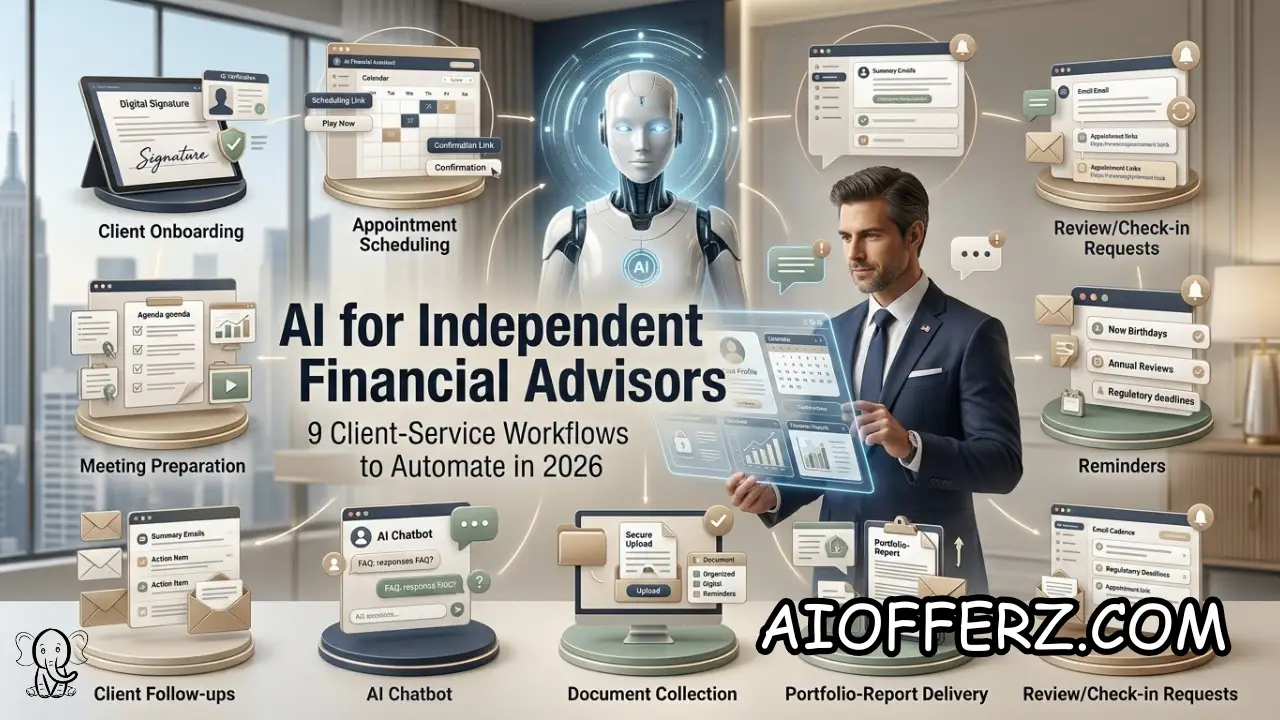
AI Workflow 1: Automating Meeting Preparation and Client Briefings
Preparing for a client meeting can require more time than the meeting itself. An advisor may need to review previous meeting notes, account information, outstanding tasks, recent correspondence, portfolio information, and documents before sitting down with a client.
AI can bring these pieces together into a concise preparation summary. Instead of manually searching through multiple systems, the advisor can start with a structured overview of the client’s previous conversations, open action items, and relevant information.
The system can also identify unfinished tasks. If a client previously asked about a beneficiary update, requested a document, or needed a follow-up conversation, AI can flag that item before the next meeting.
Another useful application is creating a meeting agenda. Based on approved information, the system can organize potential discussion topics so the advisor can review them before the meeting.
Large financial institutions are already demonstrating this type of AI-assisted advisor workflow.
JPMorganChase reported that its Connect Coach platform provides AI-generated insights and helps advisors with meeting preparation, portfolio analysis, and call summaries.
For an independent advisor, the lesson is not to copy a large institution’s technology stack. It is to automate the preparation work that currently requires manual searching and note review.
The advisor should still verify the information before relying on it. AI-generated summaries can omit context or misunderstand a document.
The value comes from faster preparation, not from assuming that every AI-generated statement is automatically correct.
AI Workflow 2: Automating Meeting Notes, Summaries and Follow-Up Tasks
Taking notes during a client meeting can divide an advisor’s attention. Trying to maintain eye contact and have a natural conversation while documenting every important detail is difficult.
AI meeting assistants can convert approved recordings or transcripts into structured summaries. They can identify major discussion points, client questions, decisions, and potential follow-up tasks.
After the meeting, AI can create a draft action list. For example, it might identify that a document needs to be sent, a beneficiary needs to be reviewed, another professional needs to be contacted, or a future meeting needs to be scheduled.
This can significantly reduce the administrative burden after client meetings. Instead of spending another 20 or 30 minutes reconstructing the conversation, the advisor can review the AI-generated summary and make corrections.
FINRA specifically identifies summarization and information extraction as common GenAI use cases in financial firms.
The advisor should still review the final record before it becomes part of the firm’s official client documentation. A meeting summary is not the same thing as an authoritative client record, and errors can matter in regulated financial services.
The best workflow is therefore AI-generated first draft, advisor review, final approval, and then storage according to the firm’s established recordkeeping procedures.
Wanna Use CustomGPT AI…
AI Workflow 3: Automating Routine Client Emails and Communications
Financial advisors send many repetitive emails. Clients may need reminders about documents, meeting confirmations, account paperwork, deadlines, forms, or routine administrative requests.
AI can prepare drafts using approved information and the advisor’s preferred communication style. The advisor can review the message, make any necessary changes, and send it.
Personalization is another useful capability. Instead of creating the same generic reminder for every client, AI can incorporate the relevant context from the client’s approved record.
FINRA lists content generation and personalization among the GenAI use cases it is observing in financial firms.
However, financial communications require more care than ordinary marketing emails. Advisors should not allow AI to invent performance claims, guarantees, recommendations, fees, or other statements that have not been verified.
The firm’s compliance process should determine which communications can be automatically drafted and which require additional review.
Marketing communications and investment-related statements may have different requirements from simple scheduling or administrative messages.
AI should also not be used as an excuse to remove the advisor’s voice. Clients often value communications because they come from a person who understands their situation.
AI should make that communication easier to produce, not make it feel mass-produced.
AI Workflow 4: Automating Client Document Intake and Information Extraction
Financial advisory firms process large amounts of documentation. Clients may provide statements, tax documents, insurance information, trust documents, account forms, and other financial records.
AI can help extract relevant information from documents and convert unstructured information into organized data. FINRA specifically describes information extraction and data transformation as emerging GenAI applications in financial services.
Instead of asking an employee to manually locate every relevant figure in a long document, AI can identify potentially important fields and prepare them for review.
This can also help with client onboarding. A new client may provide documents from several financial institutions. AI can organize those documents and create an initial summary for the advisory team.
Document comparison is another useful application. AI can help identify differences between versions of forms or highlight information that appears to have changed.
But financial document processing requires strong controls. A model can misread numbers, confuse account types, misunderstand a document, or miss an important exception.
Every material piece of extracted information should be reviewed before being used for a consequential decision.
The objective is to reduce manual searching, not eliminate verification. The advisor or qualified employee remains responsible for determining whether the extracted information is accurate.
Using Many AI’s For Many Work, Solution Is Here…
AI Workflow 5: Automating Client Service Requests and Internal Routing
Independent advisors receive many requests that do not require investment analysis.
Clients may ask where a document is, whether paperwork was received, how to schedule a meeting, what information is needed, or whether a routine administrative task has been completed.
AI can act as a first layer for these requests. It can identify the subject of the question, retrieve approved information, and route the request to the appropriate employee.
For example, a question about account paperwork can go to operations while a question requiring financial advice can be routed directly to the advisor.
This kind of classification is specifically recognized by FINRA as a GenAI use case. Firms can use AI to sort, label, and organize information into predefined categories.
A well-designed system can also identify requests that should never be answered automatically. Questions involving investment recommendations, account changes, unusual transactions, complaints, or sensitive circumstances can be escalated.
The benefit is a faster response without forcing the advisor to personally handle every administrative question.
For a small RIA or independent advisory practice, this can be particularly valuable because a limited staff often means the advisor becomes the default person for almost everything.
AI can help create a clearer division between routine service and professional advice.
AI Workflow 6: Automating Client Onboarding and Information Collection
New-client onboarding can involve many repetitive steps. Advisors need information about financial goals, household circumstances, accounts, income, assets, liabilities, risk considerations, and other relevant areas.
AI can help organize the information already provided by a prospective client. It can identify missing fields, summarize documents, create internal checklists, and prepare an initial client profile for review.
Conversational AI can also help clients understand what information they need to provide. Instead of sending a long generic checklist, the system can guide the client through the process based on the firm’s approved onboarding workflow.
This can reduce friction for both the client and the advisory team. The client receives clearer instructions, while employees spend less time sending repetitive reminders.
AI can also monitor onboarding progress. If required information has not been received, the system can create an internal task or prepare a reminder.
However, onboarding is a sensitive process. Advisors need to understand exactly what information is being collected, where it is stored, and how the AI vendor handles client data.
A useful onboarding workflow therefore combines automation with human checkpoints. AI organizes the information; the advisory team verifies it and determines whether the client is ready to move to the next stage.
AI Workflow 7: Automating Portfolio and Research Summaries for Advisor Review
Advisors often spend considerable time reviewing financial information before client conversations. AI can help summarize large volumes of documents, research, and portfolio information.
FINRA’s 2026 report identifies analysis and pattern recognition as emerging GenAI applications, including identifying trends, correlations, anomalies, and other patterns in complex datasets.
An advisor could use AI to summarize research reports, identify changes in a portfolio, organize company information, or prepare questions for further investigation.
AI can also make large document collections easier to navigate. Instead of manually searching dozens of pages, an advisor can ask for specific information and then verify the underlying source.
The SEC’s 2026 discussion of AI in investment management also illustrates the potential for AI agents to interact with large libraries of investment and disclosure information and answer questions in plain English.
At the same time, the SEC highlighted unresolved questions around liability, marketing, registration, and supervision.
That distinction is crucial. AI-generated research summaries can support an advisor’s work, but they should not automatically become client recommendations.
An advisor should be able to trace important conclusions back to reliable source information. The more consequential the conclusion, the more important human verification becomes.
The best use of AI in this workflow is therefore research acceleration. AI reduces the time required to locate and organize information while the advisor remains responsible for analysis and recommendations.
To get relief from Joint Pain , you can go for this.
AI Workflow 8: Automating Client Follow-Ups, Reviews and Service Reminders
Client follow-up is one of the easiest workflows to automate because many follow-ups are triggered by predictable events.
AI can identify clients who need a scheduled review, documents that remain outstanding, unanswered requests, or previously discussed action items.
The system can then prepare reminders for the advisor or operations team. Some routine communications may be eligible for automated delivery under the firm’s policies, while other messages should require human review.
AI can also summarize the previous client interaction before the advisor makes the follow-up call. This gives the advisor context without requiring another manual search through emails and notes.
This is particularly useful for independent practices where a small team may be responsible for hundreds of households. A consistent workflow reduces the chance that important service commitments disappear into an inbox.
Follow-up automation can also improve the client experience. Clients generally do not care which technology remembers a promised action. They care that the advisor actually follows through.
The goal should therefore be reliability rather than message volume. A good AI workflow makes sure important commitments are remembered without turning every client interaction into an automated campaign.
AI Workflow 9: Automating Internal Operations, Compliance Support and Workflow Intelligence
The ninth workflow is broader: using AI to improve the internal operation of the advisory firm.
AI can help employees classify documents, summarize internal communications, identify workflow bottlenecks, create task lists, and search approved internal knowledge.
FINRA describes workflow automation and process intelligence as GenAI use cases that can optimize business processes through intelligent routing, automation, and agents.
For an independent advisor, this might mean creating an internal assistant that answers questions about approved procedures, identifies which employee handles a particular task, or summarizes an operational process.
AI can also help identify bottlenecks. If client onboarding repeatedly stalls at the same step, workflow data may reveal the problem.
Compliance support is another possible use, but it should be approached carefully. AI can organize documents, summarize policies, or flag items for human review, but it should not be treated as an independent compliance officer.
The firm should maintain clear records of where AI is used, what data it accesses, who reviews outputs, and what decisions remain human-controlled.
This governance becomes increasingly important as AI moves from simple drafting tools toward agentic systems that can execute multiple tasks.
The SEC has an active AI initiative focused on responsible adoption and governance, while financial firms continue to explore more autonomous AI capabilities.
For independent advisors, the smartest strategy is controlled automation. Start with low-risk workflows, measure the results, strengthen controls, and only then consider expanding AI’s authority.
You can go for this to get natural Glowing Skin.
How Independent Financial Advisors Should Use AI Without Losing Trust
AI should make an advisor more available, not less personal.
The strongest client-service model combines automated preparation with human conversations. AI can prepare the meeting, summarize the previous conversation, organize documents, draft the follow-up, and create reminders.
The advisor then spends more time actually talking to the client.
Data governance should be established before sensitive client information is connected to an AI system. Firms should understand vendor security, access controls, data retention, model training policies, integration permissions, and how confidential information is handled.
Accuracy also matters. AI systems can produce incorrect statements, incomplete summaries, or fabricated information. Every advisory firm should establish a process for reviewing AI outputs before they influence a client decision or become part of an official record.
Financial firms should also consider applicable regulatory requirements. FINRA’s 2026 oversight report makes clear that GenAI is being used across financial firms and identifies a broad range of applications, but the existence of a use case does not remove a firm’s existing supervisory responsibilities.
The SEC is similarly exploring the implications of AI for investment management.
In a February 2026 speech, SEC Investment Management Director Brian Daly discussed potential AI agents that could help investors interact with extensive financial disclosures.
While emphasizing unresolved questions around liability, marketing, registration, and supervision.
Independent advisors should therefore avoid thinking about AI as simply a productivity application. It is also part of the firm’s operating and risk environment.
The best long-term approach is human-led AI. Let technology handle repetitive work, but keep professional judgment, client recommendations, sensitive communications, and consequential decisions under appropriate human control.
For independent financial advisors, the real advantage in 2026 is not becoming an AI-first firm. It is becoming a firm where AI quietly removes administrative friction so the advisor has more time for the clients who actually need an advisor.
FAQs
1. How can independent financial advisors use AI in 2026?
Advisors can use AI for meeting preparation, note summaries, client emails, document processing, service requests, onboarding, research summaries, follow-ups, and internal workflow management.
2. Can AI replace a financial advisor?
AI can automate many administrative and research-support tasks, but it does not eliminate the need for professional judgment, client relationships, recommendations, supervision, and responsibility.
3. Can AI write emails to financial advisory clients?
Yes. AI can prepare drafts for routine communications. Advisors should review communications before sending them when the content involves financial information, recommendations, marketing, or other regulated material.
4. Can AI summarize client meetings?
Yes. AI meeting tools can transcribe and summarize conversations and identify potential action items. The advisor should review the summary before treating it as an official record.
5. Can AI help with financial research?
AI can summarize large amounts of research and extract information, helping advisors find relevant material faster. Important conclusions should be verified against reliable source documents.
6. Is AI safe for financial advisory firms?
AI can be used responsibly, but firms need appropriate security, privacy, governance, supervision, and review procedures. The risks increase when AI is allowed to make or execute consequential decisions.
7. Can AI automate client onboarding?
AI can organize information, identify missing documents, prepare summaries, send approved reminders, and route tasks. Human review should remain part of important onboarding decisions.
8. Can AI automatically give investment advice to clients?
Firms should not assume that a general-purpose AI system can independently provide regulated investment advice. The SEC has specifically highlighted questions around liability, marketing, registration, and supervision for AI agents in investment management.
9. What is the best AI workflow for a small advisory firm?
Meeting summaries, meeting preparation, document extraction, routine follow-ups, and client-service routing are generally practical starting points because they can reduce administrative work without automatically delegating investment decisions.
10. What is the biggest mistake financial advisors can make with AI?
The biggest mistake is treating AI output as automatically accurate or compliant. Advisors should establish human review, data controls, vendor oversight, and clear rules for which tasks AI can and cannot perform.
Ready to Begin?
➜ Click Here to explore top rated affiliate programs on ClickBank!
➜ Reach Our Free Offers: “Come Here To Earn Money By Your Mobile Easily in 2026.”
Want To Read More Then Click Here…
If You Are Interested In Health And Fitness Articles Then Click Here.
If You Are Interested In Indian Share Market Articles Then Click Here.
Thanks To Visit Our Website-We Will Wait For You Come Again Soon…