Why U.S. Small Businesses Need an AI “Do Not Automate” List in 2026
AI can now answer customer questions, summarize documents, qualify leads, schedule appointments, analyze information, draft communications, and perform many repetitive business tasks.
For a small business, that can create significant productivity gains. But the fact that AI can perform a task does not mean that it should be given complete responsibility for that task.
The biggest mistake in AI adoption is often treating automation as the goal. The real goal should be improving the business without creating unnecessary financial, legal, security, customer-service, or reputational risk.
Some tasks are excellent candidates for automation because they are repetitive and predictable. Others depend on judgment, context, accountability, empathy, or information that AI may misunderstand.
This distinction is becoming increasingly important as AI agents become capable of taking actions rather than simply generating text.
Businesses can now give AI systems access to calendars, CRMs, email, documents, customer databases, and other software. That creates useful possibilities, but it also means an incorrect AI decision can move directly into the real world.
The National Institute of Standards and Technology’s AI Risk Management Framework emphasizes trustworthy AI characteristics including reliability, safety, security, accountability, transparency, explainability, privacy, and fairness.
NIST also recommends clearly defining human roles and responsibilities around AI systems.
For a small business, this does not mean avoiding AI. It means using AI selectively. A customer-service system can draft a response while an employee handles sensitive complaints.
An AI sales tool can qualify leads while a salesperson makes the final decision. An accounting system can identify unusual transactions while a qualified professional approves important financial actions.
The most practical approach is therefore a human-in-the-loop model for high-impact activities. AI handles preparation, organization, research, and repetitive work.
Humans remain responsible for decisions where mistakes could materially affect a customer, employee, supplier, financial outcome, or the reputation of the company.
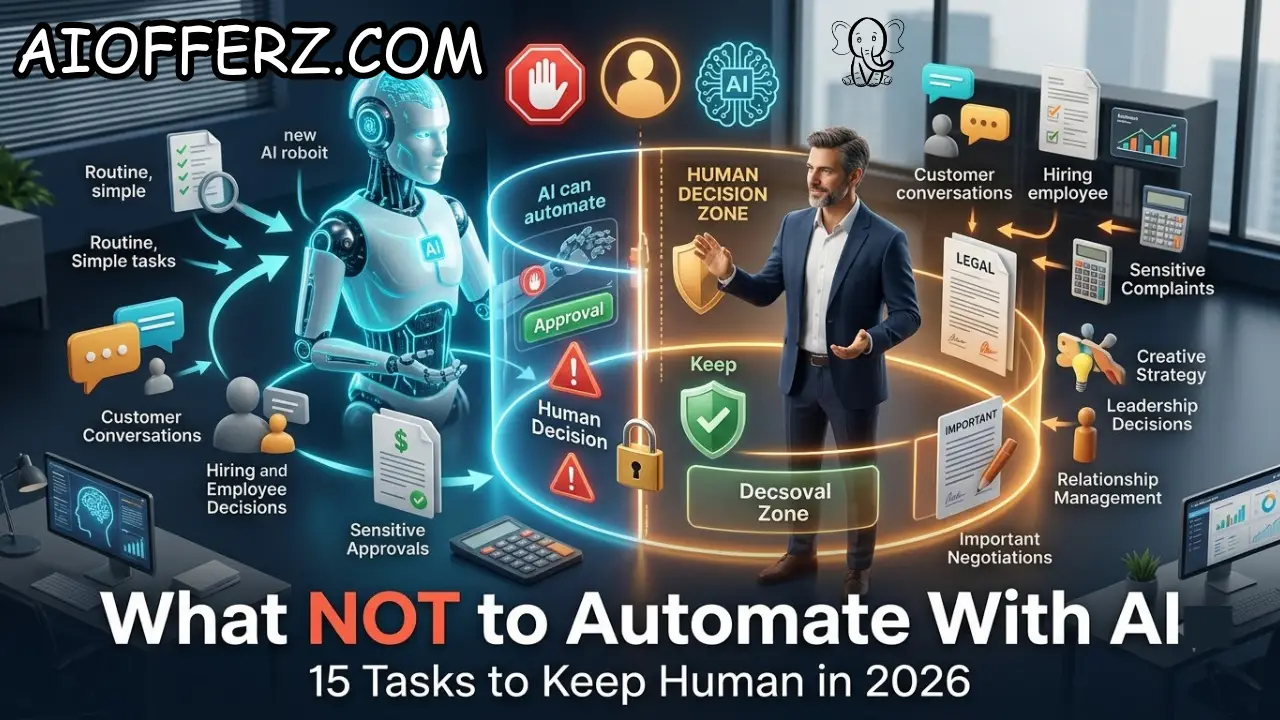
The following 15 tasks are areas where U.S. small businesses should generally be cautious about full AI automation in 2026.
Want To Use Other AI To Write…
Keep Hiring and Firing Decisions Human
Recruiting is an obvious area where AI can save time. A small business can use AI to write job descriptions, organize applications, summarize resumes, schedule interviews, and prepare interview questions.
Those are useful administrative applications because they reduce repetitive work without necessarily making the final employment decision.
The decision to hire someone, however, should remain under meaningful human control. Employment decisions involve experience, communication skills, references, cultural fit, role requirements, and other factors that may not be adequately represented by a resume or automated score.
An AI system may also reproduce problems contained in historical hiring data. If previous hiring practices favored particular backgrounds or characteristics, an automated system trained or configured around those patterns could potentially reinforce them.
The same principle applies to firing decisions. An AI system can help organize attendance records, performance information, customer feedback, or documented objectives, but it should not independently decide that an employee should lose their job.
Managers need to understand the circumstances behind performance issues. An employee may have received inadequate training, unclear instructions, unrealistic targets, or responsibilities that changed without proper communication.
Human review is particularly important when an employment decision could have significant consequences for an individual. The person responsible for the decision should be able to explain why the decision was made and what evidence supported it.
AI can therefore remain an assistant throughout the employment process. It can reduce administrative workload while keeping hiring, disciplinary, promotion, and termination decisions accountable to people.
NIST’s guidance specifically calls for organizations to define and differentiate human roles and responsibilities when AI systems are deployed.
That principle is particularly relevant to employment decisions because accountability cannot simply disappear behind an automated recommendation.
Do Not Let AI Make Final Financial and Legal Decisions
AI can be extremely useful in finance. Small businesses can use it to categorize information, summarize financial reports, identify unusual transactions, draft invoices, prepare questions for accountants, and organize financial documents.
But businesses should be extremely cautious about allowing AI to make final decisions involving significant amounts of money.
For example, an AI system might identify an unusual invoice and flag it for review. That is very different from automatically paying the invoice without human verification.
Similarly, AI can help compare vendor proposals, summarize contracts, calculate scenarios, or prepare financial analysis. A responsible employee or qualified professional should review important conclusions before the company acts on them.
Legal decisions require similar caution. AI can summarize a contract or identify clauses that deserve attention, but that does not make the system a substitute for qualified legal advice.
A small business might use AI to highlight a termination clause in a vendor agreement or summarize a lease. The final interpretation and decision should remain with the appropriate human decision-maker.
The reason is simple: AI-generated content can sound confident even when it is incomplete or incorrect. A polished answer is not proof that the underlying reasoning or information is accurate.
This becomes particularly important when a decision could result in a lawsuit, financial loss, regulatory problem, contractual dispute, or tax issue.
Businesses should also maintain clear approval thresholds. Routine low-value expenses may be automated, while large payments, unusual transactions, contract changes, refunds above a certain amount, or financial commitments require human approval.
This creates a practical balance. AI handles the administrative workload while humans retain authority over consequential financial and legal actions.
Wanna Use CustomGPT AI…
Keep Sensitive Customer Complaints and High-Stakes Service Issues Human
Customer service is one of the best areas for AI automation, but not every customer interaction should be automated.
AI is well suited to answering routine questions about business hours, basic product information, appointment availability, shipping status, standard policies, and other predictable topics.
The situation changes when a customer is angry, distressed, threatening legal action, reporting serious harm, or describing a complicated problem.
A chatbot that continues repeating scripted answers in such situations can make the problem worse.
Human employees can recognize emotion, understand context, make exceptions, and take responsibility for resolving unusual situations.
For example, an AI system might correctly identify that a customer is requesting a refund. But deciding whether to make an exception to a strict refund policy may require understanding the customer’s history and the circumstances of the transaction.
The same applies to serious complaints. If a customer claims that a product caused damage, an employee should be able to review the matter rather than allowing an AI system to independently close the complaint.
Small businesses should therefore create escalation rules.
Certain words, subjects, dollar amounts, safety concerns, threats, legal references, or unusual circumstances can automatically trigger human review.
AI can still prepare the case for the employee. It can summarize previous conversations, retrieve the customer’s order information, identify the relevant policy, and draft possible responses.
The human then reviews the information and decides what happens next.
NIST recommends measuring human oversight, overrides, errors, complaints, response times, and escalations when managing AI systems.
This is useful for customer service because it allows a business to determine whether its AI system is actually improving service or simply moving problems around.
The goal should never be “keep customers away from humans.” The goal should be “use AI to help employees spend more time solving the problems that actually need humans.”

Keep High-Value Sales Negotiation, Pricing Exceptions and Major Purchases Human
AI can dramatically improve sales operations. It can research prospects, draft emails, score leads, summarize calls, identify follow-up opportunities, and schedule meetings.
Those tasks can save salespeople substantial time.
But final negotiations should generally remain human.
A salesperson may need to understand a customer’s priorities, budget, concerns, competitive alternatives, timing, and relationship with the company.
AI can suggest a discount based on historical information, but automatically granting discounts can create pricing problems.
For example, a customer may ask for a 20% discount. AI could compare the request with the company’s normal pricing rules and tell the salesperson whether the request appears unusual.
The salesperson can then decide whether the discount is justified.
The same principle applies to major purchases and vendor negotiations. AI can compare prices, summarize proposals, and identify differences between suppliers.
The final decision should consider factors that may not be contained in the structured data, such as reliability, relationships, service quality, reputation, delivery risk, and strategic importance.
Small businesses often operate through relationships. A vendor that costs slightly more may still be valuable because it responds quickly during emergencies or consistently delivers high-quality products.
An AI system focused purely on numerical optimization may miss those less measurable factors.
The safest approach is to let AI prepare the decision rather than own the decision.
AI can answer, “Here are the five strongest options and the major differences between them.”
A human should answer, “This is the option we are actually choosing, and here is why.”
Using Many AI’s For Many Work, Solution Is Here…
Do Not Fully Automate Safety, Security and Incident Response Decisions
Some of the most important tasks to keep human involve physical safety, cybersecurity, and serious operational incidents.
AI can monitor systems, identify unusual activity, summarize logs, and prioritize alerts. Those capabilities can be valuable for a small business that does not have a large IT department.
But giving an AI unrestricted authority to make consequential security changes can introduce new risks.
For example, an AI system might incorrectly identify legitimate employee activity as malicious and disable accounts. It might block an important network connection or delete information while attempting to respond to a suspected attack.
Human approval can provide an important safety barrier for major actions.
The same principle applies to physical operations.
A construction company can use AI to summarize safety reports, identify recurring issues, and organize inspection information. A manufacturer can use AI to analyze equipment data and flag potential problems.
But an AI system should not independently override a qualified safety professional when a serious physical hazard is involved.
Human expertise matters because safety decisions often depend on physical conditions and context that may not be fully represented in the data.
Small businesses should establish predefined emergency procedures that identify which AI actions are allowed automatically and which require human confirmation.
For example, AI might automatically create a security incident ticket and notify the responsible person. A human can then decide whether to isolate a device, reset credentials, contact a vendor, or notify customers.
This approach also creates accountability.
NIST’s AI framework emphasizes security, resilience, accountability, and human oversight as components of trustworthy AI systems.
AI can therefore serve as an early-warning system without becoming the final authority during a serious incident.
Keep Employee Discipline, Sensitive HR Conversations and Personal Matters Human
AI can help HR teams organize information, create documentation, prepare meeting agendas, and answer routine policy questions.
It should not replace human judgment during sensitive employee conversations.
Performance problems often have context that cannot be reduced to a score. An employee may be dealing with training problems, changing responsibilities, communication issues, team conflicts, or other circumstances that require conversation.
An AI-generated performance score can be useful as one input, but it should not automatically determine an employee’s future.
Disciplinary discussions also require care. Employees should have an opportunity to explain their perspective and ask questions.
An AI system cannot take genuine responsibility for a difficult conversation.
The same principle applies to layoffs, promotions, compensation changes, conflict resolution, and workplace complaints.
AI can help prepare managers, but managers should remain responsible for the conversation and decision.
This is also important for employee trust. If workers believe an invisible algorithm controls important career decisions, they may become less willing to communicate problems or challenge questionable recommendations.
Human review does not mean ignoring data.
Managers should use relevant evidence, documentation, performance information, and company policies while also considering context.
AI can help make that evidence easier to understand.
But the final decision should remain attributable to a person with appropriate authority.
Businesses should document who makes important employment decisions and what role AI played in preparing the information.
This creates a clearer accountability structure and makes it easier to identify problems if an AI recommendation was incorrect.
The principle is straightforward: AI can support HR judgment, but it should not become the employer.
To get relief from Joint Pain , you can go for this.
Do Not Automate the Decisions That Define Your Brand and Business Strategy
The final category is broader but extremely important: strategic decisions and the human relationships that define the business.
AI can analyze competitors, summarize market research, identify trends, generate business ideas, and compare scenarios.
But it should not independently decide the company’s long-term strategy.
A business owner may need to choose whether to enter a new market, close a location, change pricing, discontinue a product, acquire another company, or reposition the brand.
Those decisions involve risk tolerance, values, relationships, experience, timing, and judgment.
AI can provide useful analysis, but it does not own the consequences.
The same applies to brand voice. AI can draft social posts, newsletters, website copy, and advertising variations. Human review remains important when the message represents the company’s identity.
A small business often differentiates itself through personality and relationships. If every customer interaction sounds generic, automation can reduce rather than increase customer loyalty.
Important partnerships should also remain human.
AI can research potential partners, prepare meeting briefs, summarize contracts, and track follow-ups. But building trust with a major customer, supplier, investor, or community partner requires human interaction.
Another area to keep human is crisis communication.
If the business experiences a serious service failure, security incident, employee issue, or public controversy, an AI-generated statement should not automatically be published.
A responsible person should verify the facts, consider legal implications, understand the audience, and approve the message.
The final task to keep human is deciding where AI should and should not be used in the business itself.
That may sound obvious, but it is becoming increasingly important as AI systems become more autonomous.
Businesses need clear boundaries, permissions, escalation procedures, and accountability.
NIST’s guidance recommends establishing policies that define human roles and responsibilities for oversight and monitoring, rather than treating human involvement as an undefined safety net.
In practical terms, every important AI workflow should answer three questions: What can AI do? What must a human approve? Who is accountable when something goes wrong?
Those three questions can prevent a large percentage of avoidable automation problems.
How to Build a Human-in-the-Loop AI Strategy for 2026
The goal of responsible AI automation is not to keep humans involved in every tiny task. That would eliminate much of the productivity benefit.
Instead, businesses should automate low-risk, repetitive work and reserve human attention for decisions where judgment, accountability, empathy, or specialized expertise matters.
A useful first step is to classify every proposed AI workflow according to its potential impact.
Low-impact tasks such as formatting documents, summarizing internal notes, organizing information, drafting routine emails, and categorizing basic requests can often be heavily automated.
Medium-impact tasks can use AI recommendations with employee review.
High-impact tasks should normally require meaningful human approval before action.
The business should also establish permissions. An AI system that can draft an email does not necessarily need permission to send it. An agent that can recommend a refund does not necessarily need permission to issue one.
Limiting permissions reduces the damage that can occur if the system makes a mistake.
Businesses should also monitor actual performance rather than assuming the system works correctly after deployment.
Track errors, customer complaints, human overrides, escalations, unusual outputs, and situations where employees reject AI recommendations.
NIST specifically recommends documenting human oversight and maintaining statistics about overrides, errors, complaints, response types, and escalation decisions.
The results should be reviewed periodically.
If an AI workflow performs reliably over time, the business may decide that more steps can be automated.
If error rates increase or employees repeatedly override the system, the workflow may need stronger human involvement.
This creates a gradual path toward automation instead of a dangerous jump toward full autonomy.
The most effective U.S. small businesses in 2026 will not necessarily be those with the greatest number of AI agents. They will be those that understand exactly where AI creates value and exactly where human judgment creates more value.
AI should eliminate unnecessary work, not eliminate necessary judgment.
The strongest operating model is therefore simple: automate the repetitive, assist the complex, and keep consequential decisions accountable to humans.
You can go for this to get natural Glowing Skin.
FAQs
1. What tasks should small businesses not automate with AI?
Businesses should be cautious about fully automating hiring and firing decisions, major financial decisions, legal decisions, serious customer complaints, safety decisions, sensitive HR matters, major negotiations, cybersecurity incidents, and strategic decisions.
2. Should AI make hiring decisions for a small business?
AI can help screen and organize information, but final hiring decisions should remain under appropriate human control. Businesses should also evaluate potential bias and comply with applicable employment requirements.
3. Can AI handle customer complaints?
AI can handle routine questions and initial triage, but serious complaints, legal threats, safety concerns, emotionally sensitive situations, and unusual cases should be escalated to a human.
4. Should AI approve business payments?
Low-risk, predefined transactions may be automated with appropriate controls, but unusual, high-value, or sensitive payments should generally require human approval.
5. Can AI replace a small-business manager?
AI can automate administrative work and provide recommendations, but management decisions involving employees, customers, strategy, and accountability still require human judgment.
6. Why should strategic decisions remain human?
Business strategy involves values, risk tolerance, relationships, timing, and consequences that may not be adequately represented in historical data or AI-generated analysis.
7. What does human-in-the-loop AI mean?
Human-in-the-loop means an AI system performs or recommends work while a person retains defined responsibility for reviewing, approving, correcting, or overriding important actions.
8. Should every AI decision require human approval?
No. Requiring approval for every low-risk task would eliminate much of the efficiency benefit. Human involvement should increase as the potential impact and risk of an AI decision increase.
9. How can a small business monitor AI mistakes?
Track errors, customer complaints, employee overrides, escalations, incorrect actions, response times, and other relevant performance measures. NIST recommends documenting these types of oversight and outcome measures.
10. What is the safest way for a small business to adopt AI in 2026?
Start with low-risk repetitive workflows, establish clear permissions, test the system, create escalation rules, measure performance, and gradually expand automation only when the results demonstrate that it is reliable and valuable.
Ready to Begin?
➜ Click Here to explore top rated affiliate programs on ClickBank!
➜ Reach Our Free Offers: “Come Here To Earn Money By Your Mobile Easily in 2025.”
Want To Read More Then Click Here…
If You Are Interested In Health And Fitness Articles Then Click Here.
If You Are Interested In Indian Share Market Articles Then Click Here.
Thanks To Visit Our Website-We Will Wait For You Come Again Soon…