Why AI Sales Agents Are Changing Lead Qualification for U.S. Small Businesses
For a small U.S. business, generating leads is only half the sales challenge. The harder part is figuring out which prospects are serious, which ones are a good fit, and which ones are unlikely to buy.
When a sales team has only a few people, spending valuable time manually checking every inquiry can quickly become expensive.
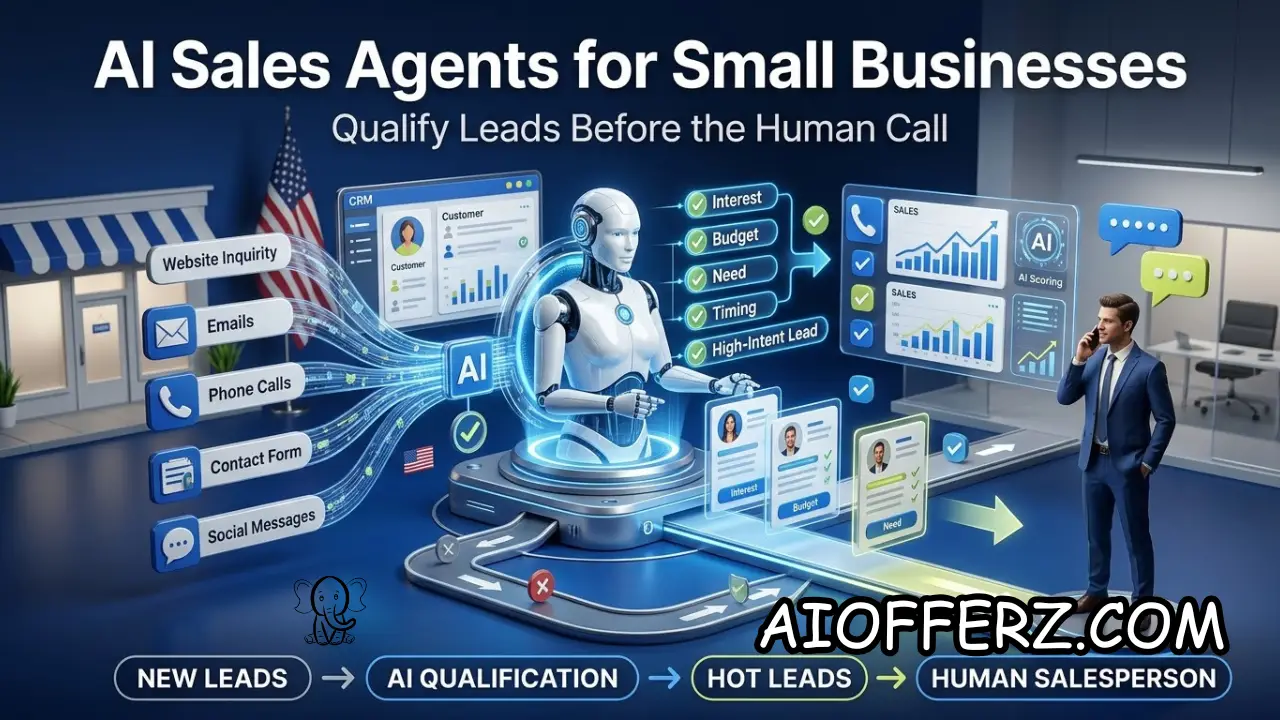
This is where AI sales agents are becoming useful. Instead of simply answering questions like a traditional chatbot, an AI sales agent can have a conversation with a prospect, collect relevant information, identify buying intent, apply qualification rules, and prepare the lead for a human salesperson.
The technology is moving beyond simple experimentation. Google introduced Business Agent for Leads in 2026, allowing businesses to use conversational AI to engage prospects, answer questions, collect information, and qualify leads before passing higher-intent prospects to sales teams.
Sales platforms are also moving in the same direction. HubSpot’s current AI tools can help businesses research prospects, prioritize opportunities, identify buying signals, personalize outreach, and book meetings.
For a small business, the biggest benefit is not necessarily replacing a salesperson. It is protecting the salesperson’s time.
A human should spend more time speaking with prospects who have a genuine need, budget, authority, and reasonable timeline rather than repeatedly asking basic qualifying questions.
That makes AI sales agents particularly interesting for businesses that receive leads outside normal business hours. A prospect who submits a request at 9:30 p.m. does not necessarily want to wait until the next morning for a response.
An AI agent can begin the conversation immediately and collect useful information while the sales team is unavailable.
The important distinction is that qualification and closing are different jobs. AI can handle much of the repetitive early-stage conversation.
While the human salesperson can take over when the prospect is ready for a deeper conversation, negotiation, technical discussion, or purchasing decision.
Want To Use Other AI To Write…
How an AI Sales Agent Qualifies a Lead Before a Salesperson Calls
The first step is capturing the lead’s basic information. Depending on the business, this may include the person’s name, company, contact information, location, service requirement, product interest, approximate budget, project size, and preferred timeline.
The AI agent should not ask every possible question. Too many questions can make the interaction feel like a form instead of a conversation. The goal is to collect the minimum information needed to determine whether the prospect should move forward.
For example, a residential remodeling company might ask what type of project the homeowner is considering, where the property is located, the approximate project size, when the customer wants the work completed, and whether they have an approximate budget.
A B2B software company could ask about company size, current software, business problem, number of users, implementation timeline, and purchasing process.
A commercial cleaning company might ask about property type, square footage, cleaning frequency, location, and desired start date.
The AI agent can then compare those answers with the company’s qualification rules. If the business only serves customers within certain states, for example, location can become an early qualification factor.
The same approach can be used for budget. If a company’s minimum project size is $20,000, the AI agent can determine whether the prospect appears to fall within that range before sending the opportunity to a salesperson.
This does not mean AI should automatically reject every prospect that does not fit perfectly. Some prospects may have unusual circumstances or future potential.
Instead, the system can classify leads into categories such as high priority, needs review, nurture, or not currently qualified.
The result is a cleaner sales pipeline. Instead of a salesperson starting every call with basic discovery questions, the salesperson receives useful context before making contact.
The Best Questions AI Sales Agents Should Ask Prospects
A strong qualification workflow begins with the questions that actually influence the sales decision. Businesses should identify the characteristics of a good customer before teaching an AI agent how to qualify prospects.
One useful category is need. The AI should understand what problem the prospect is trying to solve.
A prospect who simply wants general information may require different treatment from someone actively looking for a solution.
The second category is fit. The agent can ask questions about company size, location, industry, project type, number of employees, property type, technical requirements, or other factors that determine whether the business can realistically serve the prospect.
Budget can be another qualification signal, but it needs to be handled naturally. Instead of aggressively demanding a precise number, an AI agent may offer ranges or ask whether the prospect already has a budget established.
Timing is also important. Someone planning to purchase next week should generally receive different follow-up from someone researching options for next year.
Authority can matter in B2B sales. The AI agent can ask whether the person is responsible for making the decision or whether other stakeholders will be involved. This helps the salesperson prepare for the eventual conversation.
AI can also recognize intent signals from the conversation itself.
A prospect asking about implementation dates, pricing, availability, financing, contract terms, or next steps may demonstrate stronger buying intent than someone asking only a general educational question.
However, qualification should not become an interrogation. The best AI sales agents behave more like helpful sales coordinators than rigid questionnaires.
HubSpot’s current AI prospecting tools similarly emphasize identifying buying signals, researching prospects, and prioritizing accounts so sales representatives can focus on opportunities more likely to convert.
Wanna Use CustomGPT AI…
How AI Should Score and Prioritize Leads for Human Salespeople
Once an AI sales agent collects information, the next step is deciding how the lead should be prioritized. A simple scoring system can make this process easier for a small sales team.
A lead score might consider factors such as service fit, budget, urgency, location, company size, engagement level, and specific buying signals. The exact scoring model should reflect the company’s actual sales process rather than a generic template.
For example, a lead that matches the target customer profile, has an immediate need, has an appropriate budget, and requests a sales call could receive a high priority.
A prospect that matches the customer profile but says they are not planning to buy for twelve months might be categorized as a nurture opportunity rather than an immediate sales call.
The purpose of lead scoring is not to predict the future perfectly. It is to help a salesperson decide where to spend limited time.
AI can also summarize the reason behind a score. Instead of simply displaying “Score: 82,” the CRM might show that the prospect is in the target service area, requested pricing, has a near-term timeline, and asked to speak with a salesperson.
That context is valuable because it allows the salesperson to begin the call intelligently.
AI can also identify missing information. If the prospect appears promising but has not provided a budget or timeline, the system can flag the lead for additional qualification instead of pretending that it has enough information.
This creates a more transparent process than relying on a mysterious AI score.
Small businesses should regularly review whether the scoring system actually matches sales outcomes. If leads categorized as high priority rarely become customers while supposedly lower-priority leads convert frequently, the qualification rules need adjustment.
The AI should therefore learn from business results through controlled improvements, not simply be allowed to change qualification criteria without oversight.
How AI Sales Agents Hand Qualified Leads to Human Salespeople
The handoff is arguably the most important part of the entire system. A highly capable AI conversation has little value if the salesperson receives a lead with no useful context.
A good handoff should include the prospect’s basic information, what they are looking for, important answers from the conversation, buying signals, potential concerns, qualification status, and the recommended next step.
The salesperson should not have to read a 30-message conversation just to understand why the prospect is calling.
AI can create a concise handoff summary. For example, it might state that the prospect owns a commercial property in the company’s service area, needs the service within 60 days, has a budget within the company’s normal range, and wants a proposal for three locations.
The system can then create or update the CRM record and notify the appropriate salesperson.
Appointment scheduling can be part of the same workflow. Google specifically describes its Business Agent for Leads as a conversational experience that can capture leads around the clock, answer questions, qualify prospects, and help deliver higher-intent leads to sales teams.
The handoff can also include conversation history. This prevents the salesperson from asking the prospect to repeat information they have already provided.
That matters for customer experience. If a prospect has already explained their requirements to an AI agent and the salesperson immediately asks the same basic questions, the company can appear disorganized.
The human salesperson should also be able to override the AI’s qualification. A lead may look weak according to the predefined rules but still have strategic value.
The best workflow therefore looks like this: AI engages the prospect, AI gathers information, AI qualifies the opportunity, AI summarizes the conversation, and the human salesperson makes the final judgment.
That division allows technology to handle speed and repetition while people handle nuance and relationships.
Using Many AI’s For Many Work, Solution Is Here…
How U.S. Small Businesses Can Use AI Sales Agents Without Losing the Human Touch
The biggest concern about AI sales agents is often that customers will dislike talking to machines. That can happen when an AI system is poorly designed, difficult to escape, or unable to understand straightforward requests.
Transparency can help. A business should consider clearly identifying an AI assistant rather than pretending that the prospect is speaking with a human.
The AI should also provide an easy path to a person. If a prospect asks for a salesperson, expresses frustration, has a complex question, or reaches a sensitive situation, the system should be able to escalate.
The agent should also have clear boundaries. It should not invent prices, make promises that the company has not approved, guarantee results, or provide information outside its authorized knowledge.
This is particularly important because AI systems can generate plausible but incorrect responses.
The safest approach is to ground the agent in approved business information such as website content, product documentation, pricing rules, service areas, policies, and frequently asked questions.
Google’s Business Agent for Leads emphasizes grounding responses in a business’s website content to support more accurate, on-brand answers.
The business should also decide which actions require human approval.
Collecting information and booking a standard appointment may be low-risk, while changing contract terms or offering a nonstandard discount may require a salesperson or manager.
Data privacy should be considered before connecting the agent to customer databases. The company should understand what information the AI receives, where it is stored, who can access it, and how the provider handles the data.
A good AI sales agent should feel like a fast front desk for the sales team, not an obstacle placed between customers and employees.
The goal is simple: make it easier for qualified prospects to reach the right human at the right time.
How to Build an AI Lead Qualification Workflow That Actually Produces ROI
The first step is defining the ideal customer profile. Before buying an AI sales agent, a company should know which customers it wants more of and which characteristics usually indicate a strong opportunity.
Next, document the existing sales qualification process. Write down the questions salespeople normally ask, the information they need before a call, the reasons a lead is considered qualified, and the circumstances that require escalation.
This information becomes the foundation for the AI workflow.
The business should then connect the agent to its CRM or lead-management system. The objective is to prevent another isolated database from being created.
A new lead should enter the system automatically, interact with the AI agent, receive a qualification status, and then appear in the salesperson’s normal workflow.
The company should start with a limited pilot. It could initially use AI for website inquiries during evenings and weekends rather than replacing the entire inbound-sales process.
Performance should be measured using useful metrics. Lead response time, qualification accuracy, booked appointments, sales-call acceptance rate, conversion rate, and revenue per qualified lead are more meaningful than simply counting AI conversations.
AI should also be evaluated against human performance. If salespeople consistently disagree with the AI’s qualification, the workflow needs improvement.
The system should be reviewed regularly. Sales conditions change, products change, pricing changes, service areas change, and customer behavior changes.
Current sales technology is moving toward this type of workflow. HubSpot describes AI-powered prospecting as a way to research accounts, identify buying signals, personalize outreach, and prioritize sales actions.
The strongest implementation is therefore not “AI instead of salespeople.” It is “AI before salespeople.”
The AI handles the repetitive first conversation. The salesperson receives the context. The customer gets a faster response. And the business can focus human attention on opportunities that deserve it.
To get relief from Joint Pain , you can go for this.
FAQs
1. What is an AI sales agent?
An AI sales agent is software that can communicate with prospects, answer approved questions, collect information, qualify leads, follow up, and sometimes schedule appointments before handing opportunities to human salespeople.
2. Can an AI sales agent qualify leads automatically?
Yes. It can use predefined criteria such as location, budget, need, company size, timeline, service requirements, and buying intent to categorize prospects.
3. Can AI sales agents replace salespeople?
They can automate parts of early-stage sales, but human salespeople remain valuable for discovery, negotiation, complex questions, relationship building, and closing.
4. What questions should an AI sales agent ask?
The questions should focus on need, fit, budget, timeline, decision-making authority, project requirements, and other factors that genuinely affect qualification.
5. Can AI sales agents book sales appointments?
Yes. AI sales systems can qualify prospects and, where the business allows it, schedule meetings with the appropriate salesperson.
6. Are AI sales agents available 24/7?
Many AI sales systems can interact with prospects outside normal business hours, allowing businesses to capture and qualify inquiries when human employees are unavailable. Google’s Business Agent for Leads is one current example.
7. How does an AI sales agent know which leads are good?
The business provides qualification rules and approved information. The AI uses the prospect’s answers and interaction signals to categorize the opportunity.
8. What happens when an AI sales agent makes a mistake?
The system should have human escalation and review processes. Qualification rules should also be monitored and adjusted when the AI repeatedly misclassifies prospects.
9. Is an AI sales agent useful for a small business with only a few salespeople?
Yes. Smaller teams can benefit because AI can handle repetitive qualification and follow-up work, allowing limited sales staff to spend more time with serious prospects.
10. What is the biggest mistake when implementing an AI sales agent?
The biggest mistake is focusing on conversation volume instead of sales outcomes. The goal should be better-qualified opportunities, faster response times, more productive sales calls, and ultimately more revenue.
Ready to Begin?
➜ Click Here to explore top rated affiliate programs on ClickBank!
➜ Reach Our Free Offers: “Come Here To Earn Money By Your Mobile Easily in 2025.”
Want To Read More Then Click Here…
If You Are Interested In Health And Fitness Articles Then Click Here.
If You Are Interested In Indian Share Market Articles Then Click Here.
Thanks To Visit Our Website-We Will Wait For You Come Again Soon…