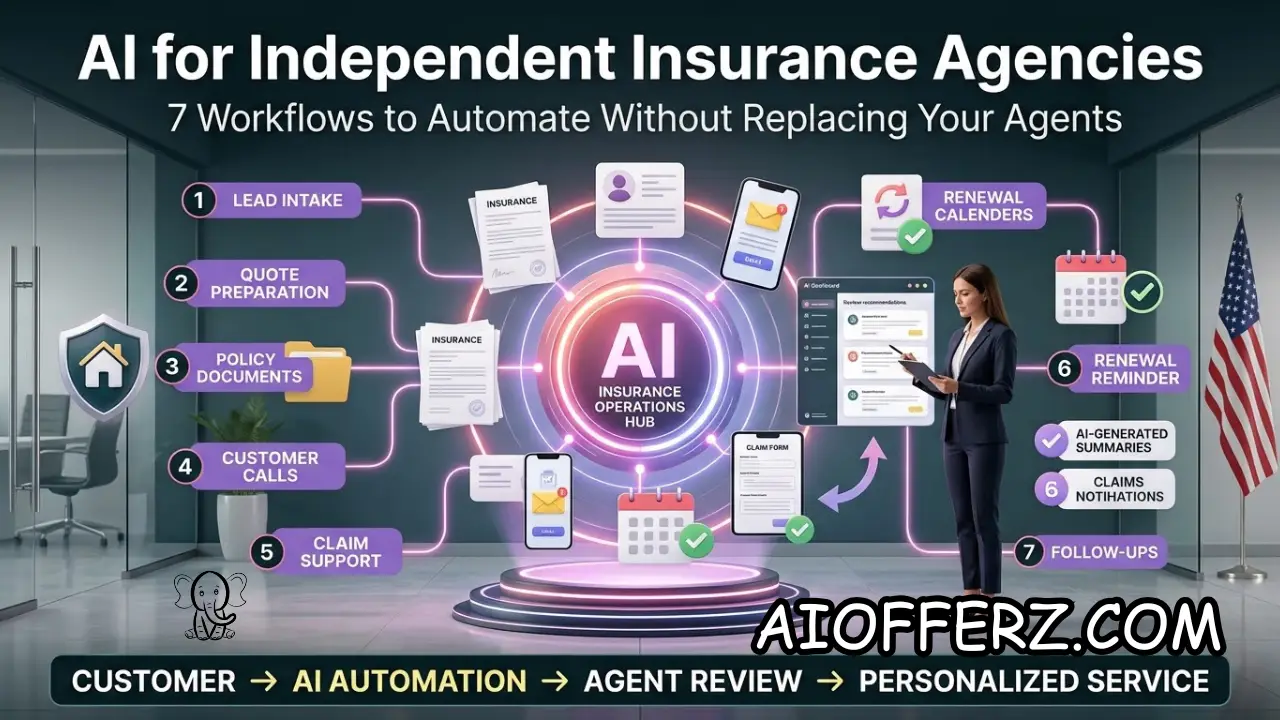
Artificial intelligence is becoming a practical business tool for independent insurance agencies in 2026. The opportunity is not to replace producers, customer service representatives, or agency owners.
It is to remove repetitive administrative work that takes people away from clients.
Independent agencies operate differently from large national insurers. They often compete through personal relationships, local knowledge, carrier access, responsiveness, and the ability to explain complicated coverage.
Those strengths are difficult to automate and should not be the target of automation.
Instead, AI can help with the work surrounding those strengths. It can organize incoming information, summarize documents, prepare drafts, identify missing information, trigger follow-ups, and move routine tasks between systems.
The agent remains responsible for judgment, recommendations, client conversations, and important decisions.
This approach is already becoming more common. Agent for the Future’s 2026 Independent Agency Growth Study reports that 65% of independent agents used AI for work during the previous year, compared with 37% in 2025.
The same research says agents using AI save an average of four hours per week.
For agencies considering AI for insurance agencies in 2026, the smartest starting point is therefore not the most impressive AI tool. It is the workflow where repetitive work is consuming the most valuable employee time.
Want To Use Other AI To Write…
Why AI for Independent Insurance Agencies Makes Sense in 2026
Insurance agencies deal with a huge amount of repetitive information.
Emails arrive with attachments, prospects submit forms, clients request certificates, renewal dates approach, policies change, and employees repeatedly move information between emails, the agency management system, carrier portals, spreadsheets, and documents.
Much of this work does not require an agent’s professional judgment. It requires consistency, organization, speed, and attention to detail. Those are areas where automation can provide useful assistance.
The National Association of Insurance Commissioners recognizes that AI is already being used across insurance functions including underwriting, pricing, customer service, claims handling, marketing, and fraud detection.
The NAIC also emphasizes that AI-supported actions must comply with applicable insurance laws and regulations.
For an independent agency, that distinction is important. An agency should not treat an AI model as a licensed insurance professional. Instead, AI should prepare information for the person who is qualified to make the decision.
The best AI workflows therefore follow a simple pattern: AI handles repetitive preparation, the employee reviews the output, and the licensed professional makes the final recommendation or decision when professional judgment is required.
This approach can also make adoption easier internally. Employees are less likely to view AI as a threat when the goal is clearly defined as reducing repetitive work rather than eliminating positions.
The 2026 independent agency research shows that many agents are currently using AI for relatively simple tasks while planning to expand into data analysis and workflow automation.
For agency owners, the business case is straightforward. If AI saves several hours per employee each week, that time can be redirected toward prospect conversations, account reviews, retention, cross-selling, relationship management, and other work that directly supports agency growth.
AI Workflow #1: Automate Lead Intake and Follow-Up
Lead intake is one of the strongest starting points for insurance agency automation because speed matters. A prospect may submit a website form, send an email, call the office, respond to an advertisement, or contact an agent through another channel.
An AI-enabled workflow can collect information from these sources and place it into the appropriate system. It can identify basic details such as the prospect’s name, contact information, requested coverage, location, business type, and preferred contact method.
AI can also help classify and route leads. For example, a commercial property inquiry may need to go to a producer who specializes in commercial accounts, while a personal auto inquiry may follow a different routing rule.
The AI does not need to decide whether the customer qualifies for coverage. It simply organizes the inquiry according to agency-defined rules.
Follow-up is another area where automation can provide immediate value. A system can remind an employee when a new lead has not been contacted, prepare a follow-up email, or trigger an approved communication sequence.
The agent can review and send the message rather than remembering every follow-up manually.
This is particularly useful for small independent agencies because a missed call or delayed response can mean a prospect contacts another agency. AI does not create the relationship, but it can help make sure the agency actually gets the opportunity to build one.
The important safeguard is to keep automated communications controlled. AI should not invent coverage terms, promise prices, make unsupported recommendations, or provide advice outside the agency’s approved process.
It should help the agent respond faster, not pretend to be the agent.
Wanna Use CustomGPT AI…
AI Workflow #2: Speed Up Quote and Submission Preparation
Preparing information for quotes and submissions can consume significant staff time. Commercial submissions in particular may involve applications, schedules, prior policies, loss information, supplemental forms, emails, and other documents.
AI can help extract information from documents and organize it into a standardized format.
Instead of an employee repeatedly searching through attachments for addresses, business descriptions, limits, dates, vehicle information, or other basic details, AI can create a structured summary for review.
The key word is review. Extracted information can contain errors, especially when source documents are incomplete, poorly scanned, inconsistent, or ambiguous.
The employee should verify important information before it is submitted to a carrier.
AI can also identify missing information. If a submission normally requires certain fields or documents, an automated workflow can flag what appears to be absent.
This can reduce the number of back-and-forth emails required before a submission is ready.
Another useful application is creating a submission summary.
The system can organize the information already supplied by the prospect into a consistent format so the producer spends less time assembling paperwork and more time evaluating the account.
Independent agencies should be especially careful not to confuse preparation with underwriting.
The agency can use AI to organize and summarize information, but carrier-specific underwriting decisions remain the responsibility of the appropriate professionals and carrier processes.
This workflow is attractive because it does not require the agency to completely replace its existing systems.
In many cases, AI can sit around the current agency management system and reduce manual data movement between documents, email, and internal workflows.
AI Workflow #3: Automate Document Processing and Data Entry
Data entry is one of the least valuable uses of a licensed employee’s time. Yet insurance agencies often require employees to enter or copy the same information into multiple systems.
AI-powered document processing can reduce this problem. A system can read incoming documents, recognize relevant information, classify the document, and prepare data for entry into an agency management system or another approved application.
For example, an incoming policy document could be classified and routed to the correct account. A renewal document could be connected to the appropriate customer record.
A certificate request could be recognized and sent to the employee responsible for processing it.
The major benefit is not simply typing faster. It is reducing unnecessary repetition. When employees repeatedly copy information from one system to another, every manual transfer creates another opportunity for a typo or missed field.
AI can also summarize long documents. An employee may not need an artificial intelligence system to interpret a policy for the client, but a summary can help the employee quickly locate important information before reviewing the original document.
Agencies should establish clear rules about which documents AI is allowed to process. Sensitive client information should only be handled through systems with appropriate security, privacy protections, access controls, and contractual safeguards.
This workflow can produce one of the most practical forms of AI productivity: fewer repetitive keystrokes and fewer administrative handoffs. The employee still owns the work, but the machine handles much of the preparation.
Using Many AI’s For Many Work, Solution Is Here…
AI Workflow #4: Improve Customer Service, Certificates, and Routine Requests
Customer service creates another large category of repetitive agency work. Clients may ask for certificates of insurance, copies of policies, basic status updates, billing information, address changes, or other routine assistance.
AI can help classify incoming requests and direct them to the right workflow. Instead of employees opening every email and deciding manually what needs to happen next, the system can identify the general request type and create a task.
For frequently requested information, AI can also prepare draft responses using approved agency language. An employee can check the information and send the response rather than writing the same basic email repeatedly.
Certificate requests are another potential automation area. AI can identify the request, extract basic information, check whether required information appears to be present, and route the task.
The actual certificate process should remain controlled by the agency’s established procedures and authorization requirements.
Customer-facing AI can also provide basic after-hours assistance. However, it should be designed to recognize when a conversation requires a human.
Questions involving coverage interpretation, complex claims, disputes, unusual circumstances, or recommendations should be escalated.
The goal is not to create an automated insurance agent that handles everything. The goal is to give customers faster access to routine assistance while protecting the human relationship when expertise or judgment matters.
A good implementation should measure response time, unresolved requests, escalation rates, corrections, and customer satisfaction. If automation makes customers work harder to reach an employee, it is solving the wrong problem.
AI Workflow #5: Automate Renewal Preparation and Retention Follow-Up
Renewals are one of the most valuable workflows for independent agencies because retention is directly connected to the quality of ongoing client service.
Yet renewal processes can involve repeated reminders, document collection, policy review, follow-up calls, and internal tasks.
AI can help create a renewal timeline based on existing agency rules. It can remind employees when an account should be reviewed, identify missing documents, summarize previous interactions, and prepare a renewal checklist.
AI can also help prioritize accounts. An agency could create rules that identify accounts requiring earlier human attention because of changes in exposure, missing information, unusual activity, or other approved criteria.
Another useful application is renewal communication. AI can draft personalized reminders using information already available in the agency’s systems.
Employees can then review the message before it goes to the client.
The system can also summarize the account history before the renewal conversation. Instead of an employee searching through multiple notes and emails, the system can provide a concise overview of previous discussions, outstanding tasks, and relevant account information.
This does not mean AI should independently recommend whether a client should change coverage. That remains a professional conversation. The value comes from ensuring the agent enters that conversation prepared.
For independent agencies, this may be one of the most important AI workflows because it connects administrative efficiency with relationship management.
Automation creates more time for agents to actually talk with clients before renewal decisions are made.
To get relief from Joint Pain , you can go for this.
AI Workflow #6: Streamline Claims Intake and Status Communication
Claims are sensitive, time-critical, and emotionally important to customers. That makes them a strong candidate for carefully controlled automation but a poor candidate for unrestricted AI decision-making.
AI can assist with first notice of loss intake by collecting basic information and organizing it for the appropriate employee or carrier process. It can identify missing fields and help create a structured claim summary.
For example, an automated intake process may capture the date of loss, type of incident, location, contact details, policy information, and supporting documents. The employee can then verify the information before it is submitted or escalated.
AI can also help summarize claim-related communications. When an employee has a long email thread or multiple documents to review, a summary can reduce the time required to understand what has happened.
Another useful application is status communication. AI can prepare routine updates based on verified information already in the system.
However, the agency should avoid allowing an AI system to invent claim decisions, coverage conclusions, settlement information, or promises.
The NAIC’s current AI work makes governance especially important. The regulator is developing and testing tools that look at insurers’ AI use, governance, risk mitigation, high-risk models, and data inputs.
Independent agencies should therefore document what their AI systems do, what information they access, who reviews their outputs, and what tasks require human approval.
The more consequential the activity, the stronger the human control should be.
AI Workflow #7: Automate Marketing, Meeting Notes, and Internal Agency Operations
Not every valuable AI workflow has to involve policy servicing. Marketing and internal operations can also benefit significantly from automation.
AI can turn approved agency information into draft newsletters, social media posts, educational articles, email campaigns, and client communication ideas.
The agency should still review content for accuracy, compliance, brand voice, and insurance-specific claims before publishing.
Meeting summaries are another easy win. AI can summarize internal meetings, identify action items, and create follow-up tasks. Instead of employees manually taking notes and later rebuilding a task list, the system can create an initial draft for confirmation.
AI can also help summarize customer calls and create structured notes. This can make account histories easier to understand, provided the agency has appropriate consent, privacy, security, and retention practices for the information being processed.
Internal knowledge management is another opportunity. An agency can use AI to help employees locate approved procedures, carrier instructions, internal checklists, and frequently used resources.
This can reduce the time employees spend searching through folders and emails.
The safest approach is to start with low-risk internal tasks. Marketing drafts, meeting summaries, task creation, document organization, and knowledge retrieval are generally easier to control than autonomous customer decisions.
Over time, agencies can expand automation when they have evidence that the workflow is accurate, secure, measurable, and useful. The objective should be controlled improvement rather than maximum automation.
You can go for this to get natural Glowing Skin.
How Independent Agencies Can Adopt AI Without Replacing Agents
The strongest AI strategy for an independent insurance agency starts with a workflow, not a software purchase. Agency owners should first identify where employees spend the most time on repetitive tasks and determine whether those tasks are predictable enough to automate.
A useful starting point is to select one workflow with high volume, clear rules, measurable outcomes, and limited risk. Lead intake, document classification, renewal reminders, meeting summaries, and routine service requests can be easier starting points than complex coverage decisions.
The agency should then define exactly what AI is allowed to do. For example, it may be allowed to summarize information, draft messages, classify documents, create tasks, or flag missing information.
It may not be allowed to make final coverage recommendations, approve exceptions, or send certain communications without human review.
Data security should be part of the process from the beginning. Agencies handle sensitive personal and financial information, so AI vendors should be evaluated for security controls, data handling, retention, access permissions, contractual terms, and integration practices.
Governance also matters. The NAIC’s current work emphasizes responsible AI use, accountability, transparency, compliance, data quality, cybersecurity, and potential bias.
Finally, measure the results. Track time saved, response time, employee corrections, customer satisfaction, errors, conversion rates, renewal completion, and other metrics relevant to the workflow.
An AI project should earn the right to expand based on measurable improvement.
The future of AI for independent insurance agencies is unlikely to be about removing the human from insurance. It is more likely to be about removing unnecessary administrative friction around the human.
Agents still bring trust, context, experience, negotiation skills, empathy, and professional judgment. AI can provide speed, organization, consistency, and assistance.
When those capabilities are combined carefully, an independent agency can serve more clients without simply adding more administrative workload.
FAQs
1. Will AI replace independent insurance agents?
AI is more likely to automate repetitive administrative work than replace the professional role of independent agents. Agents remain important for advice, relationship management, coverage discussions, negotiation, and complex client situations.
2. What is the best AI workflow for an insurance agency to automate first?
Lead intake and follow-up are strong starting points because they are repetitive, time-sensitive, and relatively easy to measure. Document processing and renewal reminders are also practical early candidates.
3. Can AI handle insurance quotes without an agent?
AI can help collect information, organize applications, identify missing data, and prepare submissions. Final recommendations and important coverage decisions should remain under appropriate human oversight.
4. How can AI help insurance agency customer service?
AI can classify incoming requests, summarize customer information, prepare draft responses, create tasks, and help with routine questions. Complex coverage issues should be transferred to qualified staff.
5. Can independent agencies use AI for claims?
Yes. AI can assist with claims intake, document organization, summaries, missing-information checks, and routine communication. It should not independently make consequential coverage or settlement decisions.
6. Is AI safe for insurance agencies?
AI can be used responsibly, but agencies need appropriate security, privacy, access controls, vendor evaluation, human oversight, and governance. Insurance regulators are increasingly focused on how AI is used and controlled.
7. How much time can AI save an insurance agent?
The amount varies by workflow and agency. A 2026 independent agency study reported that agents using AI for work save an average of four hours per week.
8. Should small insurance agencies invest in AI in 2026?
Small agencies can benefit if they choose narrowly defined workflows with measurable outcomes. They do not need to automate the entire business or purchase expensive enterprise systems to begin.
9. What should insurance agencies never fully automate?
Agencies should be cautious about fully automating complex coverage recommendations, sensitive customer decisions, exceptions, complaints, and other activities requiring professional judgment or regulatory accountability.
10. What is the biggest mistake agencies make with AI?
The biggest mistake is adopting AI simply because it is popular. Agencies should first identify a real operational problem, define the workflow, establish human controls, and measure whether automation actually improves the business.
Ready to Begin?
➜ Click Here to explore top rated affiliate programs on ClickBank!
➜ Reach Our Free Offers: “Come Here To Earn Money By Your Mobile Easily in 2026.”
Want To Read More Then Click Here…
If You Are Interested In Health And Fitness Articles Then Click Here.
If You Are Interested In Indian Share Market Articles Then Click Here.
Thanks To Visit Our Website-We Will Wait For You Come Again Soon…