Why AI for U.S. Restaurants Is Becoming a Practical Tool in 2026
AI is becoming a practical part of restaurant operations, especially for repetitive customer-service tasks. Restaurants have to manage phone calls, online inquiries, reservations, takeout orders, delivery questions, cancellations, special requests, and customer feedback while employees are simultaneously serving guests.
The challenge is not simply answering customers faster. It is doing so without taking staff away from the dining room or kitchen.
The U.S. restaurant industry is entering 2026 with significant cost and labor pressure.
The National Restaurant Association projects $1.55 trillion in restaurant and foodservice sales for 2026 and expects operators to add more than 100,000 jobs, while also highlighting persistent operating-cost pressure and the need for productivity improvements.
This environment makes automation particularly attractive to independent restaurants and multi-location operators. A phone call that takes several minutes may seem insignificant, but dozens of calls every day can consume hours of employee time.
During lunch and dinner rushes, missed calls can also become missed orders, missed reservations, or frustrated customers.
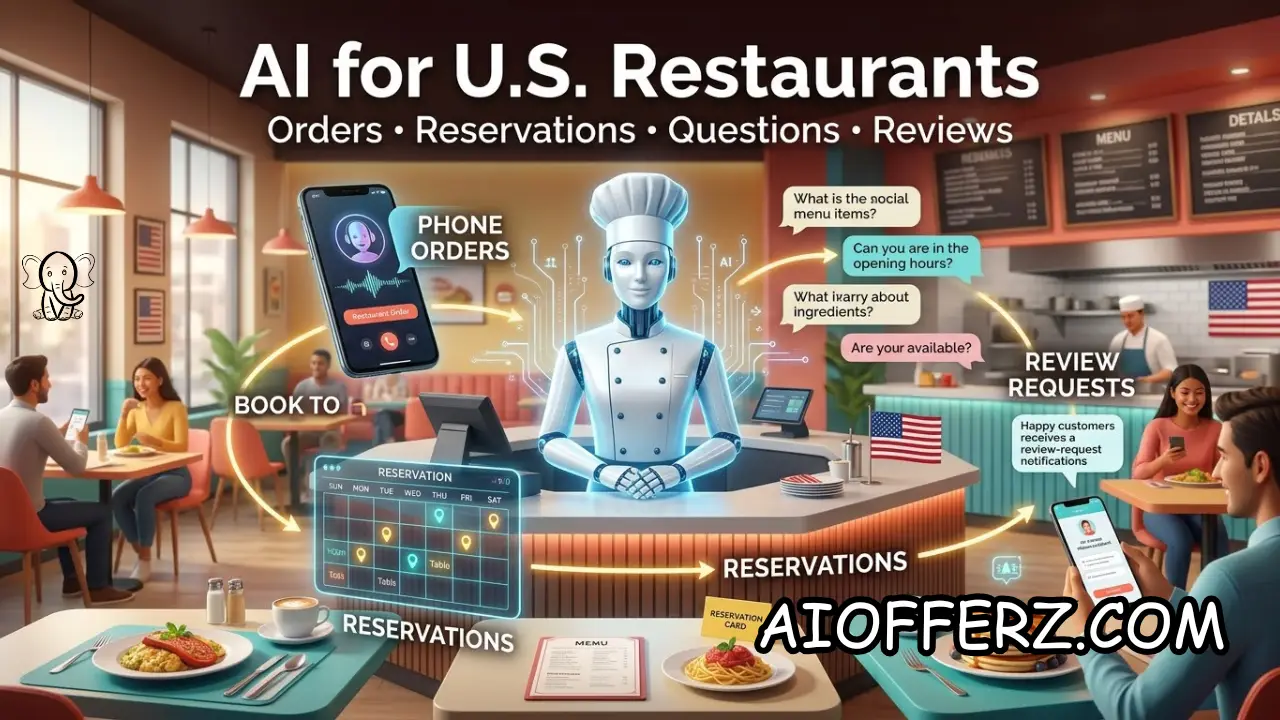
AI can now handle some of these repetitive interactions. Restaurant-specific systems are being used for phone ordering, customer questions, reservations, and other service tasks.
Toast, for example, currently supports an AI phone-ordering integration designed to handle restaurant orders, including complex menu customizations.
The National Restaurant Association has also identified customer ordering and reservations as areas already being affected by AI.
Its 2026 research found that about one-quarter of restaurants reported using AI-related tools, with customer ordering and reservations among the operational areas being impacted.
The opportunity is therefore not about replacing hospitality with automation.
It is about removing repetitive communication from employees’ workloads so they can spend more time preparing food, serving guests, solving problems, and creating the experience customers actually visit the restaurant for.
For most U.S. restaurants, the best starting point is simple: automate the calls and questions that follow predictable rules, while keeping employees involved whenever a situation requires judgment, empathy, or an exception.
Want To Use Other AI To Write…
How AI Phone Ordering Can Capture More Restaurant Orders
Phone orders are one of the clearest opportunities for restaurant AI. Customers still call restaurants for takeout, pickup, delivery, catering, menu questions, modifications, and availability. During busy periods, employees may not be able to answer every call.
An AI phone ordering system can answer incoming calls, understand what the customer wants, and guide the conversation through the restaurant’s menu.
The system can ask which items the customer wants, identify options and modifiers, confirm quantities, and collect the information required to complete the order.
Modern systems are becoming more capable of handling complicated menu structures. Toast’s current Incept AI integration, for example, is designed to take restaurant orders over the phone and handle menu customization through speech and language technology.
The biggest benefit is not simply reducing phone labor. It is reducing missed opportunities. If an employee is helping three guests at the counter and the restaurant phone rings, someone has to choose which customer receives attention.
AI can handle the phone conversation while the employee continues serving the guests physically present.
A good AI phone ordering workflow should repeat the order before completion. The system should confirm items, quantities, modifiers, pickup or delivery details, and any other information required by the restaurant.
Integration with the restaurant’s POS is also important. An AI system that takes an order but requires an employee to manually re-enter everything creates another source of errors and defeats much of the efficiency benefit.
AI should also know its limits. If a customer has an unusual allergy question, requests a modification that is not supported, disputes an order, or asks for something outside the approved menu rules, the call should be transferred to a trained employee.
The National Restaurant Association has long identified digital ordering and technology that makes ordering faster and easier as important areas of restaurant technology investment.
The strongest implementation therefore treats AI as an additional order-taking channel rather than a replacement for restaurant staff.
Customers get faster access to the restaurant, while employees get fewer repetitive calls during the busiest parts of the day.
How AI Can Automate Restaurant Reservations and Customer Questions
Reservations generate another large category of repetitive communication. Guests frequently ask about available tables, reservation times, party sizes, outdoor seating, private dining, special occasions, and cancellation policies.
An AI assistant can answer many of these questions using the restaurant’s approved information. If connected to the reservation system, it can also help guests find available times or direct them to the appropriate booking process.
This can be especially useful outside normal operating hours. A restaurant may close its phone line at 10 p.m., but customers can still want to make reservations for the weekend.
An AI system can continue handling eligible inquiries rather than forcing every customer to wait until the next day.
Customer questions go beyond reservations. Restaurants regularly receive questions about menus, ingredients, hours, parking, delivery areas, catering, private events, gift cards, accessibility, dress codes, and holiday schedules.
These questions are often straightforward if the restaurant maintains accurate information. AI can provide answers quickly instead of requiring a manager or host to stop what they are doing.
The National Restaurant Association has specifically described AI applications in areas such as online reservation management, digital menus, and AI order taking as ways technology can help restaurants handle customer-facing tasks.
However, the knowledge behind the AI must remain current. If holiday hours change, a menu item is discontinued, or the restaurant temporarily stops taking reservations, the AI system must receive the updated information.
Restaurants should also establish escalation rules. Questions involving allergies, serious complaints, unusual accommodations, large private events, or special requests may require a human employee.
The goal is not to prevent customers from reaching people. It is to ensure that employees do not spend valuable time answering the same basic questions dozens of times every day.
Wanna Use CustomGPT AI…
How AI Can Automate Restaurant Review Requests and Customer Feedback
Reviews have become an important part of restaurant reputation management, but asking customers for reviews manually is difficult to maintain consistently.
AI can help identify appropriate moments for a review request. For example, after an online order, reservation, catering event, or completed customer interaction, the system can trigger an approved message asking the customer for feedback.
The wording can be personalized without requiring an employee to write every message. AI can help create different versions for dine-in guests, takeout customers, catering customers, or loyalty-program members.
The National Restaurant Association’s 2026 research identifies customer feedback as one of the major areas where restaurant technology is being used.
A good system should focus on genuine feedback rather than simply trying to generate positive reviews. The restaurant should not instruct AI to manipulate customers into leaving favorable ratings or create fake reviews.
AI can also help summarize legitimate customer feedback. If dozens of reviews mention slow service, a particular menu item, parking problems, or inconsistent takeout packaging, AI can identify recurring themes for management to investigate.
This turns reviews into operational information instead of treating them only as marketing content.
AI can also help prepare responses to reviews. A restaurant manager can review a draft response before publishing it, especially when the customer is unhappy.
Negative reviews require particular care. An automated response that sounds defensive, dismissive, or generic can make the situation worse.
The better approach is to use AI for monitoring, categorization, summarization, and drafting while allowing a manager or owner to approve sensitive responses.
The result is a more consistent feedback process without forcing restaurant employees to spend hours manually checking every review platform.

How AI Can Handle Restaurant Customer Service Without Destroying Hospitality
Restaurant hospitality depends on human interaction, so automation should be used selectively. Customers may accept AI for simple tasks but still want employees when they have a complex request or problem.
Recent Toast research illustrates this distinction. In its July 2026 survey of 850 restaurant guests, 48% said they were comfortable with visible AI such as chatbots, automated ordering, or personalized recommendations, while 23% said they were uncomfortable.
That suggests restaurants should not assume customers either universally love or universally dislike AI. The experience depends on how the technology is implemented.
An AI assistant should be quick, clear, and easy to escape. If a customer repeatedly asks for a person, the system should not force them through additional automated questions.
Restaurants should also identify high-risk situations that always require employees. These may include serious complaints, food-allergy concerns, refund disputes, unusual catering requests, accessibility issues, and situations involving customer safety.
The AI should use approved information rather than inventing answers. A restaurant should provide its menu, hours, policies, reservation rules, delivery area, ordering rules, and other relevant information in a controlled knowledge base.
This becomes particularly important when menus change. An AI system that still believes an item is available can create frustration for customers and additional work for employees.
AI should also be designed around the restaurant’s actual workflow. If a phone order requires special preparation instructions, the system should capture those instructions in a way kitchen staff can understand.
The National Restaurant Association says restaurant technology can improve efficiency while maintaining high-touch hospitality when operators select technology according to their customer base and service model.
The right philosophy is simple: automate convenience, not hospitality. Let AI answer routine questions and take predictable orders while employees remain available for the moments when personal attention matters most.
Using Many AI’s For Many Work, Solution Is Here…
How U.S. Restaurants Can Connect AI With POS, Reservations and Customer Data
An AI tool becomes much more valuable when it connects to the restaurant’s existing systems. A standalone chatbot that cannot access current menu information or order data has limited operational value.
POS integration is especially important for phone ordering. When an AI system captures an order, that information should flow into the restaurant’s existing ordering process rather than forcing staff to manually re-enter every item.
Reservation integration works similarly. If an AI assistant tells customers that a table is available, it needs access to reliable availability information. Otherwise, the restaurant risks promising something that does not actually exist.
Customer-service workflows can also connect with loyalty and customer-management systems where appropriate. This can allow the restaurant to understand whether an inquiry relates to an existing order, reservation, or customer relationship.
However, more integration also means more responsibility for data security and access control. Restaurants should understand what customer information the AI system can access and what the technology provider does with that information.
Businesses should also establish permission levels. An AI assistant may be allowed to create an order or reservation but not issue an unrestricted refund or change important business settings.
Employees need clear rules about what AI can and cannot do. Otherwise, staff may assume the AI system is more capable than it actually is.
The National Restaurant Association’s 2026 industry report says operators are looking toward digital ordering, automation, and data analytics to improve efficiency, customer experience, and long-term competitiveness.
Restaurants should therefore focus on integration that produces a measurable operational improvement. The objective is not to connect every application simply because an integration exists.
A restaurant might begin with one workflow—AI phone ordering connected to its POS—and then add reservation and customer-feedback automation after the first workflow proves reliable.
How to Implement AI for a U.S. Restaurant and Measure the ROI
The best way to introduce AI is to start with the restaurant’s biggest repetitive communication problem. For one restaurant, that may be missed phone orders. For another, it may be reservation calls or repetitive customer questions.
The restaurant should first measure the current situation. How many calls arrive each day? How many go unanswered?, How long do employees spend handling routine questions?
And How many reservations are made by phone? How many customers ask the same questions?
These numbers create a baseline.
The restaurant can then select one workflow for a controlled pilot. For example, it might use AI to answer phone calls during peak periods while employees remain available for escalations.
After the pilot, management should compare order volume, missed calls, customer complaints, average handling time, employee workload, and revenue.
The restaurant should also measure customer satisfaction. Automation that saves labor but creates frustrating customer experiences is not necessarily a successful implementation.
AI costs should include software fees, integration expenses, setup, training, and any human review required.
Restaurants should also monitor accuracy. If the AI frequently misunderstands modifiers or creates incorrect reservations, the system needs improvement before being expanded.
The National Restaurant Association reported in 2026 that approximately one-quarter of restaurants were using AI-related tools and that technology adoption remains an area with substantial room for growth.
That means restaurants do not need to automate everything at once. A focused workflow with measurable results is generally a better starting point than a large technology project with unclear objectives.
The long-term goal is to create a restaurant operation where technology handles repetitive communication while employees focus on food quality, hospitality, service recovery, and the guest experience.
AI should make the restaurant easier to reach, not harder to talk to.
To get relief from Joint Pain , you can go for this.
FAQs
1. How can AI help a restaurant?
AI can help restaurants handle phone orders, reservations, customer questions, review requests, feedback analysis, marketing tasks, scheduling, and other repetitive administrative work.
2. Can AI take restaurant orders over the phone?
Yes. Current restaurant AI systems can handle phone ordering and menu customizations, with some integrations connecting directly with restaurant technology systems.
3. Can AI make restaurant reservations?
AI can assist with reservation inquiries and, when properly integrated with a reservation system, help customers find and book available times.
4. Can AI answer restaurant customer questions?
Yes. AI can answer approved questions about menus, hours, locations, reservations, delivery, catering, parking, and other routine topics.
5. Can AI ask customers for restaurant reviews?
Yes. AI-powered workflows can trigger approved review or feedback requests after orders, reservations, or other customer interactions.
6. Can AI respond to negative restaurant reviews?
AI can prepare a draft response, but a manager should generally review sensitive or negative feedback before publishing the response.
7. Will restaurant AI replace employees?
Not necessarily. The strongest use cases automate repetitive tasks so employees can spend more time on hospitality and customer-facing work.
The National Restaurant Association reports that most restaurant operators said recent technology investments did not permanently eliminate jobs.
8. Is AI phone ordering accurate?
Accuracy depends on the technology, menu complexity, audio quality, integration, and workflow design. Restaurants should test the system extensively and provide human escalation for unusual situations.
9. What restaurant tasks should not be fully automated?
Serious complaints, allergy-related concerns, unusual requests, complicated refunds, sensitive customer situations, and decisions requiring human judgment should generally remain under employee control.
10. What is the best first AI automation for a restaurant?
A restaurant should start with its highest-volume repetitive problem. For many operators, phone ordering, reservation inquiries, or frequently asked customer questions can be strong starting points.
Ready to Begin?
➜ Click Here to explore top rated affiliate programs on ClickBank!
➜ Reach Our Free Offers: “Come Here To Earn Money By Your Mobile Easily in 2025.”
Want To Read More Then Click Here…
If You Are Interested In Health And Fitness Articles Then Click Here.
If You Are Interested In Indian Share Market Articles Then Click Here.
Thanks To Visit Our Website-We Will Wait For You Come Again Soon…