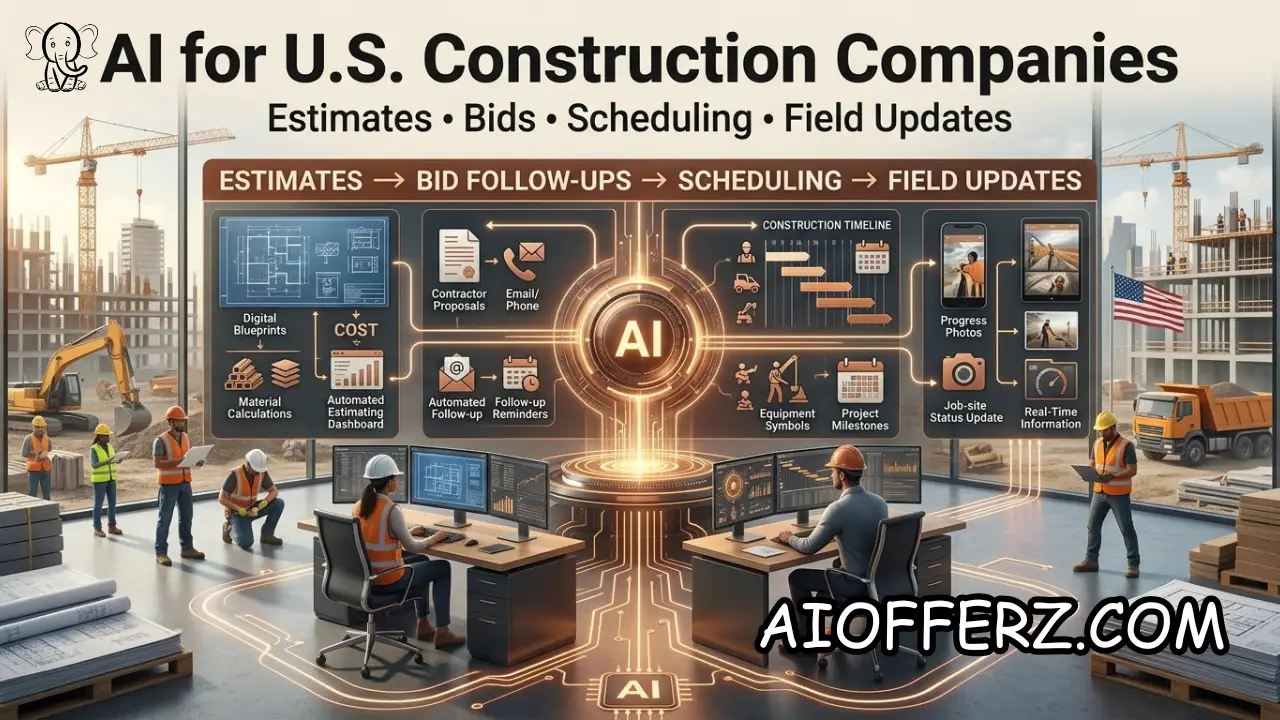
Why AI for U.S. Construction Companies Is Becoming a Practical Business Tool
Construction companies operate in an environment where small delays can quickly become expensive. Estimators are working against bid deadlines, project managers are coordinating multiple trades, superintendents are dealing with field conditions, and owners expect accurate updates.
At the same time, labor shortages, material costs, supply-chain uncertainty, and tight project schedules continue to put pressure on margins.
Deloitte’s 2026 engineering and construction outlook identifies persistent labor shortages, material-price pressure, supply-chain disruption, and schedule pressure as important challenges facing the industry.
This is where AI for U.S. construction companies can become useful. The most practical applications are not necessarily futuristic robots or completely autonomous jobsites.
They are software workflows that reduce repetitive administrative work around estimating, bidding, scheduling, documentation, communication, and field reporting.
Construction companies already have enormous amounts of information available in drawings, specifications, proposals, emails, schedules, RFIs, change orders, daily reports, photos, and project-management systems.
AI can help organize and extract useful information from that material faster than traditional manual processes.
The technology is still developing, however. RICS reported in its 2025 artificial intelligence in construction research that 45% of surveyed organizations reported no AI implementation and another 34% were still in early pilot phases.
That means construction AI is gaining attention much faster than it is becoming standardized across the industry.
For contractors, this creates an opportunity to start with narrow workflows where the financial benefit is easy to measure. An estimator does not need an AI system to make every project decision.
If AI can reduce the time spent reviewing drawings, organizing bid documents, or following up with subcontractors, that alone can create meaningful value.
The right approach is therefore augmentation rather than replacement. AI should handle repetitive information work while estimators, project managers, superintendents, and executives remain responsible for decisions that require construction experience, judgment, negotiation, and accountability.
Want To Use Other AI To Write…
How AI Can Automate Construction Estimates and Preconstruction Work
Estimating is one of the strongest starting points for construction AI because the process involves large amounts of structured and unstructured information.
Estimators may review drawings, specifications, quantities, historical costs, subcontractor pricing, material information, and project requirements before producing a proposal.
AI can help organize this information and identify relevant items. Instead of manually searching through hundreds of pages to locate specific requirements, an AI system can help surface potentially important sections for estimator review.
AI-assisted takeoff and estimating tools can also help identify quantities or classify elements in construction documents.
Current construction estimating software increasingly includes AI-powered capabilities alongside traditional takeoff and estimating functions.
The important word is “assist.” A contractor should not automatically accept an AI-generated quantity or cost. Drawings can contain ambiguities, revisions, exclusions, unusual conditions, and details that require professional interpretation.
Historical project data can also become more useful when AI is introduced. A company may have years of previous estimates, actual costs, change orders, and subcontractor information stored in different systems.
AI can help search and organize that historical information so estimators can use it as a reference.
AI can also help identify potential estimating omissions. If a project contains certain specifications or scope requirements that commonly create additional costs, an AI workflow could flag them for review.
The result is a faster preconstruction process without turning estimating into a fully automated activity.
The estimator remains responsible for confirming quantities, assumptions, exclusions, labor requirements, subcontractor pricing, and the final number submitted to the client.
How AI Can Improve Bid Management and Subcontractor Follow-Ups
Bid management becomes difficult when a contractor is handling many opportunities simultaneously. Invitations may arrive through email, bid platforms, customer portals, or other channels, and each project can have different deadlines, documents, trades, and requirements.
AI can help classify incoming bid opportunities. It can extract the project name, location, bid deadline, trade or scope, owner or general contractor, and other relevant information from documents and messages.
This creates a more organized bid pipeline. Instead of relying on individual employees to remember every deadline, the system can create structured tasks and reminders.
Bid follow-ups are another obvious opportunity. Subcontractors may receive requests but fail to respond before the deadline. AI can identify outstanding requests and prepare follow-up messages according to the contractor’s established process.
A bid-management system can also help contractors track which subcontractors have submitted pricing and which scopes remain uncovered. This is particularly valuable when bid volume increases and an estimator is managing multiple projects at once.
Current 2026 construction software guidance shows that bid-management platforms are increasingly focused on organizing opportunities, speeding solicitation, and improving bid workflows.
AI should not decide which subcontractor wins a scope simply because one price appears lower. Price is only one factor. Availability, qualifications, scope coverage, exclusions, schedule, past performance, insurance, and other requirements may matter.
The better use of AI is to make the information easier to see. The estimator or procurement team can then make the final decision using professional judgment.
Wanna Use CustomGPT AI…
How AI Can Automate Construction Scheduling and Project Coordination
Scheduling is another area where construction companies can benefit from AI because project schedules contain many dependencies. A delay in one activity can affect several other activities, trades, inspections, deliveries, and milestones.
AI can help analyze schedule information and identify potential conflicts or activities that deserve attention. It can also summarize schedule changes so project teams do not have to manually compare every version.
For example, if a material delivery moves by several days, AI could help identify which scheduled activities depend on that delivery. The project manager can then review the affected activities and determine the appropriate response.
AI can also assist with recurring coordination tasks. Meeting notes can be converted into action items, responsible parties can be identified, and deadlines can be tracked.
This is especially useful for project managers who spend significant time turning conversations into tasks. Instead of manually creating every reminder after a meeting, AI can prepare the task list for review.
Deloitte’s 2026 construction outlook identifies real-time schedule management, cost estimation, risk management, and decision support among the areas where AI could influence construction operations.
However, construction schedules are affected by real-world conditions that software may not fully understand.
Weather, site access, crew availability, inspection delays, design changes, material substitutions, and unexpected field conditions can alter the practical sequence of work.
AI should therefore provide warnings and analysis rather than blindly changing the project schedule. The superintendent and project manager should remain responsible for confirming what can actually happen in the field.
The biggest benefit is faster awareness. If AI helps a project team discover a developing scheduling problem earlier, the team has more time to respond before that problem becomes a larger cost or delay.

How AI Can Turn Field Updates, Photos and Daily Reports Into Useful Information
Field reporting is another construction workflow that can consume substantial administrative time. Superintendents and foremen may need to document labor, equipment, weather, progress, deliveries, issues, safety observations, and other daily activities.
AI can help transform field notes into structured daily reports. A supervisor can provide information through text, voice, photos, or other approved methods, and AI can organize the information into a consistent report format.
Photo analysis is another emerging application. Construction companies are increasingly exploring AI and computer vision for jobsite images, progress tracking, documentation, and quality-related workflows.
A field team could potentially use AI to compare current site photos with previous images and identify areas that appear to have changed.
This does not replace the superintendent’s inspection, but it can make large collections of photographs easier to review.
AI can also summarize field updates for project managers and executives. Instead of reading dozens of individual messages, a project manager could receive a structured summary of progress, open issues, requested decisions, and potential schedule concerns.
This becomes particularly valuable when a company operates multiple jobsites. Management can gain a faster overview without requiring every superintendent to spend large amounts of time writing lengthy reports.
Research into AI and construction work also shows that AI is increasingly being considered across construction workflows, while the practical impact on roles and workforce structures remains an evolving area of study.
The important limitation is that an AI-generated field report is not automatically proof that work was completed correctly. Photos can miss hidden conditions, computer vision can misinterpret images, and a written summary can omit context.
AI should therefore help document what the field team reports and identify items for attention. Physical inspection, safety decisions, quality control, and construction judgment should remain with qualified people.
Using Many AI’s For Many Work, Solution Is Here…
How AI Can Automate Construction Communication, Documents and Change-Order Workflows
Construction companies generate an enormous amount of communication. Emails, RFIs, submittals, meeting minutes, notices, change-order requests, schedules, daily reports, and other documents can become difficult to manage as a project grows.
AI can help summarize long email threads and documents. A project manager can use it to identify what was requested, what has already been answered, and which items remain unresolved.
Document search is another practical application. Instead of manually opening numerous files, an AI-powered system can help locate information across approved project documents.
AI can also prepare drafts of routine communications. For example, it may create a draft response to a subcontractor follow-up, meeting summary, scheduling reminder, or request for missing information.
Change-order workflows can also benefit from better information organization. AI can help connect relevant communications, documents, descriptions, and project events so the project team has a clearer record when reviewing a potential change.
However, contractors should be careful with automatically generated contractual language. Construction contracts can contain significant legal and financial consequences, and a poorly worded AI-generated message could create unnecessary risk.
The same principle applies to RFIs and formal notices. AI can help organize facts and prepare a draft, but an appropriate project professional should review the content before it is formally submitted.
The benefit is speed without surrendering responsibility. AI handles the repetitive organization and drafting while the project team controls what is actually communicated.
This can also improve consistency. When project information is stored in structured systems rather than scattered across personal inboxes and spreadsheets, companies have a better chance of maintaining an accessible project history.
How U.S. Construction Companies Can Use AI Without Creating New Risks
The first risk is accuracy. Construction decisions involve money, schedules, safety, contracts, and physical work. A confident AI answer can still be wrong, so employees need a clear process for checking important outputs.
The second risk is data security. Construction companies may store proprietary estimates, subcontractor pricing, customer information, contracts, building plans, and other commercially sensitive information.
Before connecting those systems to an AI vendor, the company should understand where the data goes and how it is handled.
Employees also need clear AI-use policies. Workers should know which AI tools are approved, what information can be entered, what information must remain confidential, and when human review is mandatory.
Construction companies should also consider intellectual-property and contractual issues. Project documents may belong to clients, architects, engineers, general contractors, or other parties.
A company should not assume that every document can be uploaded to any public AI service.
Safety is another area where automation should remain conservative. AI can help organize safety observations, identify potential patterns, or assist with documentation, but it should not replace qualified safety professionals or field judgment.
RICS recommends that construction organizations develop AI roadmaps, upskill employees, identify near-term use cases such as scheduling and cost estimating, and establish clear responsibilities and ethical expectations.
The best implementation starts with low-risk workflows. Estimating document organization, bid reminders, meeting summaries, scheduling notifications, and administrative reporting are generally easier starting points than autonomous project decisions.
Companies should also measure results. Useful metrics include estimating hours saved, bid response rate, number of missed deadlines, administrative hours reduced, change-order processing time, schedule issue detection, and field-report completion time.
AI should earn a larger role based on demonstrated value. If a workflow saves time without reducing accuracy or accountability, it can be expanded. If it creates more errors or requires excessive correction, the process needs to be redesigned.
To get relief from Joint Pain , you can go for this.
How to Build an AI Workflow for a U.S. Construction Company in 2026
The first step is not buying an AI platform. It is identifying where employees spend the most repetitive time.
A contractor might discover that estimators spend several hours each week reviewing bid documents, project managers spend significant time preparing meeting summaries, and superintendents spend too much time turning field notes into formal reports.
Those workflows should be ranked by frequency, time consumption, financial impact, and risk. High-volume, repetitive, low-risk workflows are usually the best starting points.
The next step is to connect AI to reliable information. If project data is incomplete, inconsistent, or stored across disconnected systems, AI will not magically fix the underlying problem. Better data creates better automation.
Companies should then run a controlled pilot. A contractor could begin with bid-document extraction and subcontractor follow-ups for a limited number of projects.
The team should compare performance before and after implementation. Did estimators spend less time searching documents? Did more subcontractors respond before deadlines? Were fewer bid opportunities missed?
The same approach can then be applied to scheduling, field reporting, meeting summaries, and project documentation.
The construction industry is clearly moving toward greater AI adoption, but current research shows that adoption remains uneven.
RICS found a large share of organizations still at the exploration or pilot stage, while Deloitte expects digital transformation and AI to become increasingly important to construction competitiveness.
That means companies do not need to automate everything immediately. A contractor that builds a few reliable AI workflows today may be better positioned than one that purchases a large collection of disconnected AI tools without a clear operating strategy.
The long-term goal is straightforward: let AI handle information-heavy repetitive work so construction professionals can spend more time estimating accurately, managing projects, solving field problems, communicating with clients, and building profitable projects.
AI will not eliminate the need for construction expertise. The companies that benefit most are likely to be those that combine AI’s speed at processing information with the practical judgment of experienced construction professionals.
You can go for this to get natural Glowing Skin.
FAQs
1. How can AI help U.S. construction companies?
AI can assist with estimating, document review, bid management, subcontractor follow-ups, scheduling, meeting summaries, field reports, project communication, and workflow tracking.
2. Can AI completely automate construction estimating?
AI can automate parts of estimating, including document analysis, takeoff assistance, data organization, and historical-cost research. Final estimates should still be reviewed by qualified estimators.
3. Can AI follow up with subcontractors about bids?
Yes. AI can identify outstanding bid requests, prepare follow-up messages, track responses, and alert estimators when pricing is still missing.
4. Can AI help construction companies manage schedules?
AI can analyze schedules, identify potential conflicts, summarize changes, and create reminders. Project managers and superintendents should remain responsible for actual schedule decisions.
5. Can AI analyze construction site photos?
AI-based computer vision can assist with image analysis, progress documentation, and identifying potentially relevant visual information. Human inspection remains important for safety, quality, and hidden conditions.
6. Will AI replace construction estimators?
AI is more likely to change the estimator’s workflow than eliminate the role. Estimators still need to understand scope, assumptions, constructability, pricing, exclusions, risk, and market conditions.
7. What is the best construction AI workflow to start with?
Good starting points include bid-document organization, estimate preparation assistance, bid follow-ups, meeting summaries, scheduling reminders, and daily-report automation because these tasks are repetitive and relatively measurable.
8. Is AI currently widely used by construction companies?
Adoption is growing but remains uneven. RICS reported that 45% of surveyed organizations had no AI implementation in its 2025 research, while 34% were still in early pilot phases.
9. What risks should construction companies consider before using AI?
Companies should consider inaccurate outputs, confidential-data exposure, intellectual-property issues, contractual risks, cybersecurity, employee misuse, and excessive reliance on automated recommendations.
10. How should a construction company measure AI ROI?
Track measurable outcomes such as estimating hours saved, bid response rates, missed bid deadlines, administrative hours reduced, scheduling issues identified, reporting time, and ultimately project profitability.
Ready to Begin?
➜ Click Here to explore top rated affiliate programs on ClickBank!
➜ Reach Our Free Offers: “Come Here To Earn Money By Your Mobile Easily in 2025.”
Want To Read More Then Click Here…
If You Are Interested In Health And Fitness Articles Then Click Here.
If You Are Interested In Indian Share Market Articles Then Click Here.
Thanks To Visit Our Website-We Will Wait For You Come Again Soon…