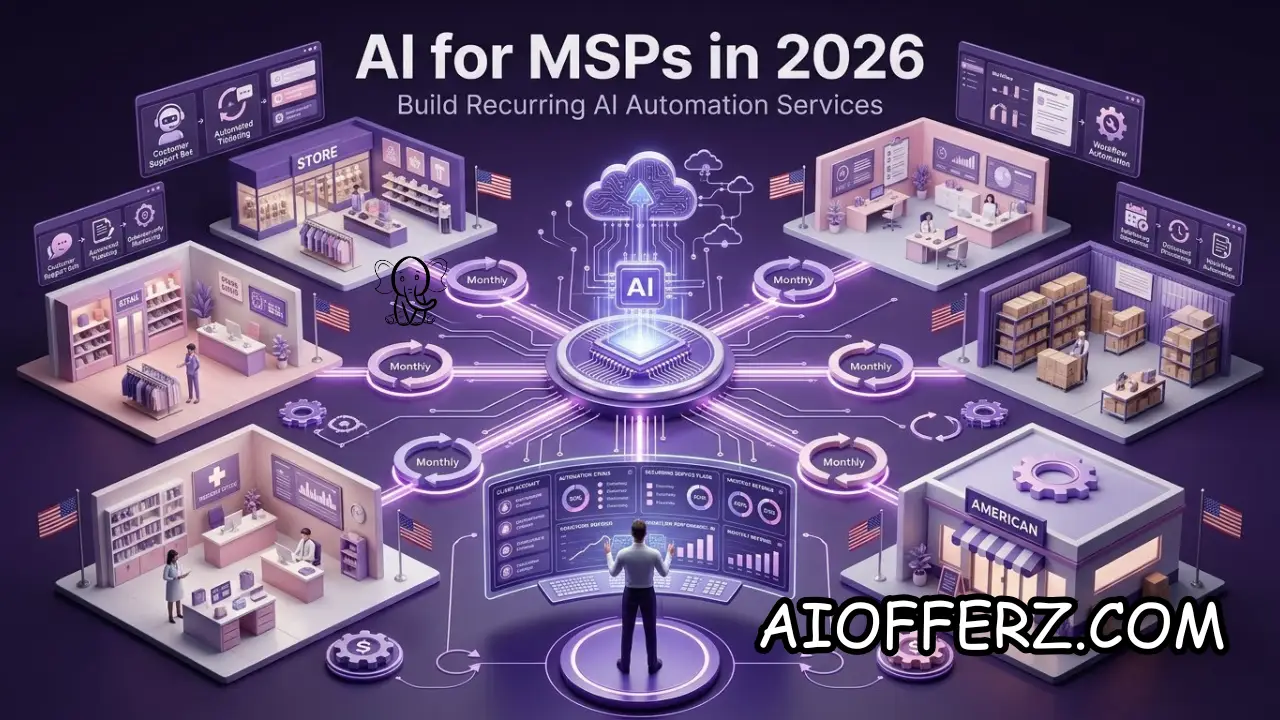
Why AI for MSPs Is Becoming a Recurring Revenue Opportunity in 2026
Managed service providers have spent years building recurring-revenue businesses around IT support, cybersecurity, cloud infrastructure, backup, monitoring, and help-desk services.
In 2026, artificial intelligence is creating another opportunity: managing the AI systems and automated workflows that small and midsize businesses increasingly want to deploy.
The opportunity is larger than simply reselling an AI chatbot or helping a customer purchase an AI subscription.
SMB clients increasingly need someone to identify useful automation opportunities, connect AI to existing systems, monitor performance, manage permissions, train employees, and make sure automated workflows continue working as business processes change.
That shift is already visible across the MSP market. Kaseya’s 2026 State of the MSP report found that 48% of MSPs identified AI and automation as the top client need for the year, ahead of security at 42% and backup at 36%.
The market is also moving beyond simple AI experimentation. MSP GLOBAL’s 2026 research found that MSPs increasingly use AI internally for operations and are also embedding AI inside existing services and offering client-facing AI-enabled services.
For an MSP, this creates two connected opportunities. First, AI can make the MSP’s own service delivery more efficient. Second, the MSP can package that expertise into recurring services for customers.
The second opportunity is particularly important. A one-time AI implementation project may generate revenue, but a managed AI service can create monthly recurring revenue.
The MSP can charge for monitoring, optimization, governance, workflow maintenance, reporting, and ongoing support.
The strongest positioning is therefore not “we sell AI.” It is “we manage business automation that produces measurable outcomes.”
That distinction matters because SMB owners generally care more about faster response times, fewer administrative hours, lower operating costs, better customer service, and increased revenue than about which AI model is being used.
Want To Use Other AI To Write…
Which AI Automation Services MSPs Can Sell to SMB Clients
The first service category is AI-powered customer communication. An MSP can help an SMB deploy AI assistants that answer routine customer questions, handle website inquiries, qualify leads, schedule appointments, or route conversations to employees.
For example, a dental practice might use an AI assistant to answer common scheduling questions. A law firm could use AI to collect basic information before a consultation.
A home-services company could qualify inbound leads before sending them to a salesperson.
The MSP does not necessarily need to build a new AI model. Its value can come from selecting the appropriate technology, integrating it with the client’s existing systems, configuring the workflow, establishing escalation rules, and monitoring performance.
A second service category is internal workflow automation. SMBs frequently spend employee time copying information between email, CRM systems, spreadsheets, accounting platforms, ticketing systems, and project-management applications.
AI can help classify incoming information, summarize documents, extract data, create tasks, draft communications, and route work. The MSP can turn these individual automations into a managed workflow service.
A third opportunity is AI-powered service desk automation. AI can categorize tickets, summarize previous incidents, suggest solutions, generate documentation, and route issues according to priority.
CloudRadial’s 2026 MSP research specifically tracks AI use cases across service-desk ticketing, service-desk automation, documentation, client management, sales and marketing, security, compliance, finance, and operations.
An MSP can package these capabilities into different service tiers. A basic plan might include AI-assisted ticketing and reporting.
A higher tier could include workflow automation, AI agents, integrations, monitoring, governance, and quarterly optimization.
The important point is that recurring revenue comes from managing the system after deployment. AI tools change quickly, integrations break, business processes change, and employees need ongoing support. That creates a natural role for the MSP.
How MSPs Can Turn AI Automation Into Monthly Recurring Revenue
The easiest way to monetize AI is often to separate implementation from ongoing management. The initial project can cover discovery, process mapping, configuration, integrations, testing, and deployment.
After implementation, the client can move onto a monthly managed AI plan. That recurring service could include monitoring, usage reviews, workflow adjustments, troubleshooting, reporting, security checks, and employee support.
This model is familiar to MSPs because it resembles how managed IT services already work. Clients do not simply buy a server and walk away. They pay for ongoing management, monitoring, maintenance, and expertise.
The same logic applies to AI workflows. An automated process may work perfectly when launched but become less effective when the client’s CRM changes, employees modify procedures, product pricing changes, or an AI vendor updates its platform.
MSPs can therefore sell AI lifecycle management rather than one-time AI installation.
One possible service structure could include an AI Essentials package for a small number of workflows, an AI Operations package covering multiple departments, and a higher-level AI Governance package covering larger automation environments.
Pricing should be based on value and service complexity rather than simply the number of AI prompts. An MSP managing several business-critical workflows has greater responsibility than an MSP providing access to a generic chatbot.
The provider can also charge separately for implementation projects, integrations, custom workflow development, and major process redesigns.
This produces a hybrid revenue model: project revenue creates the initial engagement while monthly management creates recurring revenue.
Recent MSP industry research supports this direction. Kaseya reports that AI is increasingly viewed as both a client demand and an operational lever for MSPs, while Channel Insider identifies AI-enabled services as a major growth opportunity for MSPs in 2026.
The MSP should avoid promising unlimited AI development under a small monthly fee. Clearly defining included workflows, support limits, usage allowances, integrations, monitoring, and response times protects margins.
Wanna Use CustomGPT AI…
How MSPs Can Build an AI Automation Assessment for Every SMB Client
Before selling automation, an MSP needs a repeatable assessment process. Without one, every AI project becomes a custom consulting engagement that consumes too much senior staff time.
The assessment should begin with business processes rather than AI tools. The MSP should ask where employees spend repetitive time, where information gets copied manually, where customer requests are delayed, and where important tasks are frequently forgotten.
Customer communication is usually a useful area to investigate. The MSP can examine inbound calls, emails, website forms, support tickets, appointment requests, and repetitive customer questions.
The next area is administrative work. Employees may spend hours preparing reports, entering information into multiple systems, processing documents, creating meeting summaries, or sending repetitive follow-ups.
Sales is another major opportunity. An MSP can examine how leads enter the business, how quickly they receive responses, how they are qualified, how proposals are prepared, and whether salespeople regularly forget to follow up.
Finance and operations can also reveal automation opportunities. Invoice processing, document extraction, recurring reporting, task routing, and approval workflows may all contain repetitive steps.
The MSP should then rank opportunities using several criteria: frequency, employee hours, financial impact, process consistency, technical complexity, data sensitivity, and potential risk.
This prevents the common mistake of choosing an impressive AI demonstration that has little practical value.
MSP GLOBAL’s research has found that providers are increasingly moving toward pragmatic AI deployment rather than treating AI as a standalone product.
Its winter 2025/26 report emphasized that the stronger story is the business outcome AI enables, rather than simply marketing an MSP as “AI-powered.”
That is an important sales lesson. An MSP should tell an HVAC company that AI can reduce missed leads and administrative work, not simply tell the owner that the MSP offers “agentic AI.”
Once the assessment becomes standardized, it can become part of every quarterly business review. The MSP can continuously identify new automation opportunities as the client’s business changes.
How MSPs Should Manage AI Security, Governance and Human Oversight
AI automation introduces risks that traditional managed IT services already understand from other technologies. Client data can be exposed, permissions can be misconfigured, automated actions can produce errors, and employees can use unapproved tools.
That means AI governance should become part of the MSP’s service offering rather than an afterthought.
The first requirement is an inventory of AI systems. The MSP should know which AI tools the client is using, which employees have access, what data each system can access, and which workflows can take automated actions.
Permissions should follow the principle of least privilege. An AI assistant that only needs access to appointment information should not automatically receive unrestricted access to financial records.
Human approval should also be required for high-impact actions. An AI workflow might draft a customer refund but require an employee to approve it. It might prepare an invoice but require accounting approval before submission.
The same principle applies to sensitive communications, financial transactions, employee decisions, legal documents, and other areas where an automated mistake could create significant consequences.
Data governance is equally important. MSPs should evaluate AI vendors’ security controls, data retention policies, access management, data-processing practices, and integration permissions before deploying them for clients.
KPMG’s 2026 managed-services research describes AI governance, integration, and operational expertise as increasingly important as businesses move AI from pilots toward production.
MSPs can turn this requirement into a recurring service. Monthly or quarterly AI governance reviews can check permissions, workflow changes, usage, security settings, failures, and new risks.
This also strengthens the MSP’s relationship with the client. Instead of being viewed only as the company that fixes computers, the MSP becomes a technology partner responsible for keeping the client’s growing AI environment controlled and operational.
Using Many AI’s For Many Work, Solution Is Here…
How MSPs Can Use AI Internally Before Selling AI Services
An MSP should use AI internally before aggressively selling AI automation to clients. Internal adoption allows the provider to learn where AI genuinely works and where human review remains necessary.
Service-desk operations are an obvious starting point. AI can summarize tickets, classify requests, suggest knowledge-base articles, prepare responses, and assist technicians with documentation.
Reporting is another strong use case. MSPs can use AI to summarize service metrics, identify recurring ticket categories, prepare QBR material, and highlight unusual changes in client environments.
Internal documentation can also be improved. AI can turn technician notes into structured documentation and help employees search existing procedures.
Sales and marketing provide another opportunity. AI can summarize prospect research, draft outreach, prepare meeting summaries, and identify follow-up tasks.
MSP GLOBAL reported in its Spring 2026 research that 55% of surveyed MSPs were using AI internally for operational activities such as ticket routing and reporting.
While 39% were embedding AI inside existing services and 36% were offering client-facing AI-enabled services.
This internal-first approach provides an important advantage. The MSP can calculate its own time savings before promising similar results to customers.
It also creates reusable processes. If an MSP develops an effective AI-assisted ticket workflow internally, it may be able to adapt the methodology for multiple clients.
That is how an MSP can move from custom consulting toward a repeatable managed service.
The provider should document what worked, what failed, what requires human review, how much maintenance is needed, and what metrics demonstrate value.
Over time, those lessons become intellectual capital. The MSP is no longer simply reselling another vendor’s AI feature. It is selling its own methodology for implementing and managing AI-enabled business processes.
How MSPs Can Package and Sell AI Automation Without Confusing SMB Buyers
SMB owners do not necessarily want a complicated explanation of models, agents, APIs, vector databases, or orchestration. They want to know what the service will accomplish for their business.
An MSP should therefore package AI around outcomes. Instead of selling “AI agent infrastructure,” it could offer “24/7 lead response automation,” “AI-powered service desk,” “automated customer follow-up,” or “managed document processing.”
Each service should have a defined scope. The client should know what workflows are included, which systems are connected, what the AI is allowed to do, what requires human approval, and how success will be measured.
The sales conversation should also establish the baseline. If a client receives 300 support tickets each month, the MSP can measure how many are suitable for AI-assisted handling and whether response time improves after implementation.
The same approach works for sales. If a business receives 500 website leads per month but salespeople manually qualify every lead, the MSP can identify how much of that work can safely be automated.
Recurring reporting should become part of the service. The MSP can provide monthly metrics showing workflow volume, automation rate, escalation rate, exceptions, time savings, and other agreed performance indicators.
This helps justify the recurring fee. The client can see that the MSP is actively managing an operational system rather than simply charging for access to software.
KPMG’s 2026 U.S. research found that 93% of surveyed U.S. companies viewed managed services as important for agentic AI delivery and that AI capability ranked as the most important consideration when selecting managed-services providers.
That creates a significant positioning opportunity for MSPs. AI capability can become part of the broader managed-services relationship instead of a separate technology experiment.
MSPs should also avoid guaranteeing unrealistic outcomes. AI performance depends on data quality, workflow design, employee adoption, integrations, and business processes.
The strongest promise is controlled improvement: identify a measurable problem, automate the appropriate portion, monitor the result, and continuously optimize the workflow.
To get relief from Joint Pain , you can go for this.
How MSPs Can Build a Scalable AI Service Business in 2026
The long-term opportunity is to create repeatable AI services that can be deployed across multiple SMB clients without rebuilding everything from scratch.
The first step is standardization. An MSP should develop templates for discovery, workflow mapping, security review, implementation, testing, documentation, employee training, and ongoing monitoring.
The second step is choosing a manageable technology stack. Using too many disconnected AI platforms can increase costs and operational complexity.
The MSP should favor tools with reliable integrations, appropriate security controls, strong administration, and predictable pricing.
The third step is creating reusable workflows. A lead-qualification workflow for one home-services company may be adapted for another. A ticket-triage framework may work across several professional-services clients.
The fourth step is building monitoring into the service from the beginning. AI automation should not be deployed and forgotten.
The MSP needs visibility into errors, failed integrations, unusual activity, usage, escalations, and business outcomes.
ScalePad’s 2026 MSP research shows that more mature MSPs are increasingly using AI for data, security, operational automation, communications, and client-facing services, while documented AI strategies are associated with more effective adoption.
The fifth step is developing a clear recurring-revenue model. The MSP can charge for management, monitoring, optimization, governance, support, and agreed usage.
The sixth step is training the MSP’s own team. Technicians do not necessarily need to become AI researchers, but they should understand automation design, integrations, security, prompt and workflow evaluation, AI limitations, and escalation procedures.
The final step is measuring client outcomes. If the MSP can consistently demonstrate fewer manual hours, faster response times, better ticket resolution, more qualified leads, or improved reporting, AI becomes a defensible service rather than a marketing buzzword.
In 2026, the opportunity for MSPs is moving beyond “install and maintain technology.” Clients increasingly need partners who can integrate AI into everyday business processes and keep those systems useful after deployment.
The MSP that learns how to deliver that service repeatedly can create a new recurring revenue layer without abandoning the managed-services model that already works.
AI is not replacing the MSP. It is expanding what the MSP can manage.
FAQs
1. What is AI for MSPs?
AI for MSPs means using artificial intelligence to improve the MSP’s internal operations and provide managed AI-powered automation, support, analytics, security, and workflow services to clients.
2. Can MSPs make money from AI automation?
Yes. MSPs can generate project revenue from implementation and recurring revenue from ongoing monitoring, management, optimization, governance, support, and workflow maintenance.
3. What AI services should MSPs offer SMB clients?
Strong opportunities include AI customer-service assistants, lead qualification, service-desk automation, document processing, reporting, workflow automation, employee knowledge assistants, and AI governance.
4. Should MSPs build their own AI models?
Usually, no. Most MSPs can create more value by integrating existing AI models and business applications into reliable workflows rather than developing foundational models themselves.
5. How can an MSP charge for AI services?
An MSP can combine implementation fees with monthly recurring charges based on the number of workflows, users, integrations, usage, monitoring requirements, support level, and business importance.
6. Is AI becoming a major client demand for MSPs?
Yes. Kaseya’s 2026 MSP research found that 48% of MSPs identified AI and automation as their top client need for 2026.
7. What should an MSP automate first?
MSPs should start with repetitive, measurable workflows such as ticket classification, reporting, documentation, customer communications, lead qualification, and internal knowledge search.
8. What are the biggest AI risks for MSPs?
Important risks include incorrect AI outputs, excessive permissions, data exposure, poor integration, inadequate human oversight, unclear vendor policies, and automating high-impact decisions without appropriate controls.
9. Should MSPs use AI internally before selling AI services?
Yes. Internal deployment gives MSPs practical experience, helps identify limitations, provides measurable ROI examples, and creates reusable processes that can later be adapted for clients.
10. What is the biggest mistake MSPs make with AI?
The biggest mistake is selling AI as a technology instead of selling a measurable business outcome. Clients are more interested in faster service, lower costs, better productivity, and improved operations than in the underlying AI terminology.
Ready to Begin?
➜ Click Here to explore top rated affiliate programs on ClickBank!
➜ Reach Our Free Offers: “Come Here To Earn Money By Your Mobile Easily in 2025.”
Want To Read More Then Click Here…
If You Are Interested In Health And Fitness Articles Then Click Here.
If You Are Interested In Indian Share Market Articles Then Click Here.
Thanks To Visit Our Website-We Will Wait For You Come Again Soon…