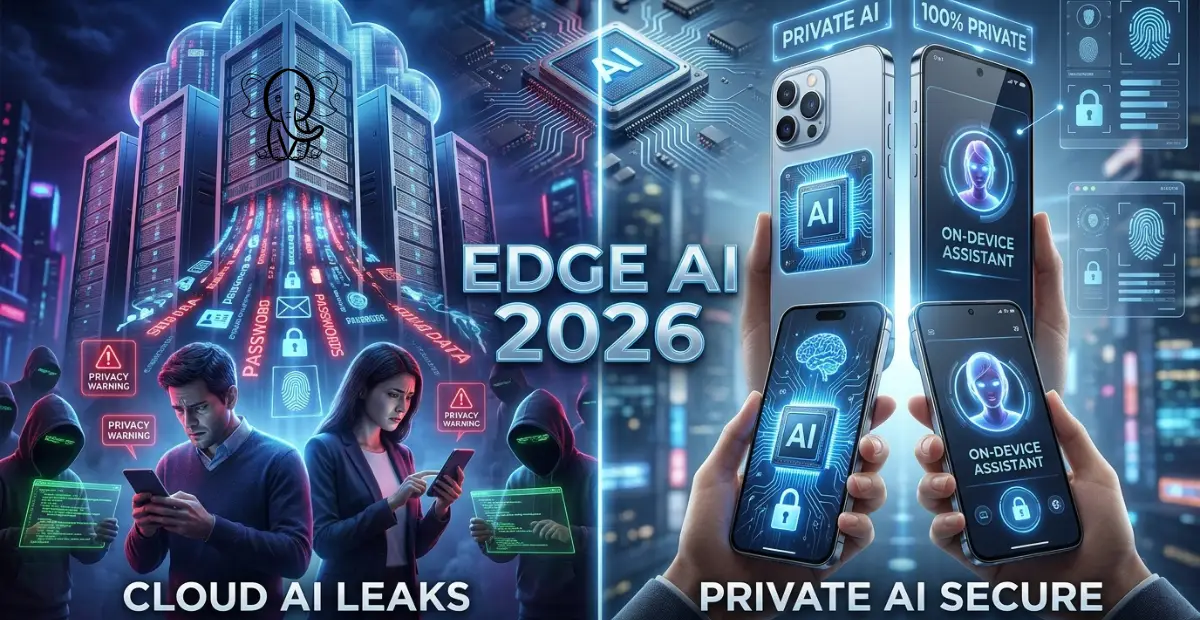
For the last two years, we’ve been living in the “Cloud Era” of AI. Every time you asked a question or generated an image, your data traveled to a massive server farm, got processed and came back. But in 2026, the “Return to Sender” movement has begun.
US users are tired of their personal conversations, photos and health data sitting on a server owned by a tech giant. The solution? On Device AI.
Whether you’re on the new iPhone 17 Pro or a Pixel 10, the smartest features on your phone are now happening locally. Here is why “Private First” Edge Intelligence is the biggest trend in the USA right now.
1. The Death of “Latency Anxiety”
Have you ever tried to use a voice assistant in a parking garage or on a plane with bad Wi-Fi? It’s frustrating.
-
The Shift: In 2026, Edge AI doesn’t need the internet. Since the “brain” (the Neural Processing Unit or NPU) is inside your phone, things like real time translation, voice commands and photo editing happen instantly.
-
The “I/Me” Take: I’ve been using on device dictation for my emails lately. There is zero lag. It feels like the phone is thinking with me not waiting for a server in Virginia to tell it what I said.
2. Privacy is the New Luxury
In the USA, privacy has become a status symbol. If your AI is “On Device,” your data never leaves your pocket.
-
-
How it works: Apple Intelligence and Google’s Gemini Nano process your most sensitive info like your messages, calendar and health stats locally.
-
Why it matters: If a hacker breaches a big tech company’s cloud in 2026, they don’t get your data, because your data was never there. This “Zero-Cloud” approach is why professionals in Law and Finance are switching to the latest AI ready handsets.
-
3. Battery Life (The NPU Revolution)
You might think running AI on your phone would kill the battery. In 2024, you’d be right. But the A19 and Tensor G5 chips of 2026 are built differently.
-
The Tech: These chips have dedicated “AI Engines” that are 50% more efficient than last year.
-
The Benefit: Running an AI task on the NPU uses a fraction of the power required to send data over a 5G/6G network and wait for a response. Your phone stays cooler and your battery lasts longer.
4. The “Personal Context” Breakthrough
Cloud AI is smart, but it doesn’t know you. On Device AI has “Local Context.“
-
The Workflow: Because the AI lives on your phone, it can safely “read” your lifestyle patterns without spying on you. It knows your daughter’s soccer schedule, your favorite coffee order and how you like to sign your emails.
-
The Result: When you ask, “When is my next trip?“, the AI finds the flight in your emails, the hotel in your calendar and the weather at the destination all without sending a single byte of that info to the cloud.
iPhone vs. Android
| Feature | Apple (iOS 19/20) | Android (v16/17) |
| Primary Model | Apple Intelligence (Local-First) | Gemini Nano (Hybrid-Edge) |
| Privacy Hook | Private Cloud Compute (PCC) | Privacy Sandbox & Trusted Execution |
| Best For | “Set it and forget it” privacy. | Flexibility and raw AI power. |
FAQs
1. Does “On-Device” mean the AI is less powerful?
It used to! But in 2026, mobile chips are so fast they can run “Small Language Models” (SLMs) that are just as smart as the big ones for daily tasks.
For massive tasks (like writing a novel), your phone might still use a “Private Cloud,” but for 90% of what you do, the on device model is plenty.
2. Is my phone constantly “listening” to me?
Technically, yes but only for “Wake Words” (like “Siri” or “Hey Google“). Because this happens on-device, the audio is never recorded or sent anywhere.
It’s like a dog waiting for its name; it’s listening for the sound but it’s not taking notes on your conversation.
3. Can I use On-Device AI if I have an older phone?
Unfortunately, no. These features require the new NPU hardware found in 2025 and 2026 models. If you’re using an iPhone 14 or an older Galaxy, your AI is still mostly cloud based.
4. How do I know if an app is using On-Device AI?
In 2026, both Apple and Google have introduced “Privacy Nutrition Labels” for AI. Look for a small “Shield” icon in the App Store this tells you the app processes your data locally and doesn’t share it with the developer.
5. What is “Edge Intelligence” exactly?
“Edge” just means the “edge” of the network the device in your hand. Instead of a “Central” brain (the Cloud), the intelligence is “Distributed” to the edge.
It’s the difference between calling a library for an answer (Cloud) and having the book in your hand (Edge).
6. What is On-Device AI and how does it differ from traditional Cloud AI?
Traditional Cloud AI sends your data (questions, photos or audio) to a remote server farm to be processed before returning the result to your phone.
On-Device AI (Edge Intelligence) processes everything locally using your phone’s internal hardware. Your personal data never leaves your device, making the process faster and vastly more private.
7. How does On-Device AI eliminate “Latency Anxiety”?
Because the “brain” or Neural Processing Unit (NPU) is built directly into your phone (like the A19 or Tensor G5 chips), tasks like real time translation, voice commands and photo editing happen instantly.
There is zero lag, and the AI works seamlessly even in areas with no internet connection, like airplanes or underground parking garages.
8. Why are professionals in Law and Finance switching to “Zero-Cloud” devices?
Privacy has become a major priority for high security industries. With a “Zero-Cloud” approach, sensitive information like confidential client messages, financial calendars and personal health stats is processed entirely on the phone.
If a tech giant suffers a cloud data breach, the user’s data remains perfectly safe because it was never sent to the cloud in the first place.
9. Doesn’t running AI locally on a phone completely drain the battery?
While that may have been true in the past, modern 2026 smartphone chips (like Apple’s A19 and Google’s Tensor G5) feature dedicated AI Engines that are 50% more efficient than older models.
Running an AI task directly on the local NPU actually uses a fraction of the power required to constantly transmit data back and forth over a 5G or 6G network.
10. What is the “Personal Context” breakthrough?
Cloud AI might be smart but it doesn’t know your personal routine. Because On-Device AI safely has access to your local data, it can securely understand your lifestyle patterns without spying on you.
It can connect the dots across your emails, calendar and preferences allowing you to ask complex personal questions (like tracking an upcoming trip) without sending a single byte of private data to an external server.
Ready to Begin?
➜ Click Here to explore top rated affiliate programs on ClickBank!
➜ Reach Our Free Offers: “Come Here To Earn Money By Your Mobile Easily in 2026.”
Want To Read More Then Click Here…
If You Are Interested In Health And Fitness Articles Then Click Here.
If You Are Interested In Indian Share Market Articles Then Click Here.
Thanks To Visit Our Website-We Will Wait For You Come Again Soon…