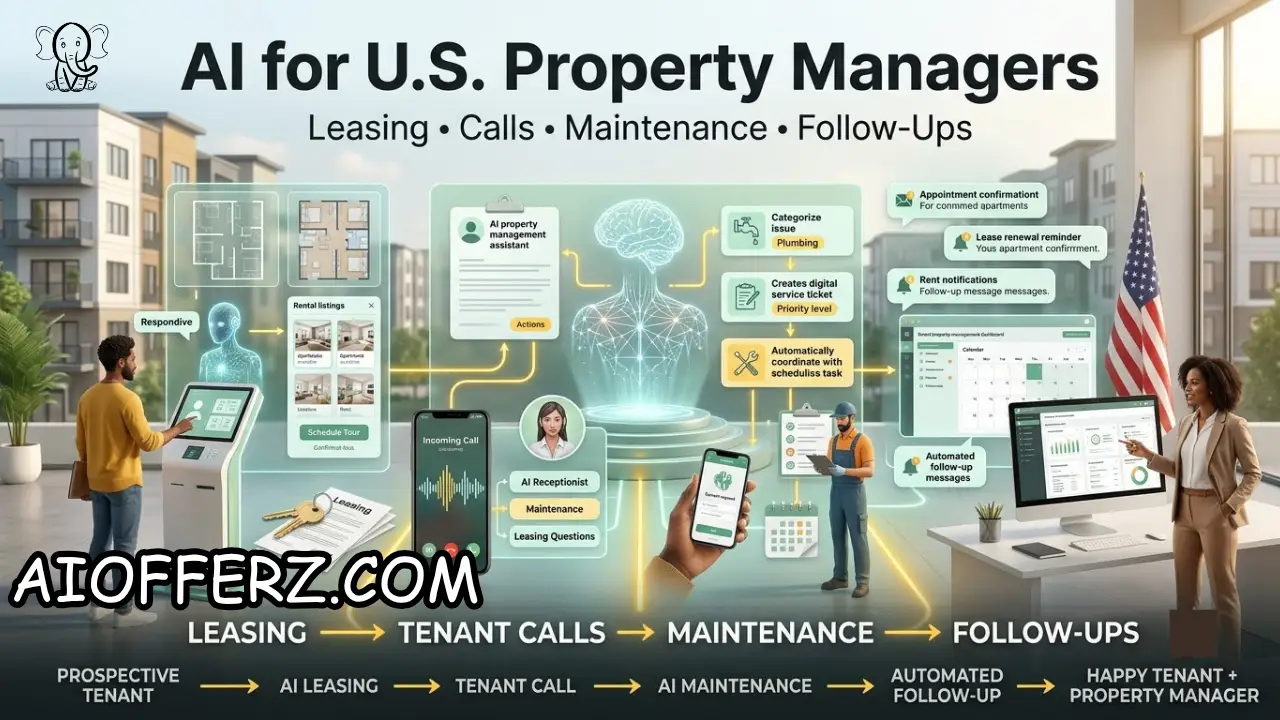
How AI Is Changing Property Management for U.S. Operators in 2026
AI is becoming a practical operating tool for U.S. property managers rather than simply another technology trend.
Property management involves a large number of repetitive interactions, including leasing inquiries, resident questions, maintenance requests, appointment scheduling, reminders, follow-ups, and internal documentation.
These activities consume employee time even when the underlying task is relatively simple.
The 2026 property-management industry research from Buildium reports that AI adoption increased from 20% in 2024 to 58% in 2025 among the companies surveyed, although only 8% reported fully automating any processes.
That difference is important because using AI to draft an email is very different from connecting AI to a workflow that actually completes a task.
For property managers, the strongest opportunity is therefore not replacing the leasing team, maintenance coordinator, or property manager. It is removing repetitive work surrounding those employees.
AI can answer routine questions, collect information, summarize conversations, classify requests, schedule appointments, and prepare follow-ups while employees remain responsible for decisions requiring experience and judgment.
This matters particularly for residential property managers because residents and prospects do not communicate only during office hours.
A prospective renter may inquire about an apartment late at night, while a resident may report a plumbing problem early in the morning. Waiting until the next business day can create a poor experience or cause a leasing opportunity to disappear.
AI can provide an immediate first response and then transfer the matter to a human when necessary. Modern property-management platforms are increasingly incorporating AI into leasing, maintenance, accounting, payments, and resident operations rather than treating AI as a separate chatbot.
The practical goal for 2026 is simple: let technology handle predictable work and let property professionals handle situations where context, empathy, negotiation, legal knowledge, or human judgment matters.
That approach can improve efficiency without turning property management into a completely automated business.
Want To Use Other AI To Write…
AI Can Automate Leasing Inquiries and Tour Scheduling
Leasing is one of the clearest opportunities for AI automation because prospects frequently ask the same basic questions.
They want to know whether a property is available, how much rent costs, what amenities are included, whether pets are allowed, when a unit is available, and how to schedule a tour.
An AI leasing assistant can respond to these routine questions using approved property information. Instead of allowing every inquiry to sit in an inbox until a leasing employee becomes available, the system can provide an immediate response and collect basic information from the prospect.
AI can also help schedule tours. After a prospect expresses interest, an automated workflow can offer available appointment times, confirm the selected time, send reminders, and record the appointment.
If the prospect does not attend, the system can initiate an approved follow-up rather than leaving the lead inactive.
This can be especially valuable for property managers handling multiple buildings or a large number of inquiries.
Industry research published in 2026 identifies leasing intake, lead response, tour booking, and after-hours coverage among the most common multifamily AI deployments.
However, property managers should be careful about what an AI leasing system is allowed to say.
It should use accurate, approved information and avoid making promises about availability, concessions, applications, or lease terms that have not been confirmed.
The best workflow is therefore not “AI replaces the leasing agent.” It is “AI keeps the leasing pipeline moving until a human needs to become involved.”
The leasing professional can then spend more time on tours, conversations, objections, negotiations, and closing rather than repeatedly answering the same basic questions.
AI Can Handle Tenant Calls and Routine Resident Communication
Tenant calls and messages can consume a significant amount of time because residents often contact property managers about routine matters.
Questions about rent payment methods, office hours, package procedures, parking, amenities, maintenance status, lease dates, and general policies may not require a property manager to personally answer every time.
AI-powered voice and messaging systems can provide a first line of communication. A resident can call or send a message, explain the issue, and receive information based on the property’s approved knowledge base.
The system can also collect details before transferring the conversation to a team member.
This is particularly useful outside normal business hours. A property manager does not necessarily need an employee answering every routine question at 10 p.m., but residents still want acknowledgement and clear information.
An AI system can provide that first response while escalating situations that require immediate attention.
The quality of the underlying information is critical. If the property’s policies are outdated or incomplete, AI can deliver incorrect answers quickly.
Property managers should therefore maintain a controlled knowledge base containing current policies, property details, contact information, procedures, and escalation rules.
AI should also recognize situations where a human is required. Complaints, disputes, potential safety issues, sensitive personal circumstances, complicated lease questions, and situations involving legal rights should not be handled casually by an automated system.
The objective is faster service rather than less human service. A resident should be able to reach a person when the situation genuinely requires one.
AI simply handles the predictable communication around those interactions so employees can focus on matters that deserve their attention.
Wanna Use CustomGPT AI…
AI Can Automate Maintenance Requests and Follow-Ups
Maintenance is one of the most promising areas for AI because requests arrive continuously and often contain incomplete information.
A resident may write, “The AC stopped working,” or “There is water under the sink,” without providing the information a maintenance coordinator needs.
An AI maintenance workflow can ask structured follow-up questions, collect photographs when appropriate, identify the general category of the problem, and create a work order.
This gives the maintenance team more useful information before someone begins working on the request.
AI can also prioritize requests according to predefined rules. A potential emergency should receive different treatment from a minor cosmetic issue.
The important point is that the AI should operate according to clearly established procedures rather than inventing its own definition of an emergency.
Once a work order exists, AI can assist with communication. It can notify the resident that the request has been received, provide approved updates, remind vendors or employees about outstanding tasks, and inform the resident when an appointment has been scheduled.
Preventive maintenance can also benefit from automation. Buildium’s 2026 research reports that 56% of owners surveyed said maintenance support was the main reason they hired a property manager, highlighting how central maintenance is to the value property managers provide.
The biggest advantage is not simply faster ticket creation. It is reducing the number of requests that become forgotten or require repeated manual follow-up.
A properly designed workflow keeps the request moving from intake to assignment, appointment, completion, resident communication, and closure.
AI Can Improve Follow-Ups, Renewals and Resident Retention
Follow-up is one of the easiest tasks for humans to postpone because it rarely feels urgent until something goes wrong.
A property manager may intend to call a prospect, remind a resident, contact a vendor, or follow up after a maintenance visit, but dozens of other tasks can interrupt the day.
AI can create reminders and trigger follow-up communications based on defined events. A leasing prospect who has not responded can receive an approved message.
A resident approaching renewal can enter a renewal communication sequence. A maintenance request waiting for vendor confirmation can trigger an internal reminder.
The technology can also summarize previous conversations before an employee makes contact. Instead of reading a long email chain, the property manager can receive a concise summary of what was discussed and what remains unresolved.
Renewal communication is particularly important because resident retention can affect vacancy, turnover costs, and operating efficiency.
AI can help ensure that renewal-related tasks are not forgotten, while the actual conversation about lease terms remains under the property’s established process.
AI can also help identify stalled processes. For example, if a prospect has asked several questions but never scheduled a tour, the system can flag the lead for human attention. If a maintenance ticket has remained open unusually long, it can be escalated.
The principle is simple: AI should remember what busy teams sometimes forget. It can provide consistency without requiring employees to manually maintain dozens of reminders and spreadsheets.
This creates a better division of labor. The system remembers deadlines, prepares messages, and tracks workflow status.
The property manager handles the conversations where a personal relationship or professional judgment can influence the outcome.
Using Many AI’s For Many Work, Solution Is Here…
AI Should Not Automatically Make High-Risk Housing Decisions
AI automation becomes more sensitive when it moves from administrative work into decisions affecting housing opportunities.
Tenant screening, applicant qualification, adverse decisions, pricing, and other consequential activities require much more caution than drafting a routine email.
Tenant screening is especially important because consumer reporting laws apply to tenant screening services and users of consumer reports.
The Federal Trade Commission explains that the Fair Credit Reporting Act places requirements on consumer reporting agencies and users of consumer reports, including obligations connected with adverse actions.
Property managers should therefore avoid treating an AI-generated recommendation as an independent legal or eligibility decision.
If AI is used around screening, the workflow should be designed around established criteria, documented procedures, appropriate data handling, and required human oversight.
Fair housing is another major consideration. Property managers should not allow AI systems to create or apply hidden preferences involving protected characteristics or proxies for protected characteristics.
A system that appears efficient can create significant problems if its underlying rules or data produce discriminatory outcomes.
The National Association of Residential Property Managers’ 2026 guidance makes a similar practical point: early AI projects should focus on low-risk repetitive tasks rather than jumping immediately into tenant screening, denial letters, or activities touching fair housing.
Property managers should also document what their AI systems are permitted to do. A system might be allowed to collect information, summarize documents, draft communications, or create tasks while requiring human approval before making a consequential decision.
This distinction should remain central to any AI strategy. Automating administrative work is very different from delegating responsibility for housing decisions to an algorithm.
The first can create efficiency; the second requires much greater legal, operational, and ethical scrutiny.
How U.S. Property Managers Can Start AI Automation Without Creating Chaos
The easiest way to introduce AI is to choose one repetitive workflow rather than trying to automate an entire property-management operation at once.
A good first project usually happens frequently, follows predictable rules, has a clear beginning and end, and has relatively low consequences if an AI-generated draft needs correction.
Tenant communication, maintenance updates, meeting summaries, leasing inquiry responses, and follow-up reminders are practical starting points.
These workflows can create measurable time savings without immediately putting AI in charge of sensitive decisions.
Property managers should document the existing workflow before automating it. If a process is already confusing, AI may simply make the confusion happen faster.
Teams should identify who receives the request, what information is required, what happens next, when a human becomes involved, and how the task is considered complete.
Integration is another important issue. AI should ideally work with the systems the property manager already uses rather than creating another disconnected database.
Current 2026 industry analysis points to integration challenges and fragmented technology stacks as significant barriers to deeper AI adoption.
Property managers should also test AI outputs before giving a system broad authority. A pilot can reveal inaccurate property information, inappropriate responses, missed escalations, or integration problems.
Human review should remain available, especially during the early stages.
Security and privacy must be considered before connecting AI to tenant records. Property-management systems can contain names, addresses, financial information, lease documents, communication histories, and other sensitive data.
Managers should understand how a vendor handles data, what permissions are required, how information is retained, and who can access it.
Finally, measure the results. Track response time, lead response rates, tour bookings, maintenance completion times, unresolved requests, employee hours saved, and resident satisfaction.
AI should be judged by business outcomes rather than by how sophisticated the technology sounds.
The strongest property-management AI strategy in 2026 is not maximum automation. It is selective automation.
Property managers should automate repetitive work where the rules are clear and keep people involved where context, fairness, empathy, legal requirements, and professional judgment matter.
To get relief from Joint Pain , you can go for this.
The Future of AI for U.S. Property Managers Is Human-Led Automation
AI is becoming an important part of property management, but the most useful implementations are not necessarily the ones with the most impressive technology. The strongest systems are the ones that solve specific operational problems.
Leasing teams can use AI to respond quickly to inquiries, qualify basic information, schedule tours, and follow up with prospects.
This helps reduce delays without eliminating the human conversation that often turns an interested prospect into a resident.
Maintenance teams can use AI to collect information, classify requests, create work orders, communicate status updates, and remind people about outstanding tasks.
This can make the maintenance process more organized while leaving complex repair decisions to qualified people.
Property managers can use AI for routine tenant communication, renewal reminders, internal summaries, vendor follow-ups, and other administrative work.
These applications can create time for higher-value activities such as owner communication, property inspections, resident relationships, and business development.
At the same time, property managers should be cautious about applying AI to housing decisions. Screening, adverse actions, fair-housing-sensitive activities, and other consequential decisions deserve stronger controls and appropriate professional oversight.
The FTC’s FCRA guidance and current industry guidance both reinforce why these areas require more care.
The bigger change is that AI is moving from isolated chatbots toward connected workflows.
In 2026, major property-management technology providers are embedding AI across leasing, maintenance, accounting, payments, and resident operations.
For U.S. property managers, that means the competitive advantage may not come from simply having an AI chatbot.
It may come from building a property-management operation where routine work moves automatically from one step to the next while employees remain in control of important decisions.
AI should handle the repetitive work. Property managers should handle the relationships, judgment, and responsibility.
That combination can make property management faster and more responsive without removing the human service that residents and owners still value.
You can go for this to get natural Glowing Skin.
FAQs
1. How is AI used by U.S. property managers in 2026?
AI is being used for leasing inquiries, tour scheduling, tenant communication, maintenance intake, work-order coordination, follow-ups, document processing, reporting, and other repetitive operational tasks.
2. Can AI answer tenant phone calls?
Yes. AI voice systems can answer routine calls, collect information, provide approved property information, create tasks, and transfer conversations to employees when human assistance is necessary.
3. Can AI handle maintenance requests?
AI can collect maintenance details, ask follow-up questions, categorize requests, create work orders, send updates, and escalate potentially urgent situations according to predefined rules.
4. Can AI replace a property manager?
AI can automate parts of a property manager’s workload, but it does not eliminate the need for human judgment, resident relationships, owner communication, inspections, negotiations, and handling complex situations.
5. Is AI safe for tenant screening?
Tenant screening requires particular caution because consumer reporting and housing-related requirements may apply. Property managers should use compliant processes and avoid allowing AI to make uncontrolled housing decisions.
6. Can AI schedule property tours automatically?
Yes. AI can respond to inquiries, provide approved availability information, schedule appointments, send reminders, and follow up after missed appointments.
7. How can AI improve property management follow-ups?
AI can monitor workflow events, create reminders, prepare messages, follow up with prospects or residents, and escalate tasks that remain unresolved.
8. What is the easiest AI task for a property manager to automate?
Routine communication, meeting summaries, maintenance updates, leasing inquiry responses, and follow-up reminders are generally easier starting points than high-risk housing decisions.
9. Does AI reduce property management staff requirements?
It can reduce the amount of repetitive administrative work employees perform. The more useful goal is often allowing existing staff to handle more properties and spend more time on higher-value work.
10. What should property managers consider before adopting AI?
They should evaluate data security, system integration, accuracy, human oversight, fair-housing considerations, applicable regulations, vendor contracts, escalation procedures, and measurable business outcomes.
Ready to Begin?
➜ Click Here to explore top rated affiliate programs on ClickBank!
➜ Reach Our Free Offers: “Come Here To Earn Money By Your Mobile Easily in 2026.”
Want To Read More Then Click Here…
If You Are Interested In Health And Fitness Articles Then Click Here.
If You Are Interested In Indian Share Market Articles Then Click Here.
Thanks To Visit Our Website-We Will Wait For You Come Again Soon…