Why Missed Calls Are a Bigger Problem for U.S. Auto Repair Shops Than They Appear
For an auto repair shop, a ringing phone is often a potential repair order. The problem is that the person most capable of answering it may already be helping a customer, diagnosing a vehicle, writing an estimate, ordering parts, or working on a car.
When nobody answers, the caller may simply move on to another shop.
This is why AI for auto repair shops is becoming a practical business tool in 2026. The goal is not to replace service advisors or shop owners. It is to make sure potential customers do not disappear simply because the team was temporarily unavailable.
Industry vendors and automotive technology providers are reporting growing interest in AI receptionists that answer calls, collect vehicle and service information, schedule appointments, and follow up with missed callers.
While individual vendors report different missed-call rates, the underlying operational problem is consistent: busy service teams cannot answer every call manually.
A missed call is particularly important when the caller is ready to schedule. Someone searching for brake repair, an oil change, tire service, a check-engine-light diagnosis, or another urgent repair may contact several shops.
If one business answers immediately while another sends the caller to voicemail, the responsive shop has an obvious opportunity advantage.
Google also recognizes the importance of phone interactions for local businesses. Google Business Profile performance reporting includes calls, website clicks, messages, bookings, and other customer interactions, giving businesses ways to understand how customers engage with their listings.
The opportunity for AI is therefore straightforward. Instead of allowing a missed call to end the customer journey, an AI-powered system can answer the call when appropriate, capture the customer’s request, determine what type of appointment is needed, and move the caller toward a confirmed booking.
Want To Use Other AI To Write…
How an AI Receptionist Can Answer Calls When Your Team Is Busy
An AI receptionist is essentially a digital front desk that can handle predefined customer conversations over the phone.
For an auto repair shop, it can be configured around the services the shop actually provides, its operating hours, appointment rules, locations, and escalation procedures.
When a customer calls, the AI can greet the caller using the shop’s name and ask what they need.
The conversation might involve a routine service appointment, a repair concern, an estimate request, a question about hours, or a request to speak with someone at the shop.
The AI can then collect useful information such as the customer’s name, phone number, vehicle year, make, model, requested service, preferred appointment time, and whether the vehicle is currently drivable.
This information can be passed to the shop’s appointment system or staff member instead of requiring the customer to repeat everything.
The system can also distinguish between routine and potentially urgent situations. A customer asking about an oil change may follow a normal booking workflow.
While a caller describing a dangerous vehicle condition may need immediate human attention or instructions based on the shop’s established procedures.
This does not mean an AI system should diagnose a vehicle over the phone. Mechanical diagnosis is a professional task that may require inspection, testing, and technician judgment.
AI should gather information and route the request rather than confidently inventing a diagnosis.
The strongest setup is therefore human-led. AI handles predictable conversations and booking tasks while the shop team remains responsible for technical advice, complex estimates, customer disputes, unusual repairs, and situations requiring professional judgment.
How AI Turns a Missed Call Into a Real Appointment Opportunity
The most useful part of missed-call automation is what happens after the phone stops ringing.
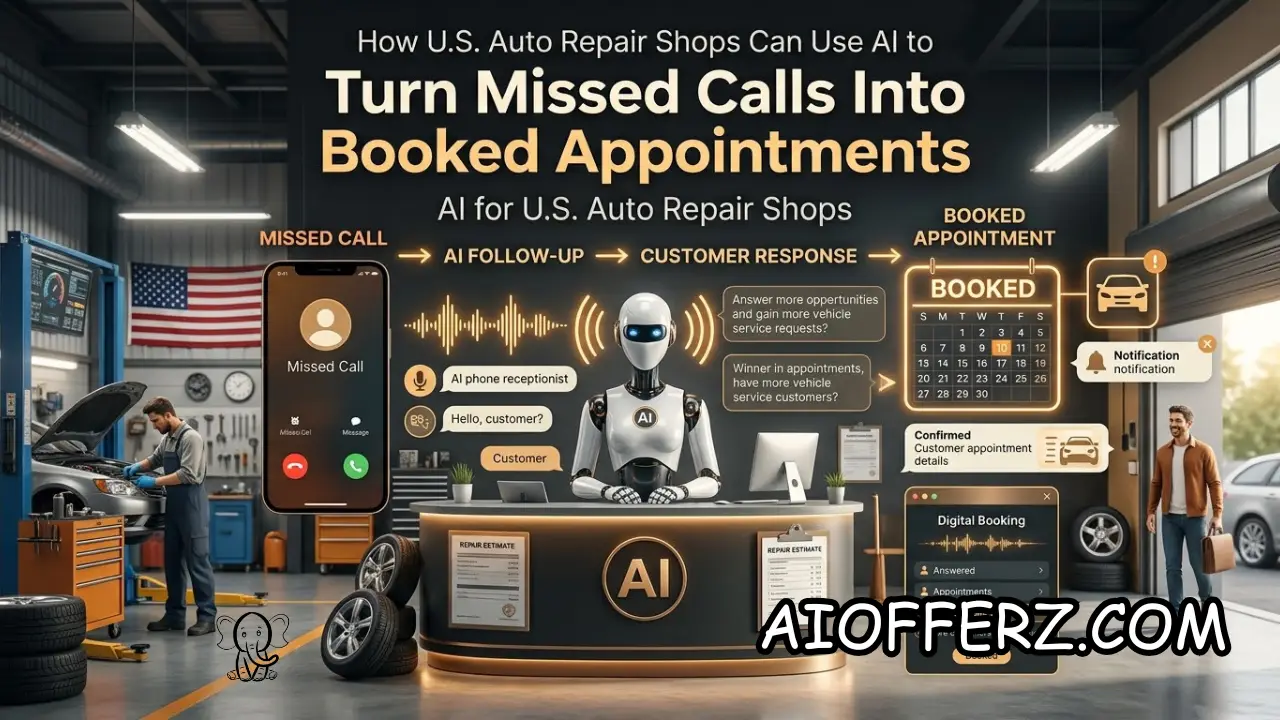
Instead of treating a missed call as the end of the interaction, an AI system can trigger an immediate follow-up through an approved text message or another communication channel.
For example, a shop can configure a workflow that sends a message acknowledging the missed call and inviting the customer to schedule.
The message can provide a booking link or continue the conversation through text, depending on the shop’s technology setup.
This matters because the customer’s intent is often highest immediately after the call. They were already interested enough to contact the business.
A quick response can keep the shop in the conversation instead of forcing the customer to search again.
AI can also identify whether the customer actually booked. If the missed caller responds but does not complete the booking, the system can send another approved follow-up or notify a service advisor that the customer needs attention.
This creates a simple recovery funnel: missed call, immediate response, customer information, appointment option, confirmation, and reminder. Every stage can be measured.
Auto repair technology providers are increasingly promoting exactly this type of workflow, including missed-call text-back, unbooked-estimate follow-up, customer reactivation, and AI-assisted phone support.
The important point is that automation should not become aggressive. A customer who does not respond should not receive endless messages.
The shop should define reasonable follow-up limits and make it easy for customers to stop receiving automated communication.
Wanna Use CustomGPT AI…
How AI Can Book the Right Service Appointment Instead of Just Collecting Leads
Getting a phone number is not enough. The real value comes from connecting the caller with the correct appointment type and available time.
An AI appointment system can ask what service the customer needs and use the shop’s predefined scheduling rules.
An oil change, brake inspection, tire installation, diagnostic appointment, and larger repair may require different amounts of technician time and bay capacity.
The system can therefore be configured to offer appropriate appointment windows instead of treating every request as identical.
This can help prevent a shop from accidentally filling its calendar with appointments that do not match available technician capacity.
Vehicle information can also be captured during the booking process. Knowing the year, make, model, and requested service before the customer arrives can give the service advisor a better starting point.
The AI can then send a confirmation containing the appointment date, time, location, and other approved information. Depending on the shop’s systems, it may also send reminders before the appointment.
Online scheduling remains useful as well. A 2026 report from Ratchet+Wrench and AutoZone cited by the publication found that only 47% of independent repair shops used an online appointment and scheduling system, leaving many shops still relying on phone calls, paper, or manual processes.
The ideal setup does not force customers into one channel. Some people prefer calling. Others prefer texting or online scheduling.
AI can connect these channels so that a phone inquiry and an online booking ultimately enter the same operational workflow.

How AI Can Follow Up on Estimates, No-Shows and Unfinished Bookings
The first appointment is not the only opportunity for AI automation. Auto repair shops also lose revenue when customers request estimates but never schedule the work.
A customer might ask about brake repairs, receive an estimate, and then become busy. Another customer may say they need to check their schedule before booking. Without a follow-up process, these opportunities can disappear.
AI can help create structured follow-up workflows. After an estimate or inquiry, the system can send an approved reminder after a defined period. If the customer responds, the conversation can continue or be handed to a service advisor.
The same approach can be used for appointment reminders. Customers sometimes forget appointments even when they genuinely intended to show up.
Automated reminders can confirm the appointment and give the customer an opportunity to reschedule according to the shop’s policies.
No-show recovery is another practical use. If a customer does not arrive, the system can send an appropriate message asking whether they want to choose another time. This is much more useful than simply marking the appointment as lost.
AI can also reactivate older customers. A shop may have thousands of previous repair orders but limited staff time to contact every customer manually.
A carefully designed system can identify customers due for approved maintenance follow-up and initiate appropriate communication.
The objective is not to bombard customers with promotions. It is to make sure legitimate service opportunities do not disappear because nobody had time to follow up.
Using Many AI’s For Many Work, Solution Is Here…
How Auto Repair Shops Can Use AI Without Losing the Human Touch
There is a common concern that an AI receptionist will sound robotic or frustrate customers. That can happen when an automated system is poorly configured, but the technology itself does not require a shop to eliminate human interaction.
The AI should have a clear purpose. It should answer routine questions, capture information, schedule straightforward appointments, and connect customers with people when necessary.
It should not pretend to be a technician or give complicated mechanical advice.
Customers should have a clear path to a human. If someone says they want to speak with the service manager, has a complaint, is discussing a complicated repair, or has a question outside the system’s approved knowledge, the workflow should escalate the interaction.
The shop should also use accurate information. Business hours, services, location, appointment availability, payment policies, warranty information, and other details should be maintained carefully.
An AI system can only be as reliable as the information it is permitted to use.
Customer communication should also comply with applicable rules. Automated calls and texts can involve privacy and communications requirements.
So shops should work with their technology providers and legal advisors to make sure their processes are appropriate for their specific situation.
Most importantly, AI should make employees more effective rather than invisible. A service advisor who receives a call summary containing the customer’s vehicle, requested service, preferred appointment time, and previous conversation can begin the interaction with useful context.
That is where AI becomes valuable. It handles repetitive communication while the people at the shop focus on diagnostics, repairs, estimates, relationships, and the actual work customers are paying for.
How U.S. Auto Repair Shops Can Start AI Automation in 2026
The best way to introduce AI is to begin with one measurable problem. For many independent shops, missed calls are a logical starting point because the problem is easy to understand and the outcome can be measured through booked appointments.
Before choosing an AI system, the shop should examine its existing call volume. Track how many calls come in, how many are answered, how many go to voicemail, how many callers request appointments, and how many appointments are ultimately completed.
The shop should then define its AI workflow. Decide which calls should be answered automatically, what information should be collected, which services can be booked automatically, when a human should take over, and how missed callers should be contacted.
Integration is also important. A standalone AI phone system that creates another disconnected calendar can create more work. The preferred setup should connect with the shop’s existing scheduling or management system whenever possible.
The shop should start with a controlled pilot. Test common calls such as oil changes, brake inspections, tire services, check-engine-light appointments, and general service inquiries.
Review conversations and correct inaccurate responses before expanding the system.
Performance should be measured using business results rather than AI activity.
Important metrics include answered calls, recovered missed calls, booked appointments, appointment show rates, estimate conversions, average response time, and revenue associated with recovered opportunities.
A successful implementation should make the shop feel more responsive without making customers feel like they are talking to a machine every time they call.
The technology should quietly handle the repetitive work while the team remains focused on vehicles and customers.
For U.S. auto repair shops in 2026, that is the real opportunity. AI does not need to replace the service advisor.
It needs to make sure the service advisor gets fewer interruptions, more qualified opportunities, and fewer customers lost simply because nobody could pick up the phone.
To get relief from Joint Pain , you can go for this.
FAQs
1. How can AI help an auto repair shop with missed calls?
AI can answer calls, collect customer and vehicle information, schedule eligible appointments, send missed-call text messages, and alert employees when human assistance is required.
2. Can an AI receptionist actually book auto repair appointments?
Yes. When connected to an appropriate scheduling system, an AI receptionist can offer available appointment times, collect service information, confirm the appointment, and send approved reminders.
3. Can AI diagnose car problems over the phone?
AI can collect symptoms and organize information, but it should not be treated as a replacement for professional vehicle diagnosis. Technicians should handle actual diagnostic decisions.
4. What happens when an AI receptionist cannot answer a customer’s question?
The system should follow an escalation rule. It can transfer the call, create a task for a service advisor, or collect the customer’s information for a human callback.
5. Can AI text customers after a missed call?
Yes. Missed-call text-back is one of the common AI automation workflows being promoted for automotive service businesses in 2026.
6. Can AI follow up on repair estimates?
Yes. AI can send approved follow-up messages to customers who requested estimates but have not scheduled the work, while escalating interested customers to staff.
7. Can AI reduce appointment no-shows?
Automated confirmations and reminders can help customers remember appointments and provide an opportunity to reschedule. The actual impact depends on the shop’s workflow and customer behavior.
8. Will customers dislike talking to an AI receptionist?
Some customers may prefer a human, which is why AI should provide an easy path to a person. A well-configured system should handle routine requests rather than force every caller through automation.
9. What should an auto repair shop measure after implementing AI?
Track missed calls, answered calls, recovered callers, booked appointments, completed appointments, estimate conversions, response times, and revenue associated with recovered opportunities.
10. Is AI worth it for a small independent auto repair shop?
It can be, particularly when the shop regularly misses calls because employees are busy. The best approach is to start with one workflow and compare the cost of the technology with measurable recovered appointments and staff time saved.
Ready to Begin?
➜ Click Here to explore top rated affiliate programs on ClickBank!
➜ Reach Our Free Offers: “Come Here To Earn Money By Your Mobile Easily in 2026.”
Want To Read More Then Click Here…
If You Are Interested In Health And Fitness Articles Then Click Here.
If You Are Interested In Indian Share Market Articles Then Click Here.
Thanks To Visit Our Website-We Will Wait For You Come Again Soon…