I still remember the brutal Texas summer of 2023 when a local HVAC owner I consult for was losing thousands of dollars a week simply because his team could not answer the phone fast enough.
The peak season heatwave triggered a flood of AC repair requests while his dispatchers were already drowning in paperwork, driver routing and angry customer voicemails.
It was a logistical nightmare where every missed ring meant a lost $500 emergency job to a competitor across town.
We knew we had to automate the inbound call flow without sacrificing the empathetic human touch that local homeowners expect when their house is 95 degrees inside.
That is exactly when we discovered the power of conversational AI and decided to build a Bland AI Voice Dispatcher. It completely transformed his business operations by answering every single call instantly, gathering critical customer details and automatically booking appointments directly into his scheduling software without a single human dispatcher lifting a finger.
Today I am going to show you exactly how to replicate this operational success for your own contractor business.
Want To Use Other AI To Write…
Why US HVAC Companies Need a Bland AI Voice Dispatcher
Running a heating, ventilation and air conditioning business in the United States comes with unique logistical hurdles. You are dealing with extreme seasonal weather shifts, massive service territories and a customer base that demands immediate solutions when their comfort is compromised.
Research consistently shows that the response time to a service inquiry is the absolute strongest predictor of lead conversion. In fact industry studies indicate that leads are exponentially more likely to convert when contacted within five minutes compared to half an hour.
High-intent prospects actively compare options in real time and they will simply move down the Google search results if your office line goes to voicemail.
Traditional answering services often fall short because they rely on shared agents who lack technical HVAC knowledge or they utilize clunky robotic IVR menus that frustrate callers.
A Bland AI Voice Dispatcher solves this by providing a self-hosted conversational agent that sounds completely human and responds with sub-second latency.
It handles routine inquiries, triages emergency repairs and integrates seamlessly with your existing CRM to schedule jobs.
This allows your human staff to focus on complex administrative tasks and relationship building while the AI scales infinitely during peak demand periods without requiring you to expand your payroll.
Wanna Use CustomGPT AI…
Understanding the Bland AI Enterprise Voice Platform
Before diving into the technical setup it is crucial to understand what makes this platform uniquely suited for American home service contractors.
Bland AI provides an enterprise-grade voice infrastructure designed to deliver fluid and natural conversations.
Unlike legacy bots that force callers into rigid decision trees this system utilizes advanced large language models to understand context, handle interruptions and guide the caller back on track.
The platform offers self-hosted deployment options which means you maintain complete ownership over your data and call recordings.
This is particularly important for businesses scaling up and navigating strict compliance requirements. Furthermore the system supports custom tools and API function calling.
This means your phone agent can actively query your database to check technician availability, process credit card payments or retrieve warranty information while the customer is on the line.
The result is a highly capable digital employee that operates 24/7 and never takes a sick day.
Using Many AI’s For Many Work, Solution Is Here…
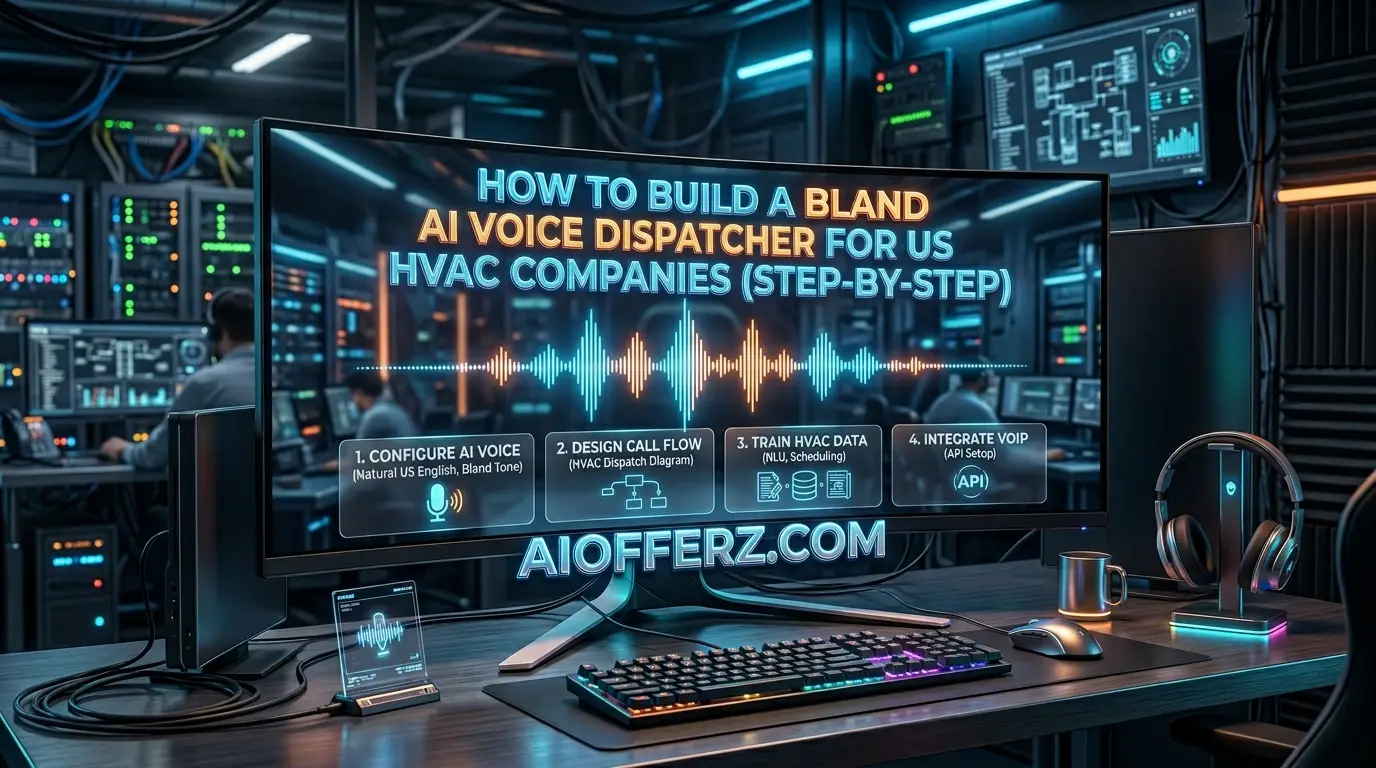
Step-by-Step Guide to Building Your Bland AI Voice Dispatcher
Building a functional and reliable phone agent requires a strategic approach. We will walk through the entire process from account creation to deployment so you can launch a system that actively generates revenue.
Step 1: Set Up Your Developer Account and Provision Numbers
The first phase involves establishing your infrastructure on the developer portal. You need to sign up for an account and secure a dedicated phone number for your AI agent.
Navigate to the platform website and create your credentials. Once you access the dashboard you can purchase a new phone number directly through their interface or integrate your existing Twilio numbers if you already have a telecom provider.
It is highly recommended to acquire a local area code that matches your target US market. Customers are far more likely to answer outbound calls or trust inbound lines that feature a familiar local prefix.
After securing your number you will receive an API key that serves as the authentication method for all subsequent backend requests. Keep this key secure as it is the gateway to your communication infrastructure.
Step 2: Define Conversational Pathways for HVAC Logistics
The true power of your new dispatcher lies in its ability to navigate complex customer interactions. You have two main options for defining behavior: using prompt-based instructions via the API or utilizing the visual Conversational Pathways feature.
For an HVAC workflow the Conversational Pathways tool is vastly superior because it allows you to map out specific dialogue trees, set strict guardrails and define branching logic based on customer responses.
You will start by creating a central greeting node. When a customer calls the AI should introduce itself clearly and ask how it can assist.
From there you create branches based on the perceived intent. One branch should handle emergency “no AC” or “no heat” scenarios where the AI is instructed to show urgency, collect the exact address and prioritize scheduling.
Another branch might handle routine seasonal tune-ups where the agent can offer promotional pricing and book standard slots.
You must clearly instruct the AI on what questions to ask such as the age of the unit, the location of the equipment and the specific symptoms the homeowner is experiencing.
Want To Get Online Cash…
Step 3: Configure Tools and Webhooks for Scheduling Integration
A voice agent that only talks is just an answering machine. To create a true dispatcher you must connect it to your scheduling software using custom tools and webhooks.
This is where the automation truly takes over and saves your office staff countless hours.
Within your pathway nodes you can define specific function calls that trigger external API requests. For example when the AI successfully gathers the customer’s address and preferred time you can configure a webhook to send that data payload directly to platforms like ServiceTitan, Housecall Pro or even a simple Zapier automation.
The AI will pause for a fraction of a second, communicate with your server to verify that the chosen time slot is available and then verbally confirm the appointment with the caller.
If the slot is taken the API returns the next available times and the AI gracefully offers those alternatives to the customer. This bidirectional data flow is the cornerstone of automated dispatch logistics.
Step 4: Clone a Custom Voice for Your Local Brand
Trust is everything in the home services industry. Your customers are inviting technicians into their private residences so the first point of contact must sound friendly, professional and geographically appropriate.
Bland AI excels in voice customization by allowing you to clone a voice or choose from highly optimized public models.
If you operate in the American South you might want a voice that carries a subtle, warm regional tone. If you are in the fast-paced Northeast a brisk and highly efficient professional voice might yield better conversion rates.
You can upload a high-quality MP3 recording of your best human dispatcher to clone their exact vocal characteristics. The system allows you to tweak the emotion, rhythm and vocabulary to perfectly match your brand identity.
This consistency builds immediate rapport and ensures that callers never feel like they are talking to a robotic machine.
“Live Chat Jobs – You have to try this one”
Step 5: Test the Phone Agent with Extreme Edge Cases
Before unleashing your automated dispatcher on real paying customers you must rigorously test its logic. Homeowners calling about a broken heater in the middle of winter are often frustrated, panicked or confused.
Your AI must be able to handle these emotional edge cases gracefully.
Utilize the built-in testing suite to simulate difficult conversations. Call the agent yourself and intentionally throw it off balance. Give incomplete addresses, ask irrelevant questions about pricing or interrupt the AI mid-sentence.
Observe how the system recovers and guides the conversation back to the primary goal of booking the appointment. If the AI hallucinates or gives incorrect pricing you must go back to your Conversational Pathways and implement stricter guardrails.
Refine the underlying prompts to explicitly forbid the AI from quoting exact repair costs until a technician actually diagnoses the problem on site.
Step 6: Deploy and Monitor Call Analytics
Once your testing confirms that the agent behaves perfectly it is time to push it live. You can route your main office overflow calls to the AI number or feature it as a dedicated after-hours hotline on your website.
Deployment is not a set-and-forget process. You must actively monitor the analytics dashboard to track call outcomes, sentiment scores and overall quality metrics.
Listen to the recordings of the first few dozen live calls to identify any points of friction. You might discover that customers frequently ask a specific question about warranty coverage that you did not anticipate.
You can then instantly update the pathway logic to include an answer for that exact scenario. Continuous optimization using real conversation data will drastically improve your conversion rates and deliver a massive return on investment within the first thirty days.
Real-World HVAC Use Cases for Automated Dispatch
Implementing this technology unlocks several powerful operational capabilities that directly impact your bottom line. Let us explore the most lucrative applications for US contractors.
Emergency Repair Routing and Triage
During extreme weather events call volume spikes unpredictably. The Bland AI Voice Dispatcher can answer fifty calls simultaneously and instantly triage them.
It can separate the true emergencies from the low-priority inquiries and flag critical jobs in your CRM for immediate dispatch. By capturing the lead instantly you prevent the customer from calling the next company on Google.
Routine Maintenance Scheduling
The shoulder seasons of spring and fall are perfect for proactive maintenance but calling past customers manually takes immense effort.
You can program your agent to run outbound campaigns to your existing database. The AI can call homeowners, remind them that their seasonal tune-up is due and seamlessly book the appointment while updating your calendar.
This proactive approach keeps your technicians busy year-round.
To get relief from Joint Pain , you can go for this.
Technician ETA Updates and Customer Communication
One of the biggest sources of customer frustration is waiting around for a service technician. You can integrate your GPS tracking software with the voice platform to trigger automated outbound calls or SMS messages when the driver is on the way.
The AI can call the customer, announce that the technician will arrive in twenty minutes and confirm that someone is home. This eliminates wasted trips and ensures your field service operations run smoothly.
Integrating with Your Existing US HVAC Software
A standalone tool adds no value if it creates duplicate data entry. The true magic happens when your AI dispatcher talks effortlessly to your existing technology stack.
Most American home service companies utilize robust field management software. Because the AI platform is API-first it can integrate with virtually any modern CRM or ticketing system.
You can set up automated workflows where a completed AI call instantly creates a new customer profile, logs the full call transcript and generates a work order ticket.
This seamless data transfer means your field technicians arrive at the property with the complete context of the customer’s problem.
By mapping these workflows with forward-deployed engineers or simple Zapier connections you bridge the gap between customer communication and operational execution.
Conclusion
Embracing automated dispatch logistics is no longer just a futuristic concept but a necessary evolution for modern contractors. Building a Bland AI Voice Dispatcher for your US HVAC company allows you to capture every single lead, slash your administrative overhead and provide an unparalleled customer experience.
By following this step-by-step guide and leveraging the immense power of conversational pathways you can transform your inbound phone lines from a massive bottleneck into your most reliable revenue generation engine.
Stop losing lucrative repair jobs to missed calls and start scaling your operations with the smartest digital employee available today.
You can go for this to get natural Glowing Skin.
FAQs
1. What is a Bland AI Voice Dispatcher?
It is an advanced conversational artificial intelligence system that answers inbound calls, makes outbound calls and manages scheduling for businesses.
It uses natural language processing to sound entirely human while integrating directly with your dispatch software to automate logistics.
2. How much does it cost to run this AI phone agent?
The pricing model is generally usage-based and calculated by the minute. Standard calls usually cost around a few cents per minute billed to the exact second.
This transparent pricing allows you to scale up during summer peaks and save money during slower winter months without paying fixed salaries for idle staff.
3. Can the AI understand thick regional US accents?
Yes the underlying language models are trained on massive datasets that include a wide variety of North American dialects.
Whether your customer has a heavy Southern drawl or a fast-paced New York accent the system processes the speech accurately and responds with sub-second latency.
4. Does the system work with ServiceTitan or Housecall Pro?
Absolutely. Because the platform features robust webhook and API capabilities you can connect it to industry-standard field service management software. It can push new customer data, pull calendar availability and update job statuses in real time.
5. What happens if the AI cannot answer a customer question?
You can build strict conversational pathways that include human escalation protocols. If a caller asks a highly complex technical question or becomes noticeably frustrated the AI can gracefully place them on a brief hold and instantly transfer the live call to your human office manager.
6. Is the call data secure and compliant with privacy laws?
Yes the platform offers enterprise-grade security including SOC2 compliance. If you opt for self-hosted deployment models you retain complete control over your call recordings and training data ensuring you meet all regulatory requirements for customer privacy.
7. Can the AI make outbound calls to follow up on estimates?
Yes you can upload a list of customers who recently received a replacement quote but have not signed the contract. The AI can dial them up, ask if they have any remaining questions about the equipment and offer to connect them with your sales manager to close the deal.
8. How long does it take to build and deploy the dispatcher?
A basic inbound agent can be set up and tested within a single afternoon. However a fully integrated dispatch system with custom API webhooks and strict workflow pathways typically takes a few weeks to map, test and refine before deploying into a live production environment.
9. Will customers realize they are speaking to a robot?
The technology has advanced so rapidly that most callers completely believe they are speaking to a human dispatcher. The system includes natural pauses, filler words and dynamic intonation that eliminate the robotic cadence of older IVR phone trees.
10. Can the AI send text messages after the phone call?
Yes the platform supports multi-modality communication. You can program the agent to follow up a successful booking call with an automated SMS message containing the appointment details, the technician’s name and a link to your company website.
Ready to Begin?
➜ Click Here to explore top rated affiliate programs on ClickBank!
➜ Reach Our Free Offers: “Come Here To Earn Money By Your Mobile Easily in 2025.”
Want To Read More Then Click Here…
If You Are Interested In Health And Fitness Articles Then Click Here.
If You Are Interested In Indian Share Market Articles Then Click Here.
Thanks To Visit Our Website-We Will Wait For You Come Again Soon…