Why AI for U.S. Staffing Agencies Is Becoming a Practical Recruiting Workflow
Staffing agencies live under constant pressure to find qualified candidates quickly. A recruiter may have dozens of open positions, hundreds of potential candidates, multiple client requirements, and a long list of people waiting for a response.
The challenge is not simply finding more candidates. It is moving the right candidates through the recruiting process quickly without allowing good prospects to disappear.
This is where AI for U.S. staffing agencies can make a meaningful difference.
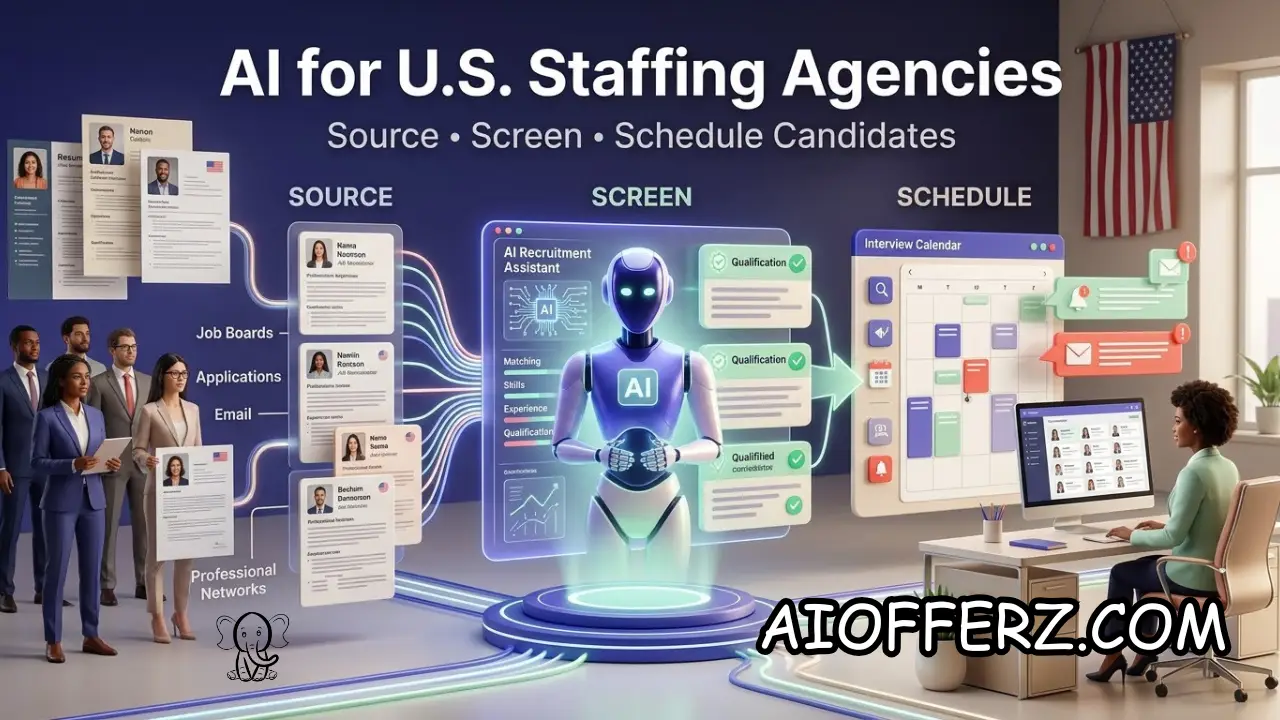
Modern AI tools can help recruiters source candidates, organize profiles, compare qualifications against job requirements, draft outreach messages, conduct initial qualification conversations, coordinate interviews, and automate routine follow-ups.
The purpose is to reduce repetitive work rather than remove recruiters from the process.
The recruitment technology landscape in 2026 is increasingly focused on the complete candidate journey instead of one isolated AI feature.
Current hiring technology categories include sourcing, applicant tracking, screening, assessments, interviewing, and background verification.
This shift matters particularly for staffing firms because speed can directly affect placement opportunities. A recruiter who takes several hours to respond to a qualified candidate may lose that candidate to another agency or employer.
Automation can help maintain momentum while recruiters focus on conversations, client relationships, negotiations, and difficult recruiting decisions.
AI also works best when it is connected to an agency’s existing workflow.
A sourcing tool by itself may find profiles, but the real value comes when those candidates can move into outreach, qualification, scheduling, and follow-up without recruiters repeatedly copying information between systems.
The objective should therefore be a connected workflow. AI finds potential candidates, helps organize and qualify them, supports recruiter communication, and keeps appointments and follow-ups moving.
The recruiter remains responsible for the professional relationship and important decisions.
Want To Use Other AI To Write…
How AI Can Build a Stronger Candidate Sourcing Pipeline
Candidate sourcing is often one of the most time-consuming parts of agency recruiting.
Recruiters may search job boards, professional networks, internal databases, previous applicants, referrals, and other sources to identify people who might fit an opening.
AI can speed up this process by turning a job description into structured requirements.
Instead of searching only for exact keywords, AI-based systems can identify related skills, job titles, experience patterns, technologies, certifications, and other qualifications that may indicate relevance.
This can be particularly useful when job titles vary between companies. One employer may call a position “Software Developer,” another may use “Application Engineer,” and another may use “Full Stack Engineer.”
A well-designed AI sourcing workflow can understand relationships between roles rather than depending entirely on one exact title.
AI can also search an agency’s existing candidate database. This is important because staffing firms often have valuable candidate information already sitting inside their ATS.
Candidates who were not selected for one role may be excellent matches for another role several months later.
Recruiters can use AI to create candidate shortlists based on clearly defined, job-related requirements. The recruiter can then review the shortlist and decide which candidates are actually worth contacting.
This reduces the amount of time spent manually opening profiles that are obviously unrelated.
AI sourcing tools are also increasingly being positioned as part of broader recruiting workflows rather than isolated search products.
Current 2026 recruitment guidance for agencies emphasizes that sourcing is only one part of the process and that candidate engagement, qualification, follow-up, and scheduling are equally important for improving recruiting productivity.
The most effective approach is therefore not to let AI automatically contact every person it finds. Use AI to expand and organize the candidate pool, then apply recruiter oversight before moving candidates into the next stage.
How AI Can Screen Candidates Without Removing Recruiter Judgment
Once candidates enter the pipeline, screening can become another major bottleneck. Recruiters may spend hours comparing resumes with job descriptions, checking experience, identifying missing qualifications, and asking basic qualification questions.
AI can assist by extracting structured information from resumes and candidate profiles.
It can identify years of experience, relevant skills, certifications, job history, education, location, availability, and other criteria that the staffing agency has determined are genuinely relevant to the position.
The agency can then establish consistent screening rules. For example, a technical role might require specific certifications or experience with a particular technology.
A healthcare staffing position may require a particular license. A temporary warehouse position might have clearly defined availability or physical job requirements.
Consistency is important because staffing agencies are subject to employment discrimination laws.
The EEOC states that employment agencies cannot discriminate in their referral practices and cannot categorize or refer candidates based on protected characteristics such as race, color, religion, sex, national origin, age, disability, or genetic information.
AI should therefore evaluate job-related qualifications rather than personal characteristics or hidden proxies for protected characteristics.
Recruiters should also regularly review whether automated screening produces unexpected patterns that exclude qualified groups.
The EEOC recommends that applications be screened consistently and that hiring practices that disproportionately affect protected groups be examined carefully.
For this reason, AI screening should be treated as decision support rather than an unquestionable final decision.
The system can organize evidence and flag potential matches, but recruiters should be able to review the underlying information and override an AI recommendation when appropriate.
Wanna Use CustomGPT AI…
How AI Can Automate Candidate Outreach and Initial Qualification
Finding a qualified candidate is only useful if the candidate responds. Staffing recruiters often spend significant time writing similar outreach messages, sending reminders, answering basic questions, and determining whether someone is still interested in a position.
AI can help personalize outreach using information already available in the candidate record.
Instead of sending exactly the same message to every person, the system can create a draft referencing the relevant position, skills, location, schedule, or other job-related details.
The recruiter can review the message before sending it. This human review is especially useful for staffing agencies because recruiters often need to explain client requirements accurately and avoid promising something the client has not confirmed.
AI can also support initial qualification conversations. A candidate may need to confirm location, work authorization where legally appropriate, availability, desired schedule, relevant experience, or willingness to work under specified job conditions. These questions can be structured in advance.
The system can record responses and create a summary for the recruiter.
Instead of reading a long message thread, the recruiter can quickly see whether the candidate appears to meet the basic requirements and whether there are unresolved questions.
AI can also trigger follow-ups when candidates do not respond. This is particularly useful because recruiting pipelines often contain candidates who were interested but became unavailable temporarily or simply missed the original message.
However, automated outreach should have limits. Candidates should not receive endless messages, and recruiters should remain available for candidates who want to speak with a person.
The goal is to increase responsiveness without making the candidate experience feel like a marketing automation campaign.
How AI Can Schedule Interviews and Keep Candidates Moving
Scheduling is one of the easiest staffing workflows to automate because the basic task is highly structured.
Recruiters often spend unnecessary time exchanging emails or messages simply to find a time that works for the candidate and hiring manager.
AI can collect availability from candidates, check approved scheduling rules, and offer appropriate interview times. Once a time is selected, the system can create or update the calendar event and send confirmation details.
This can be especially useful when staffing agencies coordinate among three groups: the candidate, the agency recruiter, and the client. A delay from one person can cause the entire process to stall.
Automated reminders can reduce forgotten interviews. The system can send an approved reminder before the appointment and provide instructions about the meeting format, location, or required preparation.
If a candidate needs to reschedule, AI can handle the initial scheduling conversation rather than forcing the recruiter to manage every calendar change manually.
The recruiter can be notified when the situation falls outside the standard rules.
AI can also update the ATS after an interview is scheduled. This reduces the need for recruiters to manually move candidates between stages.
The benefit is not simply saving a few minutes per interview. At staffing-agency scale, repeated scheduling work can consume hours every week.
Removing that administrative workload gives recruiters more time for sourcing, candidate conversations, client development, and placement activities.
The best workflow keeps recruiters informed without requiring them to perform every calendar action themselves. AI coordinates the routine scheduling while humans remain responsible for the relationship.
Using Many AI’s For Many Work, Solution Is Here…
How AI Can Automate Candidate Follow-Ups and Reduce Pipeline Drop-Off
A candidate pipeline can look healthy on paper while quietly losing people because follow-ups are delayed.
Candidates may stop responding, hiring managers may take longer than expected, interviews may be postponed, and recruiters may become overwhelmed by new requisitions.
AI can monitor these stages and identify candidates who have been inactive for a defined period. It can then prepare an appropriate follow-up message or create a recruiter task.
For example, after a candidate submits information, the system can remind the recruiter if the candidate has not moved forward. After an interview, it can trigger a request for feedback or prepare a candidate update.
Candidate follow-up can also be connected to client communication. If a hiring manager has not provided feedback within the agency’s normal timeframe, the system can create an internal reminder for the account manager or recruiter.
This creates a workflow in which candidates do not depend entirely on human memory. The recruiter still controls the relationship, but AI acts as an operational memory system that watches for stalled processes.
AI can also help re-engage existing candidates. A candidate who was not selected for one job may become relevant for another position.
Instead of searching the entire database manually each time a new requisition arrives, AI can identify previous candidates whose qualifications appear relevant.
Current recruitment technology is increasingly organized around this type of connected candidate journey, covering sourcing, screening, interviewing, and other stages instead of treating each stage as a separate activity.
For staffing agencies, this can produce a more reliable pipeline. Recruiters spend less time remembering who needs a message and more time deciding what the next meaningful conversation should be.

How Staffing Agencies Should Use AI Responsibly in U.S. Hiring
AI can improve recruiting speed, but staffing agencies cannot treat automation as a substitute for employment-law compliance. The agency remains responsible for how candidates are sourced, screened, categorized, and referred.
The EEOC specifically states that employment agencies are covered by federal employment discrimination laws when they regularly refer employees to employers.
It also states that agencies may not accept discriminatory employer preferences, such as requests for candidates based on protected characteristics.
That means an AI system should never be configured to search for or exclude candidates based on protected characteristics. Job-related criteria should be clearly defined before automation is introduced.
Agencies should also be careful with AI-based assessments. The EEOC has dedicated guidance concerning artificial intelligence, software, and algorithms used to assess job applicants and employees under the Americans with Disabilities Act.
Accessibility is therefore part of responsible AI recruiting. If a technology-based assessment creates barriers for applicants with disabilities, the agency and employer may need to consider appropriate accommodations.
Background checks also require care. The EEOC notes that employers can generally request background information subject to applicable restrictions.
But background information cannot be used in a manner that denies equal employment opportunity on a protected basis.
Staffing agencies should maintain documentation showing what criteria an AI workflow uses, what data it processes, how recruiters review results, and when humans can override recommendations.
Vendor documentation should also be reviewed before sensitive candidate information is connected to an AI platform.
The safest model is human-in-the-loop recruiting. AI can search, summarize, organize, draft, schedule, and flag. Recruiters should remain responsible for consequential decisions and candidate relationships.
To get relief from Joint Pain , you can go for this.
How to Build a Complete AI Recruiting Workflow for a U.S. Staffing Agency
A practical AI staffing workflow should begin with the client requirement. The recruiter enters a clearly defined job description, essential qualifications, location, schedule, compensation information, and other legitimate job-related requirements into the agency’s recruiting system.
AI can then structure the requirement into searchable criteria. It can identify relevant titles, skills, experience patterns, certifications, and other objective qualifications that can be used for sourcing.
The next stage is candidate discovery. AI searches approved candidate sources and the agency’s existing database to identify potential matches. Recruiters review the results before candidates move into outreach.
Once candidates are contacted, AI can support initial qualification. It can ask predefined questions, capture responses, summarize the conversation, and identify candidates who appear ready for recruiter review.
The qualified candidates can then move into scheduling. AI checks availability, coordinates interviews, sends confirmations, and updates the appropriate recruiting records.
After interviews, AI can assist with reminders and follow-ups. It can identify missing feedback, prepare candidate communications, and alert recruiters when a process appears stalled.
Finally, the agency should measure the workflow. Important metrics include time-to-submit, recruiter hours spent per placement, candidate response rate, interview scheduling time, interview-to-placement conversion, candidate drop-off, and client satisfaction.
The agency should not automate everything at once. Begin with a single workflow, measure the result, fix problems, and then expand.
Current 2026 recruitment technology research shows that AI adoption is spreading across the candidate journey, but the strongest implementations still depend on selecting the right tools and connecting them into a coherent hiring stack.
The long-term advantage is not simply having an AI recruiting tool. It is having an agency where every qualified candidate can move efficiently from sourcing to screening, outreach, scheduling, interview, follow-up, and placement without unnecessary manual delays.
You can go for this to get natural Glowing Skin.
FAQs
1. How can AI help a U.S. staffing agency?
AI can assist with candidate sourcing, resume screening, outreach, qualification, interview scheduling, follow-ups, candidate matching, and recruiting administration.
2. Can AI completely replace staffing recruiters?
No. AI can automate repetitive tasks, but recruiters remain important for candidate relationships, client communication, negotiations, judgment, and complex hiring situations.
3. Can AI screen resumes for staffing agencies?
Yes. AI can extract qualifications from resumes and compare them with predefined, job-related requirements. Recruiters should review important recommendations before making consequential decisions.
4. Can AI automatically source candidates?
AI can search approved candidate databases and other permitted sources based on job-related criteria. Human review should remain part of the process.
5. Is AI recruiting legal in the United States?
AI recruiting can be used, but staffing agencies must comply with applicable employment, discrimination, accessibility, privacy, and other laws. The EEOC specifically addresses employment agencies and discriminatory referral practices.
6. Can AI schedule candidate interviews?
Yes. AI can collect availability, coordinate calendars, send confirmations, issue reminders, and handle routine rescheduling.
7. Can AI conduct initial candidate interviews?
AI can support structured preliminary screening conversations, but agencies should carefully evaluate the technology, accessibility, fairness, data handling, and legal implications before using automated assessments.
8. How can AI reduce candidate drop-off?
AI can respond quickly, send reminders, identify stalled candidates, automate scheduling, and alert recruiters when a candidate requires human attention.
9. What should staffing agencies avoid automating completely?
Agencies should be particularly cautious about fully automating consequential candidate decisions, discriminatory preferences, disability-sensitive assessments, and other decisions where human review and legal compliance are important.
10. What is the best way to start using AI in staffing?
Start with one repetitive workflow such as sourcing assistance, resume organization, interview scheduling, or follow-up automation. Measure the results before expanding AI to additional recruiting stages.
Ready to Begin?
➜ Click Here to explore top rated affiliate programs on ClickBank!
➜ Reach Our Free Offers: “Come Here To Earn Money By Your Mobile Easily in 2026.”
Want To Read More Then Click Here…
If You Are Interested In Health And Fitness Articles Then Click Here.
If You Are Interested In Indian Share Market Articles Then Click Here.
Thanks To Visit Our Website-We Will Wait For You Come Again Soon…