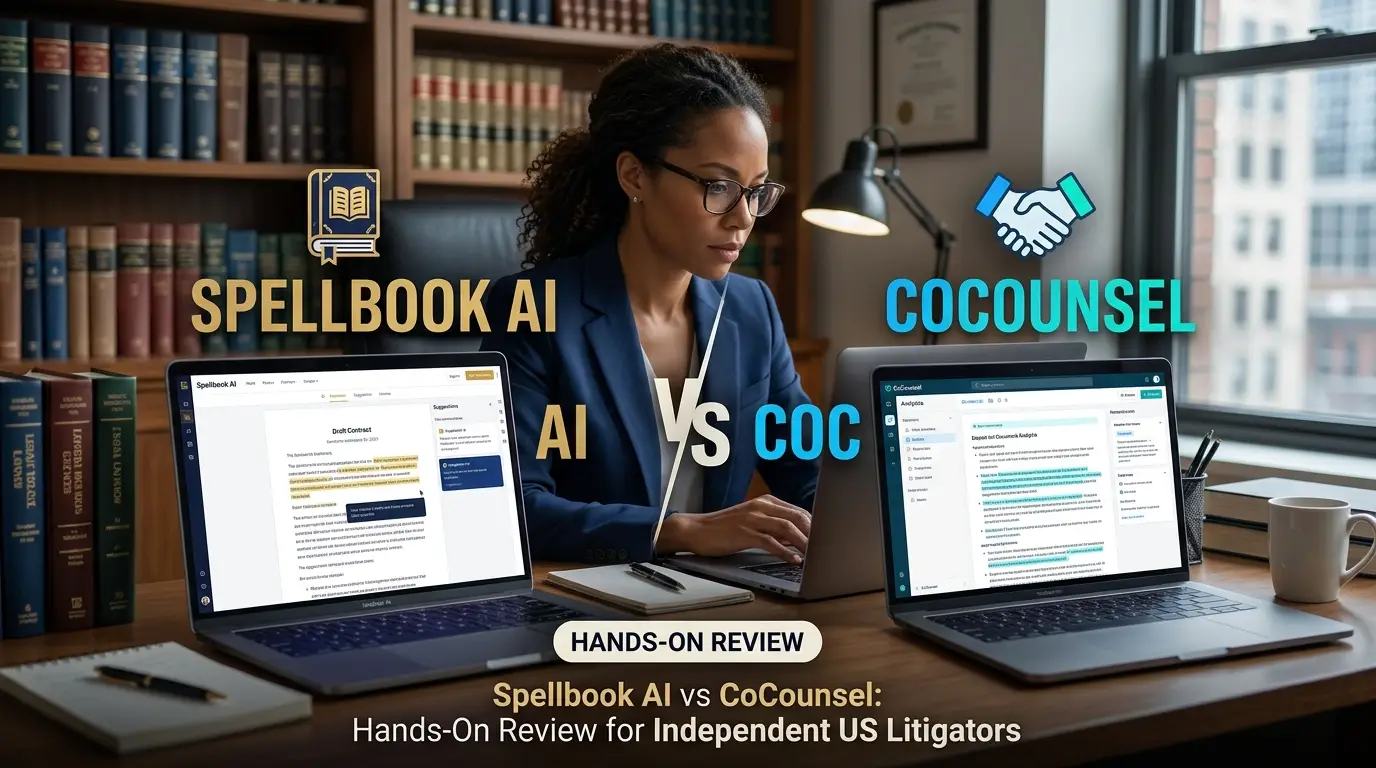
A Real Trial Practitioner’s Perspective on Legal AI
Last month I found myself staring at a 4,000-page medical malpractice production window with exactly 48 hours to draft a comprehensive motion to compel.
The defense had engaged in a classic data-dump strategy, burying critical internal communications beneath thousands of pages of irrelevant billing logs and boilerplate administrative forms.
As an independent litigator managing a lean boutique firm, I did not have an army of junior associates to pull an all-night doc review session.
I had two credit cards, a high-speed internet connection and active subscriptions to both Spellbook AI and Thomson Reuters CoCounsel.
I split the production down the middle and threw both artificial intelligence engines into the trenches. That real-world weekend pressure cooker revealed exactly where these platforms shine and where their marketing promises break down.
The independent litigation landscape in the United States demands tools that do not just look pretty in a tech demo but actively protect a billable hour and survive evidentiary challenges.
For solo attorneys and small firms, choosing between Spellbook AI and CoCounsel is not a matter of finding the overall “best” software.
It is a strategic decision about whether your workflow requires a hyper-focused transactional copilot embedded inside your word processor or a powerhouse research and document examination ecosystem tied directly to a comprehensive case law database.
This hands-on review bypasses the sales pitches to give you a raw, functional comparison of how these platforms perform in daily, high-stakes American litigation practice.
Want To Use Other AI To Write…
Understanding the Architecture: Word Plug-In vs. Comprehensive Research Platform
To understand why these platforms behave so differently during motion practice and discovery, you must look at their core design philosophy.
They are built on fundamentally different structural frameworks and that architecture dictates how you interact with them during a busy trial schedule.
Spellbook AI: The Microsoft Word Native Powerhouse
Spellbook AI approaches legal automation by meeting you where you already spend 80% of your working hours: inside Microsoft Word.
It operates as an advanced sidebar application utilizing models like GPT-5 and Claude 3.5 Opus to read, analyze and manipulate text dynamically.
Because it lives directly within your word processor, the friction of copying and pasting text back and forth between a browser window and your active pleading drafts is completely eliminated.
Spellbook AI Workflow
Spellbook AI integrates directly into the Microsoft Word document window, allowing legal professionals to work without leaving their drafting environment.
While reviewing an active motion, contract, or other legal document, users can access the Spellbook AI sidebar to draft new clauses, identify potential legal risks, suggest redline revisions and ask document-specific questions.
Powered by advanced language models such as GPT-5 and Claude. The tool helps streamline legal drafting, improve document quality and accelerate the review process.
For an independent litigator, this architecture is a massive advantage when drafting settlement agreements, liability waivers or joint defense stipulations.
You can highlight a paragraph, click a button and watch the platform suggest alternative text or flag hidden liabilities based on your customized firm playbooks.
However, because it is inherently document-centric, it does not possess a native, comprehensive repository of public case law or statutory regulations. It looks at the text you give it, rather than the vast universe of American jurisprudence.
Wanna Use CustomGPT AI…
CoCounsel Core: The Grounded Discovery and Research Engine
CoCounsel, originally developed by Casetext and subsequently acquired by Thomson Reuters, is built from the ground up as a standalone, secure web application.
It does not try to wrap itself around your word processor. Instead, it serves as a separate digital war room.
Its foundational strength lies in its direct integration with comprehensive legal research databases, allowing it to perform deep, multi-jurisdictional case law verification and massive document review operations.
CoCounsel utilizes a sophisticated multi-step reasoning protocol. When you ask it a complex question regarding a procedural rule or a substantive legal standard, it does not simply predict the next word in a sentence.
It searches the actual data, retrieves the relevant cases, verifies their validity using tools like KeyCite and synthesizes a research memorandum complete with pin citations.
For independent trial lawyers who spend their days fighting over summary judgment motions and conducting extensive deposition preparation, this architecture provides a level of verification that a simple text editor extension cannot match.
Head-to-Head Feature Comparison for Civil Litigation
When you are fighting an aggressive defense firm in federal court, you need to know exactly how your technology will perform across specific litigation tasks. Let us break down how Spellbook AI and CoCounsel handle the core responsibilities of a United States litigation practice.
1. Document Review and E-Discovery Mass Processing
The discovery phase can easily break an independent firm that lacks the overhead to manage massive data sets. During my hands-on test with the medical malpractice production, the difference between the two tools became apparent immediately.
-
CoCounsel allows you to upload massive zip files containing hundreds of thousands of pages simultaneously. You can then use the platform to execute complex semantic searches across the entire database.
For example, instead of searching for a specific keyword like “infection,” you can instruct CoCounsel to “Find every internal email where a staff member expressed concern over post-operative patient sterilization protocols.”
The platform will scan the unstructured data, group relevant documents and provide a clear summary of the evidence found.
-
Spellbook AI introduces its “Associate” feature, which is designed to handle multi-document workflows across a specific deal or folder.
While highly effective for reviewing a stack of interconnected corporate agreements or looking for inconsistencies across five versions of a commercial lease, it feels sluggish when forced into an e-discovery environment containing thousands of pages of medical records or native email exports.
If your practice regularly handles intensive document production, CoCounsel provides the infrastructure needed to compete with big-firm resources.
Using Many AI’s For Many Work, Solution Is Here…
2. Legal Research Memos and Case Law Verification
Nothing damages an attorney’s credibility faster than citing a case that has been overturned or misrepresenting a judicial holding.
| Feature | Spellbook AI | CoCounsel Core |
| Primary Focus | Document analysis and inline clause drafting | Case law research and multi-document database synthesis |
| Interface | Microsoft Word Extension Sidebar | Standalone Secure Web Application Platform |
| Research Base | Document-specific or user-uploaded context | Comprehensive US Federal and State Case Law Databases |
| Citations | Relies on citations present within the uploaded text | Generates verified pin citations backed by KeyCite verification |
| Best Used For | Drafting pleadings, motions, and settlement contracts | E-discovery, deep research memos, deposition preparation |
CoCounsel is the clear leader when it comes to substantive legal research. When you run a “Deep Research” query inside CoCounsel, the AI acts as an experienced law clerk.
It reads through state and federal dockets, analyzes holdings, and writes a detailed research memorandum. It explicitly flags where it found the supporting authority and includes hyperlinked citations so you can instantly read the original opinion.
Spellbook AI features an “Ask” tool that allows you to interact with your text but it is not connected to a live, comprehensive legal research engine.
If you ask it to find a matching precedent in the Southern District of New York regarding the tort of tortious interference with contractual relations, it will struggle unless you upload the relevant case files into its reference library yourself.
“Live Chat Jobs – You have to try this one”
3. Motion Practice and Pleadings Drafting
This is where the battle lines are drawn and the winner depends entirely on your personal writing style and workflow preferences.
When I am actively writing a motion for summary judgment, Spellbook AI feels like an extension of my brain. I can draft a section of facts, highlight it and use the “Draft” feature to generate a compelling argument based on a specific legal standard.
If a paragraph feels clunky, the “Review” tool can rewrite it to sound more persuasive or concise. It is an extraordinary asset for real-time editorial refinement.
CoCounsel approaches drafting from a macro perspective. It excels at creating the foundational structure of a motion from scratch.
By analyzing your initial intake files or a statement of facts, it can generate a comprehensive initial outline or draft a first version of a complaint that includes the necessary jurisdictional allegations and elements of the claims.
The downside is that you must then export that text out of the web interface and bring it into your word processor to finish the job.
The Usability Showdown: Friction in the Daily Billable Hour
An independent litigator has no time to waste wrestling with a complicated user interface or navigating endless setup screens. A tool must be intuitive enough to use effectively under tight deadlines without requiring a week-long training certification.
You can go for this to get natural Glowing Skin.
The Word Integration Edge
Spellbook AI wins the usability battle regarding pure workflow integration. Because it installs as a standard add-in from the Microsoft AppSource store, it fits perfectly into the routines you have spent decades building.
There is no need to maintain another open browser tab or manage a separate login credential for every paralegal in the office.
You simply open your active file, pull out the side panel and start working. The learning curve is practically non-existent for any attorney who knows how to use the standard comment track changes features in Word.
The Portal-Based War Room
CoCounsel requires you to step out of your regular writing environment and enter its proprietary web application. For deep focus tasks like sitting down for four hours to prepare for an aggressive defense deposition this setup is actually preferable. The interface is clean, organized and split into distinct “skills” such as:
-
Search Case Law
-
Review Documents
-
Summarize a Deposition
-
Extract Contract Data
This modular structure keeps your work organized but it does introduce small elements of workflow friction when you are rapidly jumping between researching a point of law and writing your brief.
The Hard Realities of Pricing and ROI for Small Law Firms
Let us talk about the reality of small-firm finances. Independent litigators do not have the luxury of absorbing enterprise software costs without seeing a direct, measurable return on investment.
To get relief from Joint Pain , you can go for this.
The legal AI market in 2026 remains highly fragmented, and pricing structures require careful analysis before you sign a long-term contract.
Crucial Financial Warning: Neither of these tools is cheap, and both typically require annual commitments per user seat. Signing up for legal AI without understanding your exact volume requirements can severely impact your monthly cash flow.
-
Spellbook AI positions itself as a premium transactional and drafting assistant. Pricing generally ranges between $100 and $300 per user per month, depending on the tier and features required.
For firms that handle a high volume of contingency-fee litigation mixed with commercial drafting, this cost can be quickly recovered by automating the initial drafting of settlement releases, medical authorization requests and standard client intake correspondence.
-
CoCounsel Core sits at a significantly higher price point, often ranging from $200 to over $500 per user per month, particularly when bundled into larger Thomson Reuters ecosystems or Westlaw subscriptions.
The loss of standalone, unbundled options following recent corporate migrations means small firms must often commit to a broader technological platform to gain access to the premium AI features.
To achieve an actual return on investment with CoCounsel, you must leverage its document review and deep research modules to replace the hours you would normally spend manually indexing discovery or paying external research services.
If you are only using it to summarize a short deposition transcript once a month, you are significantly overpaying for technology you do not need.
Security, Confidentiality and Ethical Obligations
As an American attorney, you are bound by strict ethical rules regarding client confidentiality and technological competence. You cannot simply dump sensitive client discovery data or trade secrets into a public artificial intelligence model without violating your state’s version of ABA Model Rule 1.6.
Both Spellbook AI and CoCounsel address this critical concern by implementing rigorous, enterprise-grade data protection security protocols.
They operate under strict Zero Data Retention (ZDR) agreements with their underlying LLM providers. This means that when you upload a sensitive corporate deposition or a confidential medical history file to either platform, that data is processed in a temporary, secure environment.
It is never stored permanently on external servers, it is never used to train public models and it cannot be accessed by other users or leaked into the public domain.
Both platforms comply with major US data standards, ensuring that your firm maintains the highest levels of privilege protection and client security throughout the litigation lifecycle.
To get relief from Knee,Hip and Back Pain use it.
The Verdict: Which Tool Should You Choose?
After putting both platforms through rigorous testing, the choice between Spellbook AI and CoCounsel comes down to the primary pain points of your specific practice area.
Choose Spellbook AI if:
Your independent practice focuses heavily on motion drafting, transactional work, and structured document editing. If your primary bottleneck is the physical act of sitting at a desk typing out pleadings, discovery responses and settlement agreements from scratch, Spellbook’s native integration inside Microsoft Word will save you hours of administrative exhaustion every week.
Choose CoCounsel if:
Your practice is defined by high-stakes discovery, complex federal litigation, and intensive legal research requirements. If you routinely find yourself buried under thousands of pages of unorganized document production or if your cases depend on finding obscure judicial precedents across multiple jurisdictions, CoCounsel’s deep research engine and database capabilities provide the technical edge you need to outmaneuver larger adversaries.
Try it to improve gum health and prevents bleeding.
FAQs
1. Do these AI tools create fake legal cases or hallucinations?
CoCounsel directly addresses the issue of hallucination by grounding its search functionality in the Westlaw and Casetext databases, verifying its legal output against real case law before showing it to you.
Spellbook AI operates primarily on the text you provide within Microsoft Word which inherently minimizes the risk of generating external legal fabrications as long as you provide the source text. However, you must always double-check every case citation before submitting a brief to a judge.
2. Can I use Spellbook AI or CoCounsel on an iPad or mobile device while in court?
CoCounsel runs as a responsive web application, meaning you can log into your secure portal from any browser on a laptop or iPad during a trial or deposition to run real-time queries.
Spellbook AI requires a fully functional version of Microsoft Word that supports add-ins, making it best suited for a desktop or laptop office environment rather than a mobile device.
3. Will my client’s sensitive data be used to train future public AI models?
No. Both platforms feature enterprise-grade data security policies that guarantee absolute privacy. Your uploaded files, prompts, and notes are completely isolated and are never used to train public language models or improve external systems.
4. Do I need a separate Westlaw subscription to use the research features in CoCounsel?
Following corporate changes, CoCounsel is frequently integrated or bundled with Thomson Reuters platforms. While standalone versions of CoCounsel Core exist, the most robust research features are often paired directly with Westlaw data access. Check with a sales representative to understand your specific options.
5. Can Spellbook AI automatically redline a document based on my personal firm standards?
Yes. Spellbook AI allows you to create customized playbooks. You can upload your preferred language, clauses and litigation standards, and the AI will analyze incoming agreements or stipulations to highlight deviations from those rules.
6. How many documents can I upload to CoCounsel at one time for an e-discovery review?
CoCounsel can process large, compressed zip files containing thousands of pages in a single upload batch, making it highly effective for organizing massive document productions or reviewing extensive personnel files.
7. Is it ethical to bill clients for the time I save using legal AI platforms?
According to various state bar ethics opinions, you should generally bill clients for the actual time spent reviewing, editing and managing your work, rather than billing a fictional number of hours that the AI saved you.
However, you can use the increased efficiency to handle a larger volume of cases or offer affordable flat-fee arrangements.
8. Can these platforms draft a complete appellate brief from scratch without human intervention?
No. Neither tool possesses the strategic legal creativity or nuance required to construct a complex appellate argument from scratch.
They provide exceptional structural outlines, research foundations and draft sections but a human attorney must guide the strategy and polish the final prose.
9. How do these tools handle local state court rules and standing judicial orders?
CoCounsel has access to vast databases of state-specific case law and procedural codes but it may not always account for the highly localized standing orders of an individual county judge. You must always cross-reference any generated timelines or procedural steps with your local court rules.
10. Can I cancel my subscription easily if the tool does not fit my firm’s workflow?
Most premium legal AI platforms operate on annual contracts with per-seat commitments, which can make early cancellation difficult. It is highly recommended to request a comprehensive, hands-on trial period using real case files before signing a long-term contract.
Ready to Begin?
➜ Click Here to explore top rated affiliate programs on ClickBank!
➜ Reach Our Free Offers: “Come Here To Earn Money By Your Mobile Easily in 2025.”
Want To Read More Then Click Here…
If You Are Interested In Health And Fitness Articles Then Click Here.
If You Are Interested In Indian Share Market Articles Then Click Here.
Thanks To Visit Our Website-We Will Wait For You Come Again Soon…
Want To Read More About AI Then Click Here…