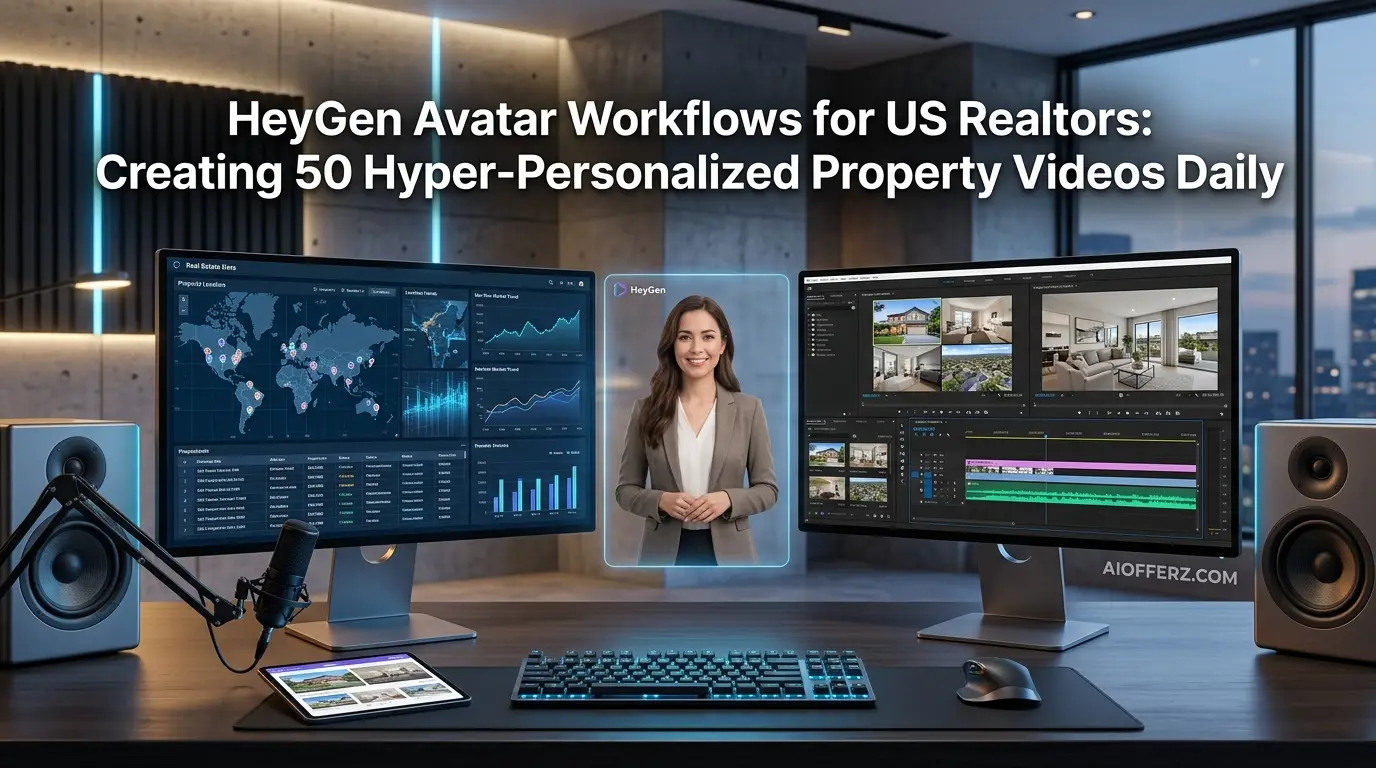
Six months ago, our real estate team faced a bottleneck that will sound instantly familiar to any top-producing agent in the US market.
We had the data, we had the listings, and we knew that video content outpaced text or static images by a factor of ten when it came to click-through rates and client engagement.
However, the physical reality of sitting in front of a camera, memorizing scripts for fifty unique properties and spending hours editing or paying a production agency thousands of dollars made scaling impossible.
We were trading our most valuable asset time for content that quickly became outdated as market conditions shifted. Everything changed when we stopped treating video creation as a performance and started treating it as a software pipeline.
By integrating HeyGen custom AI avatars with dynamic data sources, we unlocked a methodology that allows a single agent or small marketing team to generate fifty hyper-personalized property videos every single day. These are not generic, cookie cutter slideshows.
They are high-fidelity, professional-grade marketing assets where your digital twin looks directly at the camera, speaks naturally, addresses a specific client or neighborhood by name and references exact property details pulled straight from live listings.
This operational blueprint breaks down the exact mechanics, technical architecture and creative workflows required to deploy this automated system within your US real estate business.
Want To Use Other AI To Write…
The Economics of High-Volume Video Production in US Real Estate
Traditional media production models are inherently incompatible with the fast-moving nature of regional American real estate markets.
When a new listing hits the market in competitive zones, the window of maximum buyer interest opens and closes within the first forty-eight hours.
Waiting for a videographer to schedule a shoot, edit the footage and deliver a final cut means missing the peak engagement curve entirely.
Furthermore, real estate is fundamentally local and deeply relational. A generic broad-market video overview of a metropolitan area fails to capture the hyper-local nuances that drive home purchase decisions.
A buyer looking at properties in North Scottsdale wants to hear about specific school districts, neighborhood amenities and local market trends, not general statistics about Phoenix.
By utilizing programmatic video production workflows, you shift the cost structure from variable to fixed. Instead of paying per video asset, you invest initial time into building a robust technical workflow.
Once established, generating fifty distinct videos costs practically the same in overhead as generating five.
This allows you to create highly targeted campaigns for micro-markets, individual subdivisions and specific buyer demographics without destroying your marketing budget.
Step 1: Crafting the Core HeyGen Studio Avatar and Voice Profile
The foundation of a successful programmatic video campaign rests on the authenticity of your digital twin.
If your avatar looks rigid, speaks with an unnatural cadence or displays mismatched facial expressions, the psychological trust required to close high-value real estate deals evaporates instantly.
Wanna Use CustomGPT AI…
Recording the Studio-Grade Footage
Do not compromise on the initial avatar recording phase. Rent a professional studio or set up a clean, well-lit space in your office with a solid backdrop.
Use a high-end mirrorless camera or a dedicated 4K webcam capable of capturing crisp facial details. When recording your foundational video script for HeyGen, dress in the exact professional attire you wear when meeting high-net-worth clients.
Maintain natural body language. Move your hands occasionally, blink naturally and smile warmly at transition points in your speech. The algorithm requires a diverse range of natural micro-movements to map your persona accurately.
Voice Cloning and Audio Isolation
Equally vital is your vocal footprint. Use a high-quality directional shotgun microphone or a premium lavalier microphone to capture clean audio free from ambient room echo, air conditioning hum or outside traffic noise.
Read the calibration scripts with your standard presentation energy. If your everyday real estate persona is high-energy and conversational, ensure that enthusiasm transfers directly into the microphone.
The resulting voice clone must match your natural cadence, complete with the subtle inflections characteristic of your regional American accent.
Step 2: Designing Dynamic Video Templates in HeyGen
A static video is useless for a high-volume automated workflow. To achieve fifty unique videos per day, you must construct a template inside HeyGen that utilizes dynamic variables.
These variables act as placeholders that change automatically based on the data fed into the system for each specific property or client.
Using Many AI’s For Many Work, Solution Is Here…
Structural Composition of a Property Video
An effective real estate video template balances human presence with visual property assets.
Your custom avatar should occupy a prominent position, typically utilizing a clean lower-third or split-screen layout during detailed property showcases and a full-screen presentation format during the introduction and call-to-action phases.
-
The Hook (0–5 Seconds): Full-screen avatar addressing the viewer or specific neighborhood.
-
The Reveal (6–20 Seconds): Split-screen layout where the avatar moves to the side while high-resolution b-roll footage or high-definition interior photographs of the property transition smoothly in the main frame.
-
The Context (21–45 Seconds): The avatar discusses specific property metrics, such as square footage, neighborhood amenities and recent price adjustments while the background dynamically displays relevant localized charts or community maps.
-
The Closing (46–60 Seconds): Full-screen avatar returning to center stage to deliver a clear, actionable call-to-action with personalized contact information.
Defining Your Dynamic Placeholders
Within your HeyGen template design, you will designate specific text and media elements as variable inputs. For a comprehensive property workflow, define the following variables:
-
{{First_Name}} – For personalizing direct-outreach emails to specific leads or past clients.
-
{{Neighborhood_Name}} – To establish immediate geographic authority.
-
{{Property_Address}} – To anchor the video to a specific listing.
-
{{Price}} – For accurate financial framing.
-
{{Bed_Bath_Count}}- To communicate core structural specs.
-
{{Background_Video_URL}} – A dynamic link pointing to a folder containing the specific property walk-through or photo slideshow.
“Live Chat Jobs – You have to try this one”
Step 3: Structuring the Data Engine via Spreadsheets and CRM Systems
To generate fifty videos daily without manual asset generation, you must feed data into your HeyGen templates via a structured database or spreadsheet application.
Most top-performing US realtors utilize platforms like Google Sheets, Airtable or direct API exports from CRMs such as KVCore, Salesforce or HubSpot.
Designing the Automation Spreadsheet
Create a master spreadsheet where each row represents a unique property listing or a distinct buyer lead segment. Organize your columns precisely to map directly to the dynamic variables you configured within your HeyGen template design.
Your columns must follow a rigorous data taxonomy:
-
Column A: Project ID (A unique identifier for tracking file outputs)
-
Column B: Recipient Name or Market Segment
-
Column C: Target Neighborhood
-
Column D: Listing Address
-
Column E: Price Point
-
Column F: Property Bullet Points (Short, punchy sentences for the script engine)
-
Column G: Asset Folder Link (Direct path to the hosted property imagery)
Script Engineering and Dynamic Synthesis
The script text that your avatar speaks must be assembled programmatically using spreadsheet formulas.
By combining static, professionally written marketing copy with your dynamic column variables, you generate custom, tailored scripts for fifty different scenarios instantly.
For example, your spreadsheet formula will concatenate text string components to form a seamless script: “Hey there ” & B2 & “, it’s Sarah here from Prestige Realty. I wanted to give you a personal look at an incredible new listing that just went live in ” & C2 & “. Located at ” & D2 & “, this stunning home features a fully updated kitchen and a spectacular backyard perfect for entertaining. At a listing price of ” & E2 & “, properties in this pocket of the city are moving fast. Click the link below to schedule your private tour before it hits the open market.”
This structural synthesis ensures that when the data row parses, the script reads smoothly and sounds like a custom-tailored message recorded specifically for that single recipient.
You can use it for mental peace and balance.
Step 4: Activating Programmatic Batch Processing and API Integrations
Once your data repository is structured and your templates are locked, you have two primary methods to execute your fifty video daily output run: HeyGen’s native UI batch processing or a fully automated programmatic connection via Zapier and the HeyGen API.
Native UI Batch Processing
For realtors who prefer a hands-on approach without writing code or managing complex automations, HeyGen provides a native CSV import feature.
You simply export your prepared Google Sheet or Airtable database as a standard comma-separated values file. Within the HeyGen dashboard, select your master real estate template and click the batch actions button.
Upload your file, verify that the column headers map accurately to your template’s dynamic variables and initiate the run. The platform will queue the assets and process all fifty videos in the background simultaneously.
Advanced Automation via Zapier and API
To build a hands-off marketing engine, connect your CRM directly to HeyGen using Zapier or Make.com.
Set the system trigger to activate whenever a new listing status updates to “Active” in your database or when a high-intent lead fills out a form on your landing page.
The automation platform captures the raw property details from the listing service, parses the text through your script formula, and pushes a structured payload directly to the HeyGen video generation endpoint via an API call.
Once the rendering process concludes, the system triggers a follow-up action that delivers the completed video asset link directly back to your CRM, ready for immediate distribution via automated text messages or email marketing workflows.
You can use it to be healthy and fit forever.
Step 5: Distributing Video Content for Maximum Market Impact
An automated content engine is only as valuable as the distribution framework supporting it.
Generating fifty hyper-personalized real estate videos daily gives you a massive inventory of rich media assets that must be directed down the correct marketing channels to maximize lead generation and conversion metrics.
Hyper-Local Paid Advertising Campaigns
Take your fifty daily videos and deploy them directly into Meta Ads Manager or Google Ads targeting hyper-specific zip codes across your market area. Instead of running a single ad for an entire city, run fifty micro-targeted ads.
A buyer browsing social media in a specific subdivision will stop scrolling when they see a high-quality video of a local agent saying, “If you are looking for a home right here in Willow Creek, I have an exclusive update on a property that just hit the market.”
The hyper-local relevance drives down your cost-per-click while significantly boosting lead quality.
One-to-One Personal Email and Text Outreach
Convert cold real estate leads into warm conversations by sending personalized video landing pages.
When a prospect requests information about a listing or registers on your search site, trigger an automated text message containing their personalized video.
Seeing an agent look directly at the screen and address them by name creates an immediate psychological bond, establishing an unprecedented level of professional authority before you ever pick up the phone for a live call.
You can try it to save homes from the energy crisis and reduce electricity bills.
Avoiding Critical Compliance and Brand Mistakes
Operating a high-volume automated video engine requires strict adherence to industry standards, licensing rules and federal fair housing guidelines to protect your real estate license and maintain brand integrity.
Clear Attribution and Disclosure
Transparency is paramount when utilizing digital twins for commercial real estate marketing in the United States.
Ensure your video designs or the description text directly accompanying the video assets includes clear, unambiguous labeling indicating the use of synthetic media technology.
A simple, professional disclosure watermark in the lower corner or a text note stating “Digital representation of Agent Sarah Jenkins” builds consumer trust and ensures compliance with evolving state-level digital transparency regulations.
Ensuring Accurate Property Pricing and MLS Data
Because your scripts are generated programmatically from spreadsheet rows, a single data-entry error can cause your avatar to misstate a property price or quote incorrect square footage numbers.
Always implement a human-in-the-loop review process or write validation filters within your spreadsheet logic. Ensure that listing data matches the verified regional MLS input exactly before triggering the final batch render.
Presenting inaccurate financial terms to consumers can trigger costly regulatory investigations or fair advertising violations.
Try it to make the body more active and healthy.
FAQs
1. How long does it typically take to render a batch of 50 property videos inside HeyGen?
Batch processing times vary depending on overall server demand and individual video length but a standard one-minute property video generally renders within three to five minutes.
When you initiate a concurrent batch run of fifty videos, the entire queue typically processes completely within one to two hours, giving you a massive library of ready-to-use video assets before your morning prospecting session concludes.
2. Can I use copyrighted background tracks for my real estate videos?
No, you must never use copyrighted music without explicit commercial licensing agreements. Doing so can result in your video assets being flagged and removed from platforms like YouTube, Instagram or Facebook and can expose your brokerage to severe copyright infringement penalties.
Always utilize the royalty-free audio tracks provided natively within the HeyGen platform or source tracks from accredited commercial audio libraries that explicitly grant unlimited digital distribution rights.
3. Do I need an expensive camera setup to create my initial custom avatar?
You do not need to buy Hollywood-grade cinema gear, but you do need clean, professional footage. A high-quality mirrorless camera or a modern smartphone capable of recording stabilized 4K video at thirty frames per second will work perfectly if paired with excellent studio lighting.
The cleaner and more detailed your source video file is, the more lifelike and accurate your final digital twin will appear to your prospective clients.
4. Will these automated real estate videos violate Fair Housing regulations in the US?
The technology itself does not violate Fair Housing guidelines but the copy you write and the target demographics you choose for your advertising campaigns must always comply with federal and state regulations.
Ensure your programmatically generated scripts focus strictly on the physical property attributes, neighborhood amenities and objective market data.
Avoid any descriptive language or targeted audience selections that could be construed as discriminatory toward protected classes.
5. How do I update a video if a property price drops or goes under contract?
This is where programmatic video creation shines over traditional production models. Because your entire framework relies on a structured data spreadsheet.
You simply update the price or status column in your data row, check your script formula output and click render to regenerate that specific asset.
Within minutes, you will have a brand-new, completely updated video ready to replace the outdated marketing asset on your active digital platforms.
6. Can my HeyGen avatar speak multiple languages to reach diverse buyer demographics?
Yes, HeyGen features robust multi-language translation and voice cloning features. You can take your English-language real estate template and feed it text data translated into Spanish, Mandarin or Vietnamese.
The system will use your cloned voice profile to deliver the script in the target language while maintaining your distinct vocal identity and automatically adjusting the mouth movements of your digital twin to match the new pronunciation patterns.
7. What is the best video aspect ratio to use for real estate marketing campaigns?
The optimal aspect ratio depends heavily on where you intend to distribute the content. For paid advertising campaigns on platforms like Meta, Instagram Reels, TikTok or YouTube Shorts, use a vertical 9:16 layout to maximize mobile screen real estate.
For property detail pages on your website, email newsletters or traditional YouTube channels, stick with a standard horizontal 16:9 widescreen format to present property interior images with maximum visual fidelity.
8. Is an API plan required to scale up to 50 videos every single day?
While you can comfortably process fifty videos daily using the manual CSV batch upload feature available inside HeyGen’s premium web interface plans, upgrading to an API-tier plan is highly recommended if you want to achieve hands-off workflow automation.
The API configuration completely eliminates the manual steps of downloading and uploading data files by linking your production queue directly to your CRM triggers.
9. How do consumers react when they discover they are watching a digital twin?
Consumer sentiment data shows that target audiences respond exceptionally well to synthetic media assets if the content delivers real, immediate value.
When a prospective buyer receives a highly personalized video containing precise data about a neighborhood they are actively researching, they appreciate the immediate responsiveness and professional presentation.
Clear labeling ensures transparency, eliminating any sense of deception while showcasing your modern approach to business.
10. What is the most effective call to action to include at the end of these clips?
Avoid using weak, passive closings like “visit my website to learn more.” Instead, use an explicit, high-value call-to-action that matches the personalized nature of the video asset.
Instruct the viewer to click a direct link underneath the video window to instantly access a private tour scheduler, download an exclusive market velocity report for that specific zip code or send a direct text message to your phone line to view the full disclosure documents.
Ready to Begin?
➜ Click Here to explore top rated affiliate programs on ClickBank!
➜ Reach Our Free Offers: “Come Here To Earn Money By Your Mobile Easily in 2025.”
Want To Read More Then Click Here…
If You Are Interested In Health And Fitness Articles Then Click Here.
If You Are Interested In Indian Share Market Articles Then Click Here.
Thanks To Visit Our Website-We Will Wait For You Come Again Soon…