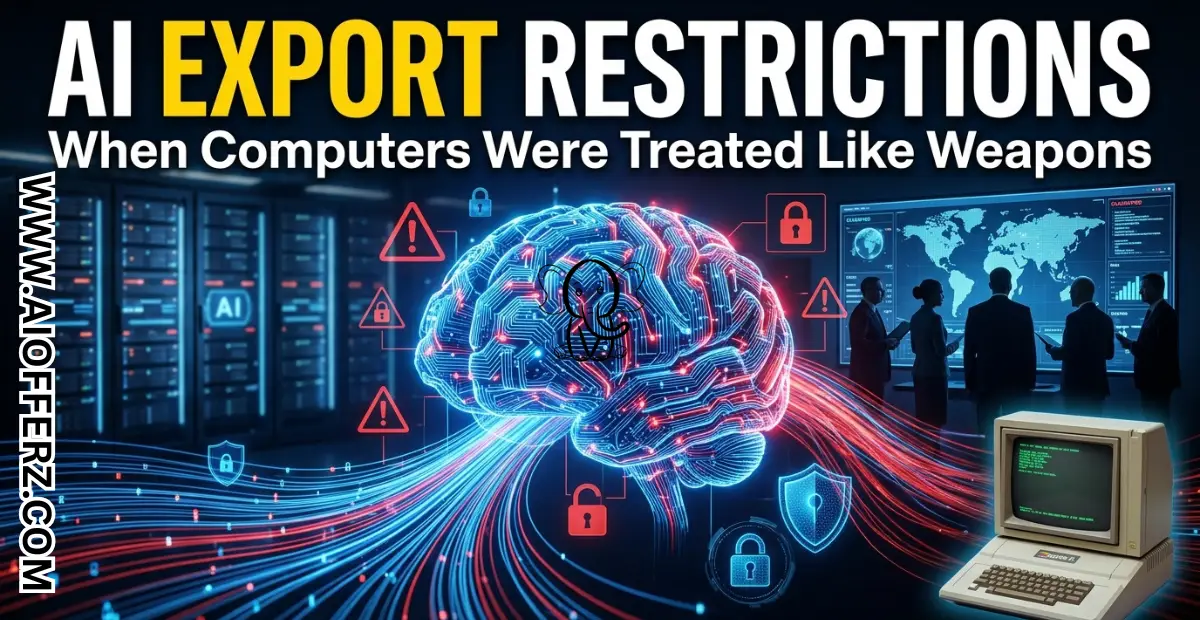
AI Export Restrictions Revive a Surprising Chapter in Technology History
The growing debate around artificial intelligence regulations has brought back memories of one of the most unusual moments in technology history — a time when an Apple computer was officially treated as a weapon by the US government.
The discussion resurfaced as advanced AI models developed by companies such as Anthropic face increasing scrutiny over potential export restrictions. Governments around the world are becoming more cautious about allowing powerful technologies to be freely distributed due to national security concerns.
Experts say these concerns are not entirely new. Decades ago, powerful computing technology was also considered strategically sensitive.
When an Apple Computer Was Treated Like a Weapon
During the late 1980s and early 1990s, the US government imposed strict export controls on certain high-performance computers because of their advanced computing capabilities.
One notable example involved an Apple computer that featured strong encryption technology. At the time, encryption software was classified under regulations that treated it similarly to military equipment and weapons systems.
The restrictions meant that exporting certain computers and software to other countries required government approval. Authorities feared that advanced computing power could be used for military purposes, intelligence gathering, or secure communications by foreign adversaries.
Steve Jobs Challenged Technology Restrictions
Steve Jobs and other technology leaders opposed some of these regulations, arguing that excessive restrictions could slow innovation and weaken the competitiveness of American technology companies.
As the internet era expanded globally, pressure mounted to ease export controls. Eventually, the US government relaxed several rules as computers became more common and encryption technologies entered mainstream use.
Industry experts say the situation offers valuable lessons for today’s Artificial Intelligence industry.
AI Faces Similar National Security Concerns
Today, advanced AI systems are attracting the same level of geopolitical attention once reserved for encryption technologies and supercomputers. Governments are concerned that highly capable AI models could be used for cyberattacks, surveillance, military applications, and strategic advantages.
The AI Industry is rapidly becoming a battleground for technological leadership, with countries introducing new regulations to control access to powerful models and computing resources.
As debates around AI Export Restrictions intensify, many analysts believe policymakers are repeating a familiar pattern: balancing innovation with national security.
The comparison between Apple’s past and today’s AI race highlights an important reality. Technologies that reshape economies often attract government intervention before eventually becoming widely accessible.
The challenge for regulators will be ensuring that Artificial Intelligence continues to advance without compromising security, competition, and global innovation.